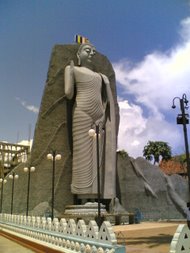
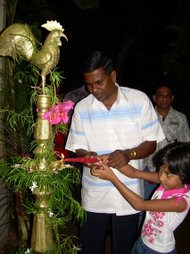
"Star Lanka Online" Our NEW Web site And Web TV Channel Launched

TFGE , The Future Global Educational Center Has Launched
the official web site, called
*** Star Lanka Online Dot Com ........................

www.starlankaonline.com will be completed in very near future....

*** Star Lanka Online TV Channel,..................

Just One Click ahead ...

Now you can watch "Star Lanka Online TV" channel broadcasts from Matara, Sri Lanka in most part of the day. Still we are keeping a test transmission also. There is a link right side of your hand to watch our TV channel. You can watch (Click On the Box) live channel on this site without going to another site to watch the TV. and also recorded parts, following the below link.

Place your Own Ad Here

Sunday, August 24, 2008

Reducing cellulite without pain

Reducing cellulite without pain

Endermologie is a unique, non-invasive way of reducing the appearance of cellulite and circumferential body measurements. There is also an improvement in skin tone and texture.

What is cellulite?

When normal fatty tissue is stored, it is held in place by connective tissue fibers and is supplied by a network of vascular and lymph vessels. When the system works well, the vascular system takes energy from the fat stores when required, and toxins are flushed away via the lymph.

However, when the waste removal system starts to fail, waste products start building up and the connective tissue becomes inflamed and swollen. Growing fat cells (adipocytes) destroy the network of collagen and elastin fibers, which then thicken (fibrose) around these cells forming hard pockets of fat encroaching on vascular and lymphatic vessels. These hard pockets of fat are the cause of cellulite.

How does it work?

The LPG machine features autonomous rotary cylinders, capable of moving separately. These rollers lift, stretch, mobilize, mechanize, stimulate, relax, collect and separate the connective tissue fibers, creating a wave-like action, which affects the lymphatic system and muscles. This suction action reactivates the natural processes of the cells, which tend to slow down over time. The LPG roller stimulates lipolysis (fat breakdown), smoothes away cellulite and resculpts, the body contours. Collagen and elastin production is also activated.

The LPG Cellu M6 machine has been cleared by the FDA to temporarily reduce the appearance of cellulite and circumferential body measurements.

What does the procedure involve?

During the treatment you will wear a specialized body stocking. This makes it more comfortable and also protects your modesty! The therapist carries out the treatment, which involves a hand held massaging head that delivers intermittent suction and rolling action to the area being treated. Each treatment will last approximately 40 minutes, at the rate of about 1 - 2 per week.

How many Enderinologie sessions are required?

Endermologie treatments are 40 minutes in duration, twice a week. The average women will need 12 to 15 treatments to achieve optimal results. Once a month follow-up treatments are usually recommended to maintain results.

Can diet and exercise eliminate cellulite?

No, because cellulite is a complex problem it must be addressed at the subcutaneous layer to eliminate excess toxins. Whereas both diet and exercise affect a deeper fat they fail to remedy the underlying cause of cellulite found within the superficial tissue of your skin. Many women who exercise regularly and follow low fat diets still have cellulite.

Why are diet and exercise encouraged?

Inadequate nutrition and poor lifestyle tend to worsen the appearance of cellulite. It stands to reason that a balanced diet and regular exercise can to a certain degree prevent the advanced stages of cellulite. Diet and exercise are recommended because they are, complementary to endermologie.

Is there scientific validation?

Long term, thorough scientific investigations which have been conducted around the world by prestigious academic and medical teams have provided undisputable of efficacy and safety. It is the only non-invasive cellulite treatment which has received FDA approval.

Is it New?

Endermologie is the world’s forefront leader in cellulite technology for over fifteen years. LPG sets standards in the industry, working closely with leading research teams, universities and hospitals. Moreover, Endermologie is a hot topic in popular beauty magazines such as Vogue, Glamour, Allure, Shape and Mirabella. Top models and fitness experts alike regularly utilize this treatment to accompany their rigorous health and beauty routines.

Can men benefit from Endermologie?

Most men do not have cellulite but still benefit from body shaping and toning of the skin. Areas that respond well to Endermologie are the back, abdomen, and "love handles".

Endermologie, the only FDA approved non-invasive treatment for reducing cellulite and circumferential body measurements is available only at The Ramani Fernando Salon at The Hilton Residence, Union Place, Colombo 2. Tel: +94-11-2300631, 2300632.

The Muslim Problem?

The Muslim Problem?

A few months ago after the fall of the East, a prominent Sinhalese expatriate had toured the area and a luncheon meeting was arranged in an Indian restaurant in a five star hotel in Colombo. There were four of us for lunch including a senior government official. The expatriate explained his observations and concluded that everything was fine but for one factor which was of concern. The government official inquired what it was and the expatriate answered that it was the "Muslim issue". There was an uncomfortable momentarily silence at the table, after which the official remarked "you don’t need to worry about the Muslims, worry about the LTTE".

What I heard that day was not isolated. It is a concern that I hear expressed privately in every strata of Sinhalese society, very frequently. I also hear these same concerns in the United Kingdom, again in every strata of English society. The latest was at the start of this summer at "Regatta", an Italian restaurant in Winchmore Hill, North London, when the topic came up for discussion during dinner with some English friends who are prominent businessman in the area. Their 16-year old daughter summed up their concerns by stating that the dress code of Muslim women was "scary".

In Sri Lanka and in the United Kingdom, the Muslim population is growing, primarily because of the lack of the use of birth control. This rise in population itself causes concern and social destabilisation.

In both countries the increase in population is particularly prominent at the less affluent levels, where there is considerable strain placed on scarce resources such as land, employment, access to educational and medical facilities etc. In both countries the social tensions created prevent the smooth assimilation/interaction among differing ethnic groups, resulting in underprivileged ghettos and in creased susceptibility to radical Islam. It is a recipe for social and political conflict and confrontation.

A few decades ago, both Catholics and Muslims were reluctant to use birth control because of social and religious reasons. Before that the Sinhalese had huge families. But over the years, increased access to education has made more and more Buddhists and Catholics practice birth control and reap the benefits of stable population growth and a reduction in political and social tensions.

Among the Muslim community too, the more educated and affluent Muslims tend to practice birth control and they are the ones who have been far more successful in interacting with the other ethnic communities. The newer affluent generations of Muslims tend to be more progressive and understand the sensitivities at play and the need to compromise antiquarian religious and cultural practices for ethnic harmony and political and social stability.

Recently, a Muslim explained to me the politics of the minaret. In the middle ages, the Mullahs used the minarets to call the faithful who were mainly scattered goat herders in the barren lands of the Middle East to prayer.

This was understandable. Goats and their herders did wonder in those far-off barren lands.

Today, in metropolitan Colombo and London, during the age of the digital watch, Mullahs are broadcasting the call to prayer via loudspeaker. Pray, where are these goat herders in London and Colombo who do not have a digital watch? Not to be beaten, the Buddhist monks too have taken to broadcasting their prayer in Colombo via loudspeakers.

Those who use these loudspeakers seem unaware and unconcerned by the irrelevancy of their actions in modern society and the nuisance they cause to others.

Of the three major ethnic communities in Sri Lanka, the Muslims are socially, culturally and religiously the most distant from the other two communities. Therefore social and political stability and cohesion is a matter of priority.

Islamic fundamentalism, the changes in dress code of some Muslim women, increase in conservatism among Muslim men etc are causing concern both among the Sinhalese in Sri Lanka and among the English in Britain, amidst a trend of increasing Muslim population growth in both countries and the formation of low income ghettos breeding a culture and a mind set alien to Sri Lanka or Britain and more in tune with the Middle East.

To ease tensions and address misconceptions there needs to be a positive and a transparent dialogue. While the government is aware of all the issues and fundamentalist elements in the East, they are at present reluctant to address these issues or open a positive dialogue, primarily because of internal and external political alliances.

Internally there are powerful Muslim politicians aligned to the government and they are fearful that opening a dialogue and addressing issues may effect their popular vote. Externally there are close alliances with Islamic nations such as Pakistan, Iran, Saudi Arabia etc.

The Government is more inclined to allow their powerful Muslim politicians to handle the Muslim community. Isn’t this what we did in the last century, allowing the powerful Tamil politicians to handle the Tamil community. Look where it has got us.

Unfortunately for the government and the Muslims, the Sinhalese majority are not concerned about such alliances and for them the "Muslim issue" is a matter of concern, no different to that found in the United Kingdom among the English.

It’s an issue that needs to be addressed, to reduce tensions and improve social and ethnic relations as was found between the Sinhalese and the Muslims after the Tsunami. The Muslims were the most affected during the Tsunami as they are concentrated in ethnic enclaves hugging the coast.

BBC and CNN reported a Buddhist monk from an interior temple for the first time visiting a coastal mosque near Beruwala and bringing food and other necessities to help the Muslims. It was a refreshing gesture. The Muslims were visibly surprised and it made the International news. This was clearly a positive development in ethnic unity and harmony, which needs to be encouraged.

Compare this to a senior DIG in the MSD unit a few years ago, under the previous regime, extracting money from a prominent Muslim businessman, while exercising near the Kotte Parliament stating "you Muslims have plenty of money". Reality is that an overwhelming proportion of Muslims are poorer than their Sinhalese and Tamil brethren and have a lower level of educational attainment as a community in comparison with the others.

There needs to be a transparent dialogue, to address issues by both communities in a constructive manner so that there would be better understanding and harmony. If we had such a dialogue 50 years ago, we may have been able to pull the carpet from under the Tamil nationalists/facists and avoid the present carnage. History must not be repeated.

Britain is having a dialogue with their Muslim communities in trying to defuse tensions and it is time for Sri Lanka to begin a similar process.

Poor governance in Sri Lanka results in the state not having adequate political processes to address and defuse social and ethnic tensions.

The press is also partisan and weak. A long standing American citizen of Sri Lanka explained that when he wakes up on Sunday morning and reads the newspapers it is as if he is living in several different countries at the same time.

These weaknesses results in the problem becoming exacerbated and then the state responds with last minute fire fighting exercises at great cost to the nation, using the police and the security forces to contain what should have been addressed politically

Wednesday, August 20, 2008

Dondra, Devinuwara Sri Vishnu Devala Festive Season Has Begun for the year 2008

Dondra (Devinuwara in Matara, Southern Region of Sri Lanka), Festival season has begun on 16th of August 2008. The season usually begins with a PERAHERA on “The Nikini Poya” Day (Full moon poyaday in August ). In the festive season, hundred thousands people gather to worship the God, named “Sri Vishnu”( Upulwan Devindu), has been predicted for one time a “Lord Buddha”, after thousand of coming years. Until then he has to fulfill some more “Pin” (Good minded things to do for the wellbeing of the people and entire life being) . Many people believe (Including Me) , God Vishnu alias “UpulWan Devindu”,has powerful ability to fulfill some people’s wish, and their dream to make come true in short period.


************************************************************

************************************************************

************************************************************

************************************************************

************************************************************

One day in our house,(Last Year) about 15 people in the second floor, and about twenty , in the first floor. To organize a trip to Dondra (Devinuwara), I’ve asked who wants to come in a van , to worship the Lord Buddha, in Dondra, with God Upulwan Devindu. In the first floor all the people agreed without any comments to do that without get so long in the day after that day. In the Second floor, without one person, all others didn’t like to go there on that day. Then I gave them a lesson, saying a God can’t do every thing only we can do that like driving, but some unexpected events we can’t resist. Only God know. While the speech, a smell like we smell in Dondra, came to our room, every one felt that. Then I said “If this is God’s power wnen I going to change the topic, this coming smell must be stopped.” As I said , It has vanished with my topic changed. Nothing smelt.

After that I came downstairs and asked others did you feel some thing like that sort of smell. Everyone said NO. Then I realized, It was only for the 2nd floor, near this floor. This is one of my many experiences regarding the God Vishnu in a short period of time. In my early years I didn’t want to believe, Gods like Vishnu and I trusted myself These stories are false. After My A/L ( In Maths Subjects) in school times I’ve done many experiments regarding Gods and many Un-Seen subjects. ( I can’t write down every thing here). My experiences , you will be able to know in the future if you are with me in my blogs and the site , named “StarLankaOnline.Com”.


************************************************************

************************************************************

************************************************************

************************************************************

************************************************************


************************************************************

************************************************************

************************************************************

************************************************************

************************************************************


************************************************************

************************************************************

************************************************************

************************************************************

************************************************************
Again to the topic, now the festive season has begun and you’ll be able to worship the Lord Buddha, and God there. If you really want to get bless from the site, Don’t visit there getting Meat, Fish or Beer, Arrack or having drunk. The God really help you if you can do that. As long as you keep the things going on, your ill or sick health going to be vanished forever and the development of in your life will be done.

Here are some Photos in 2008 season.( In this time, Main, Basnayaka Nilame , The Highest Position of the programme, is Mahinda Wijesekara’s Son,)


************************************************************

************************************************************

************************************************************

************************************************************

************************************************************
All The Photos has been taken by me, Priyantha De Silva, Using my NOKIA, Camera Phone.
************************************************************

In their religious observances the Sri Lankan Buddhists have adopted from Indian tradition the use of the lunar calendar. The four phases of the moon are the pre-new-moon day, when the moon is totally invisible, the half-moon of the waxing fortnight, the full moon, and the half-moon of the waning fortnight. Owing to the moon's fullness of size as well as its effulgence, the full-moon day is treated as the most auspicious of the four phases. Hence the most important religious observances are held on full-moon days and the lesser ones in conjunction with the other phases. In the Buddhist calendar, the full moon, as the acme of the waxing process, is regarded as the culmination of the month and accordingly the period between two full moons is one lunar month.[10]

The religious observance days are called poya days. The Sinhala term poya is derived from the Pali and Sanskrit form uposatha (from upa + vas: to fast) primarily signifying "fast day." Fasting on this day was a pre-Buddhist practice among the religious sects of ancient India. While the monks use the monthly moonless day (called amavaka in Sinhala) and the full-moon day for their confessional ritual and communal recitation of the code of discipline (Patimokkha), the lay devotees observe the day by visiting temples for worship and also by taking upon themselves the observance of the Eight Precepts.

A practicing Buddhist observes the poya day by visiting a temple for the rituals of worship and, often, by undertaking the Eight Precepts. The Eight Precepts include the Five Precepts (see above, pp.5-6), with the third changed to abstinence from unchastity, and the following three additional rules: (6) to abstain from solid food after mid-day;

(7) to abstain from dancing, singing, music, and improper shows, and from ornamenting the body with garlands, scents, unguents, etc.;

(8) to abstain from the use of high and luxurious beds and seats. If one decides to observe the Eight Precepts, one would wake up early, bathe and clad oneself in clean white garments, and go to the nearest temple. The incumbent monk administers the precepts to the entire group assembled for the purpose. Thereafter they would spend the day according to a set timetable which would include sermons, pujas, periods of meditation, and Dhamma discussions. At meditation centers there will be more periods of meditation and fewer sermons and pujas.

The observance of the Eight Precepts is a ritualistic practice of moral discipline quite popular among the Sinhala Buddhists. While the Five Precepts serve as the moral base for ordinary people, the Eight Precepts point to a higher level of training aimed at advancement along the path of liberation. The popular practice is to observe them on full-moon days, and, among a few devout lay Buddhists, on the other phases of the moon as well.

The poya observance, which is as old as Buddhism itself, has been followed by the Sinhala Buddhists up to the present day, even after the Christian calendar came to be used for secular matters. Owing to its significance in the religious life of the local Buddhists, all the full-moon days have been declared public holidays by the government. Another noteworthy fact about this day is that every full-moon poya has assumed some ritualistic significance in one way or other.

The first and the foremost of the poya holy days is the full-moon day of Vesak (May), commemorating the birth, Enlightenment, and passing away of the Buddha. The significance of Vesak is further heightened for the Sinhala Buddhists, as Sri Lankan tradition holds that it was on the Vesak Poya Day, in the eighth year after his Enlightenment, that the Buddha paid his third visit to Sri Lanka, journeying to Kelaniya on the invitation of the Naga King Maniakkhika (Mhv. i,72ff.). Consequently, Kelaniya has become a very popular place of worship and pilgrimage, the center of worship there being the celebrated dagaba, enshrining the gem-set throne offered to the Buddha by the Nagas (dragons). An annual procession is held there to commemorate the event.

Both in importance and in temporal sequence, the next significant poya is the full-moon of Poson (June), which is specially noteworthy to the Sri Lankan Buddhists as the day on which Emperor Asoka's son, the arahant Mahinda, officially introduced Buddhism to the island in the 3rd century B.C. Accordingly, in addition to the normal ritualistic observances undertaken on a poya day, on Poson day devotees flock to Anuradhapura, the ancient capital city of the country, for it was there that arahant Mahinda converted the then ruler, King Devanampiya Tissa, and his court to Buddhism, thereby setting in motion a series of events that finally made Sri Lanka the home of Theravada Buddhism. Even today, on Poson Poya, Anuradhapura becomes the center of Buddhist activity. Mihintale, the spot where the momentous encounter between the Elder and the King took place, accordingly receives the reverential attention of the devotees. The two rituals of pilgrimage and the observance of the Eight Precepts are combined here. Processions commemorative of the event, referred to as Mihundu Peraheras, are held in various parts of the country.

The next poya is Esala (July), which commemorates several significant events in the history of Buddhism. The most prominent of these is the Buddha's preaching of his First Sermon, the Dhammacakkappavattana Sutta, to the five ascetics at the Deer Park, near Benares, thereby inaugurating his public ministry. The other noteworthy events connected with this day include the conception of the Bodhisatta in the womb of Queen Maya, his Great Renunciation, the performance of the Twin Miracle (yamaka-patihariya), and his preaching the Abhidhamma for the first time in the Tavatimsa heaven. An additional factor that enhances the value of this poya to Sri Lanka is the first local ordination of a Sri Lankan, when Prince Arittha, the nephew of the king, entered the Order at Anuradhapura, under arahant Mahinda, following the introduction of Buddhism. On this day there also took place the laying of the foundation for the celebrated dagaba, the Mahathupa or the Ruwanvelisaya and also its enshrinement of relics by King Dutugemunu. It is owing to the combination of all these events that the Sinhala Buddhists fittingly observe the day ceremonially by holding Esala festivals throughout the island, giving pride of place to the internationally famous Kandy Esala Perahera.


* * *
The term perahera, primarily meaning "procession," signifies a popular Buddhist ceremony replete with many rituals, commencing and culminating respectively with the kap-planting and the water-cutting ceremonies. These two ceremonies are respectively the introductory and the concluding rites of the annual Esala festivals, held in July and August in various parts of the island. They are essentially connected with the Buddhist deities, either to invite their blessings or to give thanks to them for favors received. During this period every year, such religious festivals are held in almost all the religious centers of Sri Lanka where there are abodes dedicated to various Buddhist deities. However, the festival par excellence of this category is the Kandy Esala Perahera, which is connected with the Temple of the Tooth and the abodes (devalayas) of the four Buddhist deities, Vishnu, Kataragama, Natha, and the Goddess Pattini. The main feature of all these festivals held during this period is the elaborate procession held on the lines of the Kandy Esala Perahera.

Both the kap-planting and water-cutting ceremonies are performed by the lay officiating priests (kapuralas) of the devalaya concerned, who are traditionally the experts regarding the details of their performance. These details are generally regarded as secret and are not divulged to the profane public.

The preliminary rite of kap-planting consists of planting a shaft, usually fashioned from a felled young jak tree, which must have borne no fruit. When cut, this tree exudes a white sap which is regarded as a symbol of prosperity. Even felling the tree is done with several attendant rituals at an auspicious time: the trunk is divided into four, one for each of the devalayas, where it is carried with drums and attendance. On the day of the new moon, at an auspicious hour (nakata), the "kaps" thus prepared are set up in the ground in a special place decorated with leaves, flowers, and fruits. For five nights small processions are conducted within the devalaya precincts around the consecrated kaps. Sometimes benedictory stanzas are chanted by monks.

This rite of kap is a kind of vow that the Esala festival, consisting mainly of the perahera, will be held; it is also an invitation to the deities to be present during the festival, providing the necessary protection for its successful performance. In this sense it is this ritual that inaugurates the festival.

The water-cutting ceremony (diya-kapum-mangalyaya), which is the concluding ritual of the Esala festival, is performed in the early hours of the day following the final perahera. The officiating lay-priest (kapurala) proceeds on a caparisoned elephant to a selected place along a river bank. He would either go to a selected spot in the river by boat or wade through the water to a particular spot and after drawing a magic circle on the water with the sword he carries, he "cuts" the water and fills the vessel he carried there with water from that spot. Before doing so he empties the water that he took in this same manner the previous year. He then returns to the devalaya, and the vessel of water is kept there until the following year. The ritual is repeated annually in an identical manner. This is believed to be a rain-making ceremony of sympathetic magic, which type of ritual is quite common in agrarian societies the world over. The Buddhists seem to have adopted this to suit their purposes.


* * *
The annual Esala Perahera in Kandy, held in honor of the Sacred Tooth Relic of the Buddha, is the most colorful traditional procession in the country. It is the prototype of the other peraheras held elsewhere in the island in such places as Kataragama,[11] Aluthnuwara, Lankatilaka, Bellanwila, Devinuwara, etc. The Kandy Perahera is itself the latest expression of the annual festival in honor of the Tooth Relic that has been held with state patronage from the time the relic was brought to Sri Lanka from India in the 4th century A.C. Although periodically there have been intermittent breaks due to unsettled political conditions, the festival was never neglected intentionally. This had been so even during colonial times. Respected as the palladium of Sinhala royalty, the Relic had been accommodated in different parts of the country, depending on the change of the capital city. Ultimately it came to stay in Kandy, which was the last royal seat of the Sinhala people.

Esala Poya assumes prominence for yet another ritual of the Sri Lankan Buddhists. This is the annual rains retreat of the monks, Vassa, which commences on the day following the Esala full moon (discussed in Chap. 8). On the next poya day, Nikini (August), those monks who failed to commence the normal Vassa on the day following Esala Poya, are allowed to enter the "late Vassa."

The poya that follows Nikini is Binara (September), which assumes solemnity as marking the inauguration of the Order of Bhikkhunis (nuns) with the ordination of Queen Mahapajapati and her retinue. Next follows the Vap Poya (October), which concludes the final month of the three-month rains retreat. During the following month kathina robes are offered to the monks who have duly completed the Vassa. The high esteem in which this ritual is held by the Sinhala Buddhists may be gauged from the fact that the month is popularly referred to as the "month of robes" (see Chap. 8). The November full moon, called Il, signifies the terminal point for the kathina ritual. It is also the day for commemorating such events as the despatch of the first sixty disciples by the Buddha on missionary work, the prospective Buddha Metteyya being declared a sure Buddha-to-be by Gotama Buddha, and the passing away of the arahant Sariputta, the Buddha's foremost disciple.

The Unduwap Poya that follows in December is of great moment to Sri Lanka as commemorating two memorable events connected with the visit of Theri Sanghamitta, sister of arahant Mahinda, from India in the third century B.C. (Mhv.iv,18-19). The first of these events was the arrival at Anuradhapura of a sapling of the sacred Bodhi-tree at Buddhagaya, brought to Sri Lanka by Sanghamitta. The planting of this tree is the origin of the Bodhi-puja in the country (see Chap. 4).

The other memorable event commemorated by this poya is the establishment of the Order of Nuns (bhikkhuni-sasana) in Sri Lanka by the Theri Sanghamitta when she ordained Queen Anula and her entourage of 500 women at Anuradhapura. Records indicate that the Bhikkhuni Sangha thus established flourished during the Anuradhapura period (third century B.C. to eleventh century A.C.), but disappeared after the decline of that kingdom. Historical records are silent as to the reasons for its extinction, but they do report how the Sinhala Bhikkhuni Sangha helped in the establishment of the Order of Nuns in China.[12] In the 5th century a group of Sinhala nuns headed by the Bhikkhuni Devasara went to China to confer higher ordination there and the Bhikkhuni Sangha thus established survives there to this day. The Sinhala Buddhists commemorate this poya day with peraheras, observance of the Eight Precepts, and meetings. The day is designated Sanghamitta Day. Nowadays the dasasil matas (ten-precept nuns) take an active part in initiating these commemorative functions.

Next follows the Durutu Poya (January) when the Sinhala Buddhists commemorate the first visit of the Buddha to the island. According to the Mahavamsa, nine months after his Enlightenment, the Buddha visited present Mahiyangana in the Badulla District, where stands the dagaba by that name enshrining the Buddha's hair relics and the collar bone (Mhv.i,197). The Buddhists remember the event by holding an annual perahera. This much-venerated dagaba is also of consequence as the first edifice of this type to be constructed here, originating the ritual of dagaba worship in Sri Lanka.

The poya that follows, Navam Poya (February), celebrates the Buddha's appointment of the two arahants, Sariputta and Moggallana, as his two chief disciples. It also marks the Buddha's decision to attain Parinibbana in three months' time. The Medin Poya in March is hallowed by the Buddha's first visit to his parental home after his Enlightenment, during which he ordained the princes Rahula, Nanda, and many others as monks. The month that follows is called Bak (pronounced like "buck"), which corresponds to April. In this month it is not the full-moon day but the new-moon day that invites attention as signalizing the Buddha's second visit to Sri Lanka, when he visited Nagadipa[13] on the day preceding the new-moon day (amavaka: Mhv.i,47) in the fifth year after his Enlightenment.

The above brief account of the twelve poya days demonstrates how the poya day has become intimately connected with the life of the Buddha and consequently with the principal events of early Buddhist history. The Sri Lankan Buddhists, quite accustomed as they are to commemorate such events with rituals and ceremonies in full measure, have maintained these traditions up to the present.

Extract from Buddhist Ceremonies and Rituals of Sri Lanka
1995
A.G.S. Kariyawasam
Buddhist Publication Society

A banquet served on banana leaves

A banquet served on banana leaves

Banana leaves figured very prominently whenever banquets were held by the King of Kandy to visiting Dutch Ambassadors who called on him now and again. Why banana leaves? Well, they used them as plates. In a country where they ran things very very simply there was no need for elaborate chairs and tables and other paraphernalia when there were simpler substitutes.

The lack of these, of course, may have caused some awkwardness for foreigners to sit for either lunch or dinner. But the Dutch did sit, even on the ground, knowing very well not only that one should in Rome do as the Romans do but also if they didn’t the King would view it as a breach of diplomatic etiquette and the punishment would be very, very severe.

Habits

A previous Ambassador, Herr de Joeng, who had slighted the King, may be even unwittingly, was kept waiting for seven months a few distances away from Gannoruwa, denying him an audience until he died in oblivion. What the history book hasn’t told us about is our eating and drinking habits in the past.

Johann Wolfgang Heydt, a German artist who worked for the Dutch East India Company, spreads out his story handsomely with drawings and all. It tells us about his two and a half years stay in Ceylon, the greater part of it being spent in the Maritime Provinces.


Food wrapped in banana leaf

To come back to the banquet which Heydt is speaking of, it first began with a presentation of gifts. The King had ordered that all the representatives of the Dutch company down to the slaves be given gifts.

There was a tame elephant for the Ambassador, a Sinhala crafted sabre and a well-worked sheath of solid silver and a baldrick to hang the sabre from, which was done immediately by strapping it across the ambassador’s right shoulder.

Other gifts of Sinhala craftsmanship included two rings of gold set with precious uncut gems, silks and fine linen and delicately carved ivory combs used by women to keep the hair in place.

“I for my part,” remarks Heydt, “received a few piece of linen, a piece of silk, a knife, a stylus [panhinda] neatly inlaid with silver, together with a silver sunang or lime box [killottay]; but the others received somewhat less, down to the slaves, each of whom was gratified at the least with a petticoat, such as they are accustomed to wear.”

With everybody pleased in one way or another they were now looking around to sit for the meal. The Ambassador and his two assistants were seated on a long bench laid with straw mats.

The bench was about a foot high from the ground. Heydt doesn’t tell us exactly where the Ambassador placed the banana leaf he was given or how his two assistants settled down to receive the food, because in the picture he drew there is no table visible.

For one thing, he was seated on the ground far away from the Ambassador and his assistants. And he may not have been watching them either when the Royal servants started serving the food, beginning with the Ambassador, in a hierarchical order down to the slaves.

It was a fairly crowded hall that afternoon as the retinue, nearly a mile or two long, that came with the Ambasador included some company officials, an interpreter, native soldiers employed by the Dutch and slaves and attendants who also had to be accommodated at that meal.

Meanwhile, Heydt not being an expert in the art of sitting in the padma asana style was squatting on the ground with his outstretched feet parallel to the floor. For him the ground, as he said, was both his table and chair.

Thus seated on the ground with the banana leaf handed to him lying beside him, the attendants came along to distribute what he said were baked cakes, which were in a basket. Each guest was given about two or three cakes.

The other dish that was served was also a baked dish but had a Portuguese name Keteri.

Express delight

At the next round the attendants distributed a few other items, which he said included what he called pepper balls, sugar and bananas. The fate of Herr de Joeng was very much in their minds and they had been instructed not to show displeasure at what they were consuming, but to express their delight in the food they ate.

“If we should have laughed much among ourselves,” admits Heydt, “at their fantastic entertaining and showed a poor appetite, we then might suffer vexation.” So, much against their will, they stuffed themselves and some fell ill later as a result.

Something that lifted their hearts at the end of the meal was the sight of a “lovely black drinking vessel, very ornamentally made, (that) was set before the Ambassador” and before each of the five other Dutchmen including Heydt.

But to their disappointment the vessel contained, alas, not wine as the Dutchmen expected, but only water. Yet for all that they were intrigued by the coolness of the water this beautiful vessel contained.

They were told that the vessel was made from a special type of clay obtainable only in the Kandyan kingdom and as a result these drinking vessels were in great demand in the Maritime Provinces. So, says Heydt “We, therefore, took these vessels away with us.”

When the ambassadorial party finally got back to Colombo they had been away for three months. On their outward journey, which passed through Hanwella and Sitawaka they had halted for a few days at these forts. They had started out from Colombo on November 9, 1736 and reached Kandy, on December 31.

The most precious object they were taking with them were the letters to the King from the Dutch Company which were borne by members of the Appuhamy and Appo rank; the Appuhamys were strictly responsible for carrying the letters on a specially made silver tray placed on the head while the four Appos were appointed to hold a canopy over it and all of them relieving each other as the journey proceeded.

Unburdened as they were on the return journey they did the march in a record time of seven days, a distance of 72 miles!

Sinhala law

Heydt is not as entertaining a writer as Robert Knox. In a way, however, he supplements Knox by telling us what took place in the Maritime Provinces, which were under the Dutch. The Dutch took the precaution of not interfering with the Sinhala law that prevailed throughout the island when they came.

But occasionally they seem to have departed from it. Under the King only the males were whipped for offences. In the Maritime Provinces both parties, men and women, were whipped for certain offences.

Commenting on the Sinhala law with regard to marriage and divorce, Heydt says, “They make therefore little ado in their divorces, but the wife takes with her the dowry that she brought, perhaps a few head of cattle, some money, clothes and now and then, if she is of higher rank, some slaves.”

Heydt pays a compliment to the Sinhala woman - “And in truth they have in this, much better learning than the Dutch women, to know how they must act right lovingly with their men.”

And a compliment to men, which should be highly treasured today in this age of scandal and corruption: “One notices also...a great obstinacy in them when one offers them money...nothing is had from them for money, since they think that for money only Coulys carry, or do other work.”

And also, “There are no lawyers among them as with us, but their disputes are argued among themselves and settled at once, which also is better than our long suits.”

And how things have changed from those days before the values from the West distorted our style of living. Heydt who comes from a land of schnapps and wine would have been greatly surprised by what he saw: “The most excellent thing about them is, that they have a loathing of drunkenness, and one sees among them very few who give themselves to it, except the most degraded of them. And in general they are very temperate, and it is not hard to consort with them; and when one has been taught a little of their customs, one can get on well with them.”

Heydt’s Ceylon has been translated from the German into English by Major Raven Hart who was for a time in the Fifties domiciled in Ceylon. He was an adventurer who undertook difficult exploits like rowing up the Mahaweli Ganga or down the Mississippi or up the Irrawadi.

Arthur Clarke has called him ‘a most unforgettable character.’ Apart from his canoeing he had an interest in antiquarian books and in philosophies that may have led him to take an interest in Heydt’s German original. ‘Heydt’s Ceylon’ was published by the Government Information Department in 1952.

Keep your child safe on the internet - dangerous sexual predators are online

Debate - Rajmi Manatunga:

Keep your child safe on the internet - dangerous sexual predators are online

The internet is great and it offers great opportunities but at the same time it poses a great threat as well.

With ever increasing amounts of materials on the net like websites, images, videos and activities such as chatting, searching etc dealings on the net carefully is crucial, but how can parents help children be safe on the net?

Children can interact and communicate with friends and people from all over the world on the net.

Chatting over the internet can be done with a group of people in a chat room, or with the person you are playing an online game. As well as being able to add your comments to a conversation in a chat room or online game between a number of people, it is also usually possible to chat privately to one person in these environments.

There are however, potential risks in communicating to people that you don’t know, and unfortunately some children have been hurt having gone to meet the ‘friends’ they have made online.

Adults with a sexual interest in children have used chat rooms and other interactive areas online to make contact with and befriend children, and persuaded and manipulated them to meet up where they have been abused.

There have also been cases of children being bullied or threatened online in chat environments.

Children use search engines to find things on the Internet. In addition to the incredible positives and benefits that search brings, for example helping to research for school and on their interests, there is a risk to children searching the net getting exposed to material that may be potentially harmful to them, or even material that is illegal.

Parents need to know what current good practices are in relation to child safety and be aware of what they can do to help their children to surf on the internet in a safer environment.

What can Parents do to help Children on line and in Chat Rooms?

In early stages of the internet, blocking content seemed like the ideal means of protecting children from potentially unsuitable material. However, it subsequently became apparent that most such programs do not block all material which parents may expect to be blocked.

It is stressed that these programs are far from a perfect answer and products should be investigated thoroughly, including the maker’s policies and blocking criteria, prior to children’s use of same.

Now there are computer monitoring software packages that enable parents to watch as much or as little of their children’s computer and Internet activity as they see fit.

Parents can keep their children safe from Internet predators by monitoring computer activity, including keystrokes (including chat room dialogue), programs used and sites visited on the Internet.

It also captures screen shots of what children have been viewing. There are functions that enable parents to block access to specific web sites which they deem inappropriate, offensive, or dangerous.

There are a number of things you can do as a parent to keep your children safe on the internet and chat rooms;

Learn about the technology - try to gain an understanding of the Internet and how chat rooms operate

Understand the jargon - discover the terms children are using. Be able to talk to children in the language they understand

Try a chat room yourself - Experience first hand what chat rooms are and how they work. Remember they are considered wonderful tools by millions of users

Rules, rights and responsibilities - set up a plan for effective use of the internet and chat rooms at home encourage children to make the rules with you so they have ownership of them, discuss what rights all family members have when using the Internet and what responsibilities go with these rights. At all times be positive about the Internet.

Privacy - Discuss this with your children. Do not single out online chatting as the only place where privacy should be maintained, as it should be maintained in all online activities

Talk to other parents at school or in your neighbourhood about the positive and potential dangers of children using chat rooms. Sharing experiences with others can often uncover Internet safety ideas you may not even thought about

Find out about your child’s online access at home and schools - Are there adequate safeguards in place?

Do the schools have Acceptable Usage Policies before they let children use these technologies? If your children’s school has one in place, go over the details with them and his or her teachers.

Use Internet filters as a technological tool to help you protect your children online. Filtering software can restrict times when the Internet can be accessed and also restrict what is viewed and downloaded.

Use parental monitoring software to keep track of exactly what your children are doing online. There are many programs available which will let parents see every email, chat room transcript, instant messaging transcript, website and more that is typed into a computer.

While some people may claim that this is an invasion of privacy, it is important that parents seek a balance that is acceptable to their family values and rules.

Check for online resources - there are many places on the Internet which can help you keep up with the latest technologies

Know how to report issues and concerns - Know to whom and how you can report any criminal or suspect behavior. Remaining silent about suspected trouble can often lead to more problems further on, so it is best that you act on any suspicions.

Show interest in how children are using the Internet and provide them with valuable and relevant guidance

Government Initiatives

The Government should enact suitable laws, guide lines and internet advisory guide lines and WebPages with the intention of providing a safer environment to the community about managing children’s access to the Internet.

Some initiatives that the Government should implement should include; active monitoring of online material, commissioning research and development into technological means to prevent access to overseas hosted Internet content and to facilitate adult verification prior to accessing overseas content, operating telephone advisory service (‘hotline’- (phone, fax, email) for “instant help with Internet safety”.), provide assistance in lodging complaints with authorities.

The Government should also take immediate action to enact laws and regulate the activities of Internet Service Providers (ISP) and Internet Content Hosts (ICH). Internet censorship laws can be implemented to regulate the activities of ordinary Internet users and content providers.

The censorship regime can be “complaints based”. There should be no openings or loopholes for political establishments to abuse the freedom of speech or to take undue advantage of the process to take political advantages.

It should not be illegal for Internet Service Providers (ISP) and Internet Content Hosts (ICH) to make available/host any particular content online unless the content has been determined to be “prohibited content” or “potential prohibited content” by a regulatory body. Content should become “prohibited content” only after it has been complained about to the regulatory body and determined to be “prohibited content” by the regulatory body.

However materials involving child pornography should be illegal under specific laws and should be also be under the Crimes Act with prison sentences.

Child Pornography/Child Abuse Material

The Parliament should enact specific laws making it a criminal offence to use a carriage service (e.g. an Internet service, a telephone service, etc) to access (or distribute, etc) child pornography material and/or child abuse material.

Accessing and/or obtaining material that is illegal to possess via the Internet

The terms in the laws should be interpreted and be used in a way that would include accessing/viewing accidentally or otherwise. The onus of proving accidental use should be on the user.

Online material generally cannot be viewed until it has been downloaded to the user’s computer and most web browsers automatically place a copy in the cache on the user’s computer hard drive.

In some countries laws appear to attempt to address the possibility of accidental, unintentional viewing of illegal material by using terms such as “knowingly possess”, and some laws do not.

Even in cases where the law refers to knowing possession, it may be difficult for an Internet user/defendant who unintentionally viewed illegal material to successfully refute the prosecution’s allegations that they had knowingly obtained possession of illegal material.

In conclusion it should be noted that while children need a certain amount of privacy, they also need parental involvement to protect them from harmful material and people on the internet. The Government has a great role to play in this regard and immediate action should be taken.

The writer is a resident of Australia and is practising as an Australian Solicitor / Barrister. He can be contacted on dweerakkody@hotmail.com.


Curbing the porn menace

The Internet is so widespread now that even the remotest villages have at least one kiosk offering Net access. As the term World Wide Web implies, the Internet enables us to go all over the world and learn new things every day without ever leaving our seat. It is useful for everyone from students to retired workers.

But the Net does have a darker side. There are thousands of pornographic sites on the Web, which can be freely accessed by anyone with an Internet connection. If not supervised properly, it is all too easy for children to access such explicit content.

This is precisely what the Government intends to prevent. President Mahinda Rajapaksa recently instructed the Telecom Regulatory Commission to block porn sites, in a bid to save the younger generation.

But can this step alone curb the proliferation of pornographic literature? There are thousands of porn books, magazines and DVDs in circulation. Shouldn’t these sales points be also raided? Some cinemas show almost X-rated movies which have apparently been passed by the censors. It is no secret that many schoolboys, some of them still in shorts, watch these so-called ‘adults only’ movies.

What more should be done to end this scourge? Or are present laws adequate to deal with it? Send in your views in less than 1,500 words on ‘Curbing the porn menace’ to Daily News Debate, 35, D.R. Wijewardene Mawatha, Colombo or email debate@dailynews.lk on or before August 26, 2008.

Pornographic content extremely detrimental

Pornographic content extremely detrimental

The strip teaser dances in, and starts tripping around in the ring. In a bustle skirt, she looks cute, compact, and compelling.

As she moves about, she slowly undresses. And, the audience, a peculiar group of wanderers, goes wild with imagination. Eventually, stark naked, the dancer ceases to be the object of excitement.


Internet use is becoming widespread

Oh! If you wish to be the ballerina in the ring, you should know how to keep the monkeys guessing on and on. Always leave a peanut or two for their imagination!

Next, in sheer desperation, she bursts open her abdomen. And, the audience, horrified, retreats in quick succession. Even though her anatomy alienated the masses, it undeniably excited the intelligentsia.

Desmond Morris vividly portrayed the above scene in “Naked Ape,” one of his best sellers. Michelangelo, Leonardo da Vinci, and many other anatomical artists saw no mystery about human surfaces. These great explorers deemed human anatomy as an art.

Art lives through human imagination, and imagination works wonders. For example, the arctic tern is considered to be a great adventurer. This wonderful bird tracks constellations light years away to adjust its path migrating across the equator, let alone Galileo, the telescope, and many other human endevours far away.

The microscope extends human intellectual horizons in the inward vision too. Visions inward or outward, certainly, science and art bear depths unfathomable.

Some argue pornography as an art too. Seemingly funny associations with too much flesh, and stopping just short of the skin, pornography simply invites an adventurer to examine as if there’s any bountiful sources or tantalising depths in scantily dressed women.

In real-life, and in unprepared minds, pornography unleashes a wave of excitement, but it rarely keeps the viewer guessing in the long run. As audiences become more sophisticated, interest in porn slowly declines.

Still, the human figure remains a primary focus for painters, sculptors, and, now, for photographers. However, the problem seems the amount of flesh the artist tends to reveal. It may either be a crude expression arousing sexual excitement, or a masterpiece humanising and rationalising audiences.

Hence the issue becomes not only sensitive, but also tricky and controversial. Pornography should be subjected to censorship, but it should be open for discussion before implementation.

What is obscenity or art?

What straddles the boundary between pornography and art? In actual fact, setting obscenity standards is really challenging, and it’s not just to spare the women of their blushes. Obscenity is a legal concept.

Criminal law limits obscenity to the forms that it considers detrimental to the society. A simple expression in Europe may turn out to be an extremely explicit portrayal of sex in Sri Lanka.

Many parents have been increasingly becoming worried of easily available pornographic content. Sri Lankan parents, rural or urbane, are still a culturally sensitive lot. They are of the view that properly set obscenity standards make life more meaningful and safer for younger generation.

Such counter measures and initiatives, even though not on popular demand, will be much appreciated by the masses in the long run. An ideological change takes affect slowly and steadily with less expense and without much burden on the economic efficiency.

Even though crucial to social advancement, the masses rarely feel things with a consequence when they are not tangible. And, the Government’s ambition to embed such policies is really praiseworthy, but if it fails to send the message to the masses, its efforts may be in vain.

That’s not for any political gain or cheap publicity, but empowerment of ideological gains make their lives more oriented and meaningful.

Similarly, as an ideological measure, the government banned smoking in public places two years ago. From the outset, it had been a welcome measure even among habitual smokers.

Certainly, it has changed the society and it will not be reversed by any sensible Government in future. Two years on, smoking still takes place in public in frequently, but the many have already given up the habit. And, the hard-core smokes less now. Even subsequent Governments are compelled to live with such ideologically driven changes.

Centerpiece

The period between cradle and school is crucial in determining a child’s chances in life. And, the children have been the centerpiece of the incumbent Government’s election manifesto some years ago.

Even though not mentioned specifically, the ban of smoking and curtailing pornography seem the sharpest examples of how the Government intends to carry out its visions. Like smoking, pornography is also a menace that should be banned. In the same way, and in the long run, pornography will also be another habit ridden partially or completely.

Making things worse, online porn industry, worth some $5 billion annually, has been becoming one of the most thriving businesses over the internet. It doesn’t sit in the old-fashioned newspaper stand now.

Without argument, the portrayals are not only filthy, but also extremely detrimental. Any conscientious institution will never allow such content in the open. Governments all over the world strive hard to block access while porn merchants persist with their notorious websites.

Many nations, schools, libraries and offices are all up for blocking such websites completely. But how do they tag such notorious sites and block it? The responsibility lies with the Internet Corporation for Assigned Names and Numbers (ICANN), a private sector enterprise that manages the domain name system. Several UN agencies have urged ICANN to approve a web suffix to identify such undesirable sites, but, so far, as a technical body, ICANN is not interested in others value judgments.

Internet pornographic content is extremely detrimental, and Sri Lankans, as many other culturally sensitive nations, bear an instinctive dislike for it. Even now, through your computer, and over the internet, such obscenity is just a mouse click away.

Like it or not, many parents shut down their home computers as a means of damage control. It really destructs the child’s education, but it’s a fierce struggle between the good and the evil.

In a landmark judgment, a French judge ordered Yahoo!, an internet portal, to restrict access to Nazi memorabilia from France, but, even though Yahoo! agreed, it was in vain.

A United Nations group has been attempting to take control of ICANN and put the internet on an intergovernmental basis, but it is still in vain. Many countries such as China, Cuba, Iran and Saudi Arabia have already created barriers to internet use, but considering the immense resources accessible over the network, such measures have not been welcomed overall.

Destruction

Over the world, pornographic industry is condemned for its destructive behaviour. It has its own unsavoury effects against younger generation, and it’s no surprise that it seems extremely evil.

A fight is on over whether governments should manage the internet more closely, and many countries are dissatisfied with the way the internet’s technical standards are set. It’s high time for ICANN to share control over valuable internet protocols with nations of diverse commitments.

In an interview with Arthur C. Clarke, a presenter asked, “What sustains you? What keeps you going?” The legendry scientist responded, “Curiosity. What happens next? And why am I curious?

Is it genetic? Was it my upbringing?” Certainly, curiosity is what sustains us. And, you should bear a knack for paying attention to things skin deep too.

There is no need to be much squeamish of out own anatomy, but we must learn to accept the ultimatum, the soul.

How not to be not funny, Asian style

How not to be not funny, Asian style
The Island.LK

There was a heated debate the other day on the internet. "Asian comedians are retarded," complained Wah Jai on Asian-Central.com. "They give Asians a bad name. Anyone who finds them funny are only laughing because they make fun of the Asian stereotype with the retarded accents they have."

A guy called Ray fought back, but didn’t sound very convincing: "Some Asian comedians are funny. At least the Japanese ones. Don’t like too many of the American Asian comedians. Some of the Filipino ones, umm, yeah, they were ok."

A response from one John Lee said: "You are clearly jealous of the Chinese because we have the real Buddha and your Indian religion is a fake! Or as we say in Beijing: ‘Shur shur shur she shar’."

The odd thing is that "Asian comedy" was defined as North Americans who mock the culture of their parents, such as Russell Peters, born in Toronto.

But in fact there are actual Asian comedians—Japan has dozens, and even Hong Kong has a few. Some are legends in their own country, such as Dolphy in the Philippines. But none are internationally known—yet.

I went to see a British comedian the other day who shall be nameless (and who should for his own good always forget to reveal his name).

His act consisted of shooting out the sort of puns you have to think about. "When a clock is hungry, it goes back four seconds," he quipped.

The audience stared back at him blankly.

"A bicycle can’t stand on its own because it is too tired," he offered.

The audience stared back at him even more blankly.

Now I can well imagine that a few hours later, some members of the audience may have thought hard about his routine (although I doubt it). It "goes back four seconds" could also mean it goes back for second helpings. "Too tired" could also mean "two-tired".

It’s no use doing this sort of joke. By the time the audience gets it, the joke-teller has been sacked and is tucked up in bed with a nice cup of hot strychnine.

I also saw some good comedians. Wilson Dixon, a cowboy, talked about his family. You knew he was making it up but it was so silly you had to laugh. "My uncle Cleetus is illiterate and ambidextrous which is a double tragedy," he said. "He is unable to write with both hands."

Some performers make serious points. One group of actors and dancers is living in a cage at Edinburgh zoo this month. They have relabelled it "Enclosure 44: Humans." It was a visual statement on the complex relationship between humanity and other animals—oh no, it wasn’t. Zookeeper Angus Balbernie told the media: "This particular species, the dancer, is disappearing off the planet due to a problem called arts funding." The group was after more money.

The best performers manage to be topical and funny at the same time. British comedienne Bridget Christie is doing a show in which she imagines that the world’s first diarist, Samuel Pepys (born in 1633), is transported to the modern day and introduced to the modern equivalent of the diary – blogs on the Internet. He comments: "August the second. Ate a stick of celery. See, it’s rubbish. Stop blogging."

Have a nice cup of strychnine instead.

* Or visit our columnist’s website at www.vittachi.com

Monday, August 18, 2008

Amazing facts

Amazing facts

* The size of anything depends on your point of view!
The biggest land animal is the African Elephant. It can weigh over 5 tons.
By the side of an elephant, a man looks and feels very small. Yet some animals are so small that a human eye cannot see them. Even among mammals, there are shrews and mice that size less than a human finger and are much smaller than the elephant’s smallest toe. A human being is an enormous creature next to a pygmy shrew, but the largest person in the world is small beside an elephant or a giraffe, which is the tallest mammal, about 6 M (20 ft)

* The blue whale is also a mammal, though it lives in the sea. A land animal as big as a blue whale would be impossible-- its bones would not bear its body weight. If you put an elephant next to a blue whale, it does not look large any more! Yes, the size of anything depends on our point of view!

* Sleep & You
We need six sleep hours to relax and rejuvenate our brains each night, with an additional one to three hours to repair and restore the body’s cells, say sleep experts. Women need an average of 54 minutes more sleep than men each night, and those who get enough sleep will feel healthier and live longer than men. On average, men make at least 12 full body twists and turns once asleep. They move or twitch more than 70 times a night!

* Nile delta is sinking
Geologists warn that the Nile delta is slowly sinking below sea level. The slow subsidence does not mean immediate floods but could become soaked in salt, rendering it useless, Daniel Smith and his colleagues at the Smithsonian institution in Washington say. Combined with a gradual rise in sea-level, the whole area is losing about five mm [two tenths of an inch] a year, they wrote in a report in the science journal Nature.

* Indonesia’s volcanoes
Indonesia, which has over 200 volcanoes, is the country with the maximum concentration of volcanoes. The Krakatoa, which caused the loudest explosion, is in Indonesia. It erupted on Aug. 27, 1883 and its explosion was heard nearly 4800 km. away.

The eruption of Mount Tambora in Indonesia in 1815 released 6 million times more energy than that of the atomic bomb. The largest crater formed by a volcano, Toba is also in Indonesia-its area is 1775sq.km.

* A Tiny Monkey

Brazil has the world’s greatest number of monkey species. Of about 250 known species, 80 are in Brazil. The world’s second smallest species {Sagui Dwarf } was discovered there by a Dutch scientist Marc Van Roosmalen in 1997. An average adult of the species measures only 10cm. The smallest known monkey is the Pygmy Marmoset, with an average size of 9.1cm.
* Snakes have no external ears. Therefore, they do not hear the music of a “snake charmer”. Instead, they are probably responding to the movements of the snake charmer and the flute. However, sound waves may travel through bones in their heads to the middle ear.
* The tongue of snakes has no taste buds. Instead, the tongue is used to bring smells and tastes into the mouth. Smells and tastes are then detected in two pits, called “Jacobson’s organs”, on the roof of their mouths. Receptors in the pits then transmit smell and taste information to the brain.
* At the radio station, the announcer speaks into a microphone. The microphone changes the sound of his voice into an electrical signal. This signal is weak and can’t travel very far, so it’s sent to a transmitter. The transmitter mixes the signal with some strong radio signals called carrier waves. These waves are then sent out through a special antenna at the speed of light! They reach the antenna of your radio. Your antenna “catches” the signal, and the radio’s amplifier strengthens the signal and sends it to the speakers. The speakers vibrate, and your ears pick up the vibrations and your brain translates them into the voice of the radio announcer back at the station. When you consider all the places the announcer’s voice travels
(From the internet)

Don't Throw Away Plastic Bags, Recycle It !!!!!

Reproduction of a 15th century portrait of a young woman


This photo provided by prof. Alessandro Vezzosi of the "Museo Ideale Leonardo Da Vinci" Monday Aug. 4, 2008, is a reproduction of a 15th century portrait of a young woman. Experts say this artwork previously attributed to an anonymous German artist, is likely a drawing made by Renaissance master Leonardo da Vinci for a long-distance marriage proposal. The drawing, which could be worth millions if the new attribution is confirmed, was bought in 1998 for US$21,850 (?14,029) by a private collector at an auction in New York, said Alessandro Vezzosi, the director of a museum dedicated to the artist in his hometown of Vinci. "Every element points to Leonardo," said Vezzosi, one of the experts who examined the drawing. (AP Photo/Alessandro Vezzosi - Museo Ideale Leonardo Da Vinci, HO)
------The Island --------

Facebook > Fans

NASA Breaking News - Feed

Astronomy.com - News

Space Wire Top Stories Feed

Today"s Highlights Of The World

Today in History

Birthdays Today

NASA Image of the Day - Feed

NASACast Audio , To listen, Click - Feed

Medicine Net Daily News - Health News

Health News from Medical News Today - Feed

The New York Times

Crestock Daily Free Image

BBC News | Science/Nature | World Edition

BBC News | Health | World Edition

BBC News | UK | World Edition

BBC News | Asia-Pacific | World Edition

BBC News | Africa | World Edition

BBC News | Middle East | World Edition

BBC News | Europe | World Edition

BBC News | Business | World Edition

BBC News | Entertainment | World Edition

BBC News | Technology | World Edition

Sky News | World News | First For Breaking News

CNET News.com

PC World: Latest Technology News

Newsweek Top News

Guardian UK - Unlimited