"Star Lanka Online" Our NEW Web site And Web TV Channel Launched

TFGE , The Future Global Educational Center Has Launched
the official web site, called
*** Star Lanka Online Dot Com ........................

www.starlankaonline.com will be completed in very near future....

*** Star Lanka Online TV Channel,..................

Just One Click ahead ...

Now you can watch "Star Lanka Online TV" channel broadcasts from Matara, Sri Lanka in most part of the day. Still we are keeping a test transmission also. There is a link right side of your hand to watch our TV channel. You can watch (Click On the Box) live channel on this site without going to another site to watch the TV. and also recorded parts, following the below link.

Place your Own Ad Here

Showing posts with label History. Show all posts

Monday, July 26, 2010

Mahasenapathi Dutugemunu Rajatuma An excellent book on King Dutugemunu

Mahasenapathi Dutugemunu Rajatuma An excellent book on King Dutugemunu


www.island.lk

article_image

Reviewed by Bandu de Silva


Much has been handed down to us about King Dutugemnu through chronicler tradition and by word of mouth since the 6th century AD compiler of Mahavamsa wove the story into an epic poem. But, a book devoted singularly to this king using sources outside the chronicler tradition is still a rarity. Dr. P.G. Punchihewa’s new book written in Sinhala, tries to meet this lacuna, though he does not claim so.


Though the book is not a voluminous historical treatise, but a small work of 125 pages primarily written for school children, who through the wisdom of our present day rulers were denied the opportunity of learning their own history in schools, it contains information selectively derived not only from the chronicler and other literary tradition but also folk tradition, again without being engrossed in details, and historical evidence presented by epigraphic sources which are far more reliable.


The book is arranged under 16 themes and presented in a lucid style, something that school children and adults alike could read in one sitting without getting bored.


The author, Dr. Punchihewa needs no introduction as a writer. The long inventory of his publications in Sinhala and English including books for children, his literary compositions, fiction, travel accounts and translations from English to Sinhala and vice versa , all numbering around two dozens, which were well received speak for his writing skills.


The strong tradition about Dutugemunu had drawn little support from more reliable historical sources but epigraphists have since brought to light much evidence which gives credence to some aspects of the popular story. The author has brought in this new data to support the traditional account. Dutugemunu himself is identified as Gamini Abhaya of the cave –donor’s inscriptions which record their genealogical background. His father Kavantissa is also identified with ‘Tisa’ who possessed a number of paladins referred to in one inscription. But for some other identifications by Paranavitana like that of ‘Abi Savera’ of an inscription as a reference to Vihara Maha Devi one has to depend on the respect for his great authority and ‘intuition’ than to the validity of the argument. Magama seals with the symbol of a ship could confirm the tradition about sailing tradition in the days of Vihara Maha Devi and the modern day Tsunami about the memory of the great deluge which inundated the Kelaniya kingdom. The book uses some of this evidence. To this evidence one could add the important identification of [Saddha] Tissa in the genealogical references of a number of inscriptions left by his son Lajji Tissa (Lajaka Tisa) found in the Ampara district where according to tradition, both father and son spent much of their time developing that district. (Dighavapi or Digamadulla). That strengthens the chronicler tradition.


The author refers to the several inscriptions of great significance which clearly establish the historicity of Dutugemunu’s paladins, the Dasa Maha Yodhayas. They are not mere legendary men of great prowess of the tradition but Commanders of a professional soldiery who supported Dutugemunu in his enterprise to unite the whole of Sri Lanka. Dr. S. Paranavitana interpreting a cave inscription at Ritigala had asserted that Dutugemunu himself presided over these area Commanders was a great Commander himself. It is in view of this interpretation of Dutugemunu as against the traditional presentation of him in purely legendary heroic characteristics that the author has portrayed him in the book as: "Maha Senapathi Dutugemunu Rajatuma."


The author makes a vital departure from the Mahavamsa tradition which portrays Dutugemunu’s father Kavan Tissa as a weak ruler. This is done by projecting him as laying the foundation for the unification of the scattered settlements in the island through the use of diplomacy and laying the foundation for the bigger battles north of Mahaweli by placing guards at vital strategic points. This is also an aspect that Collin de Silva introduced through his historical-fictional writing. I would have called both Kavantissa and Dutugemunu pioneers who worked towards achieving the ‘Ekachchatra’ (unification and unity) idea in the island which continued till the last days of the Sinhalese kingdom which helped to sustain itself as an independent nation through out history before the final subjugation by the British.


The author agrees with the tradition in portraying Vihara Maha Devi as a courageous and resourceful female who motivated Prince Dutugemunu to unite the country (Ekachchatra) and accompanied him in the war against Elara. However, she disappears suddenly from history after her presence halfway through the war, an aspect to which attention has not been drawn by any writer. The present work too avoids it. Could one find the reason for this in the proposal of a marriage alliance to the Tamil chieftain named Titthamba at a place called ‘Ambatitha’ (crossing ford named Amba)? Mahavamsa refers briefly to the employment of the strategy to entice this Commander by placing ‘the mother in view.’ (mataram dassayitvana tena lesena aggahi=Showed the mother and captured the opponent). That was after a long drawn war with him lasting four months. The Mahavamsa Tika, however, explains this as a matrimonial proposal, i.e., ‘Dutugemunu promising to his adversary marriage with his mother and with it the expectation of government’. (Geiger). ‘He was caught like a fish going after the bait’, the Tika says. At this point of time did the queen –mother decide on a less adventurous settled life style with this adversary with the son’s blessings for the greater security of the rear during the march against Elara? Such a proposition might not please those who hold Vihara Maha Devi in high veneration but this is a reality to which Mahavamsa itself briefly, and Mahavamsa Tika, in more emphasis alert us.


Dutugemunu’s youth is briefly discussed leaving out much of the folk tradition in Kotmale area but the author brings to our attention two cave inscriptions which are considered references to Dutugemunu’s wife, Ran- etana of tradition. The inscriptions refer to ‘Rajika’(Ven.Medhankara)and to ‘Kati" (Paranavitana). These are nothing but surmises which could arouse curiosity more than support the tradition. Like other works this book too does not inquire into this aspect.


It is interesting to note that Dutugemunu crowned himself (sayam rajje ‘bhsecayi") after returning to Magama from exile. This is another point that has evaded scrutiny of writers on Dutugemunu including the present writer. Was the Prince facing a problem because there was no queen of equal birth to be anointed with him? Did he then like Napoleon crown himself at Magama without ceremony? Though the king’s [second] consecration at Anuradhapura is mentioned in the Mahavamsa the name of the consecrated queen is conspicuous by its absence. The curiosity arises not because the names of queens are mentioned on other occasions of consecration but because the chronicle makes out the king’s consecration was carried out with great pomp with attendant festival customs.(kilam abhisittanam carittam canurakkhtum). The consecration could not have taken place with an ordinary woman as queen. That was against the tradition Mahavamsa was upholding. Did this absence of any reference to the anointed queen then present the occasion for folk writers to compile the story of ‘Dutugemunu rajatuma ha Naga kanyawo describing the king’s amourous behavior towards the Naga maidens; and the king’s envious remarks about son Prince Saliya’s choice of a beautiful woman as his spouse albeit a Chandali ?


The author does not leave out the folk tradition about the king’s death by a cobra bite though he does not discuss the story referred to above about ‘Naga-kanya’ which is behind the folk story of the king’s death. That folk tradition is not compatible with the character of Dutugemunu that Mahavamsa presents; but like the love affair with Ran-etana, the daughter of the village smith which the chronicle has avoided, it reveals a human side of this ruler. As any virile man might have been tempted, he too was, perhaps, tempted by the beauty of the three Naga maidens bathing in his pond (their diyaredda sticking to the body?). The other folk account of his encounter with the Chandali daughter-in-law when he said to the Prince that he himself would not have hesitated to make such a choice also brings out the human side of the king. To me these three folk traditions (two found in the form of written manuscripts) present a truly human situation of a ruler which deserves sympathetic understanding. Neither pouring scorn nor trying to hide them under the cloak of high moral rectitude could help a fair evaluation. If the Arahants could speak of redemption for the king over the death of multitudes in war by virtue of the his destiny to achieve Arahathood in the time of Maitriya Buddha why did these lesser circumstances become unacceptable to the chronicler tradition?


The book also points to the close relationship between the Prince and the elephant Kandula who accompanied him throughout the war since he came over to him during the battle of the two brothers. I recall during a discussion of the French translation of Collin De Silva’s book "Winds of the Sinhale" presided by me in Paris, the lady translator explained to the audience that one of the reasons for her getting interested in the book was the relationship between man and beast. (the Prince and the Elephant in this case).


The account of King Elara is briefly discussed highlighting both the version of his justice as well as the later version in Rajavaliya which places him in negative light. However, the point made in Rajavaliya that Kavantissa paid tribute to Elara has drawn the attention of the author. He tries to explain this by quoting from Manorathapurani where Dighahajantu, Elara’s commander is referred to have gone to worship Samantakuta which is in Rohana country. The author suggests that there could have been some amicable relationship between Elara and Kavantissa. Later, in the 14th century one finds Ariyacakravrti, the Jaffna ruler helping Ibn Batuta with an escort to accompany him to Adam’s Peak. The Rajavaliya account could be drawing from this latter day reality of the Jaffna ruler exacting toll in the Sinhalese kingdom.


The story of Elara belongs to the common pool of mariner’s tales in West Asia and South Asia. It was present in Persia in the story of the legendary hero Anosharvan complete with the bell of justice and the story of the cow and the bird long before Sri Lanka was colonized around the 5th century B.C. and is part of the popular tradition even in present day Islamic society. I commented on this point through my newspaper articles after I learnt of this strong tradition during my stay in Iran. India too has its own versions. Dr. Merlin Peris has brought out other similarities between Mahavamsa and Greek legends.


The author focuses attention on the character of Dutugemunu in the episode of ‘Vittaka’ (remorse?) over the death of large numbers in the war. The Mahavamsa version of discounting the number of deaths to one and half is a curious one. Gananath Obeysekera pointed out that the Mahavamsa compiler had been influenced by the morals in Bhagavatgita. The present book points to different versions given in Thupavamsa and Sumangala vilasini on the issue. The author also draws a distinction between the situation of Emperor Asoka’s repentance and Dutugemunu’s ‘vitakka.’ (doubt).He says quite rightly that Dutugemunu knew from the beginning that people would die in the war but the war was executed with the objective of uniting Sri Lanka and to confirm the stability of the Buddha Sasana in the country. He also shows that the Commanders who fought in the war were well rewarded by the king. The inference is there did not exist a circumstances for the king to worry over the deaths.


The penultimate two themes are devoted to the religious work performed by the king. The construction of Mahathupa has received emphasis. The last discussion is an over all assessment of the role of the ruler in the history of the island.


The significance of Dr.Punchihewa’s present work lies in the fact that he has been able to overcome prejudices found in some of the earlier writings like presenting an overtly Buddhist perspective. He has presented to school students and the general readers a book which all Sri Lankans could accept as a balanced piece of writing. If Ponnambalam Arunachalam could appreciate the chronicler version of Dutugemunu why should the story be hidden from the new generations?


The book deserves to be in every library and school as well as to be pursued by general readers.


Published by Sarasavi Printers Ltd. the book is moderately priced.

Last Queen of Sinhala: Kusumasana Devi

Last Queen of Sinhala: Kusumasana Devi


http://www.island.lk

article_image

by Walter Wijenayake


It was on July 20, 1613 that Kusumasana Devi, also known as Kamalasana Devi or Lokanatha Maha Biso Bandara, the queen of Wimalasharmasuriya I, breathed her last at Velimannatota, present Rock Hill Estate in Kegalle. Today is 397 years.


She was a daughter of King of Kandy - Jayaweera II alias Karaliyadda Bandara, who ruled the Kingdom from 1500 to 1542.


Sitawaka Rajasinghe was instrumental in banishing this King in order to annex the Kandyan Kingdom to Sitawaka. The King Jayaweera II with his queen, son, three year old daughter along with his sister and nephew fled to Mannar to seek refuge under the Portuguese. There the king and the queen breathed their last on an attack of smallpox.


The church of Mannar undertook the custody of the orphan Princess and handed over to the Portuguese nuns. They baptised her as Dona Catherina. Further they gave her an education befitting a queen keeping in their mind a plan to give her in marriage to a Portuguese General at the appropriate time and place her in the Senkadagala throne so that they achieve what they failed by might by sheer diplomatic manoeuvres.


She learnt under the Portuguese the languages, religions, music, state crafts and diplomacy, etiquette and all other intricate details befitting a would be queen.


The Portuguese, who were waiting for the right opportunity to invade the Kandyan Kingdom, planned in 1594 to bring Dona Catherina to Kandy from Mannar. Their motive was to enthrone her as the Queen of Senkadagala and get her married to a Portuguese Prince. When the proposal was made Dona Catherine/Kusumasana Devi who was far-sighted with a balanced mind decided to totally reject this proposal at the right time.


She came to Kandy accompanied by 150 Portuguese soldiers, a batch of Sinhala slaves, two Portuguese Generals and the residents of Mannar. Her trip to the destination took eight days. Don Pedro Lopez, the Portuguese General in Kandy accompanied by all the Kandyan Chiefs, Dissavas, other headmen and Provincial leaders were in attention to receive the Princess. Large crowds gathered on either side of roads to pay their respects and have a glimpse of the heir to the throne and the daughter of their deposed king.


She was crowned in Kandy. She married Wimaladharmasuriya I on January 2, 1594, who became the King of Kandy. This union brought an end to the civil wars within the country.


Kusumasana Devi begot by King Wimaladharmasuriya I, three children, namely, a son Mahaasstane (the legal heir to the throne), two daughters Sunya Mahudasin and Cathan Adsain and lived in the old palace in the premises of the present Kataragama Devale where the palace complex was within inner Fortress as indicated in the old Portuguese maps as well as the French but copied mirror reserved by Spilborgen in 1602.


It was in this particular period that the Perahera of four devales of Kataragama, Vishnu, Matha and Pattini was established. Kusumasana Devi with the King restored peace and harmony in the country and did so much for Buddhism and built the Sri Dalada Maligawa in Kandy.


The King Wimaladharmasuriya breathed his last in August 1604 and Kusumasana Devi then married Senarath, cousin of the late king on January 5, 1605. By this marriage she bore three sons, namely, Wijepala, Kumarasinghe and Mahadasin.


Had Kusumasana Devi got caught in the Portuguese trap and been married to a Portuguese prince at a time when Don Juan Dharmapala of Kotte too had given the country to the Portuguese on a deed of gift we would have lost our country in 1592 and not in 1815. If there had been no Kusumasana Devi, there would have been no Dalada Maligawa today, for Wimaladharmasuriya’s legitimacy derived from his marriage to her.


While residing in a palace in Velimannatota, she passed away on July 20, 1613.

Sunday, February 14, 2010

A MAHAVAMSA STORY, Vijaya woos daughter of Pandu king

A MAHAVAMSA STORY: Vijaya is consecrated King of Lanka

Vijaya woos daughter of Pandu king

By Elmo Leonard

www.lakbimanews.lk


Vijaya, the son of Sinhabahu, from the land of Lala, in the Bengali region of India was now in the island of Lanka. His union with a yakkhini ( demon with supernatural powers) Kuvenna, bore them a son and daughter.
Vijaya’s ministers were intent on crowning him king. But he told them that it would not be so unless a princess of royal blood was anointed queen, with him.
The ministers then entrusted people with many precious gifts such as jewels and pearls. They set out for the city of Madhura in south India. Vijaya’s intention was to woo the daughter of the Pandu king. The Pandu king consented to send his daughter and beckoned his ministers to follow suit. The ministers agreed. A hundred maidens, heralded with drum beat and bedecked with ornaments, according to their ranks, got ready. They were sent with elephants and horses and wagons, worthy of a king. The Pandu king also sent craftsmen accompanied by a thousand prominent families, with a letter to the conqueror Vijaya. They landed at Mahatittha, now Mantota opposite the island Mannar.

Vijaya rids himself of Kuvenna

Knowing that the princess had arrived, Vijaya told the yakkhini to go away, leaving him with the two children, `for men are ever in fear of superhuman beings.’ The yakkhini, again and again wanted Vijaya to stay, but in vain. And Vijaya said he would give her an offering (bali for she was a yakkhini) to appease her and a thousand pieces of money.
The yakkhini went taking the two children with her to the city of Lankapura, for she feared some evil would come out of it.
The yakkhini sent the children outside and went into the city of Lankapura. When the yakkhas recognised the yakkhini, they took her to be a spy. There was a great stir among the yakkhas and a yakkha killed her with a single blow of his fist.
A maternal uncle of Kuvenna went forth from the city and when he saw the children, asked them whose children they were. So the yakkhini’s uncle told the children that their mother had been slain. If they wait, they too would meet the same fate. `Thus flee swiftly.’

The origin of the Veddah race

The children fled to Sumanatatu or Adam’s Peak. When the brother, the elder of the two grew up, he took his sister to be his wife. Here, they multiplied with issue of sons and daughters and dwelt in the Maya country with the king’s leave. The Mahavansa says, it is from there, in the mountains, that the Pilindu, barbarous tribes or the Veddahs originate.

King Vijaya reigns for 30 years

The Pandu king sent his envoys with the maidens. At their head was his daughter, with gifts to Vijaya. Prince Vijaya treated them with gracious hospitality and bestowed honour on the envoys. The maidens, according to rank were given to his ministers and retainers. Then according to custom the ministers consecrated Vijaya king of Lanka, amidst an assembly of great festivity.
King Vijaya, in turn, anointed the daughter of the king of Pandu, queen. His ministers were bestowed with wealth. Every year Vijaya sent his wife’s father a pearl-shell worth twice a hundred thousand pieces of money.
The Mahavamsa claims that Vijaya forsake his former evil way of life and that he ruled over all Lanka in peace and righteousness, in the city of Thambapani, for 38 years.

Monday, September 8, 2008

THE HISTORY OF EGYPT

THE HISTORY OF EGYPT

***** Lakbima News

About 5,000 years ago, a remarkable way of life, or civilization, grew up along the banks of the Nile River in Egypt. It flourished for over 3,000 years, longer than most other civilizations in the world’s history. Egypt is among the most influential of Arab states. It lies between Africa and the Middle East. This ancient country holds a history of over 6,000 years and has many exciting attractions for travelers.

EGYPT’S CREATION

Egyptian history begins around 3300 BC. This was when the Egyptians finally had enough symbols in their writing to record history. From 3100 BC inscriptions created a way for later Egyptians. It was also the time when the pharaoh, King Menes, created Egypt by uniting the two parts of Egypt, also known as Upper and Lower Egypt, into a single kingdom. He started Memphis in the north and Abydos in the south as his capital cities. A series of strong and able rulers established a well organized government. The calendar was introduced during this time and the sun-god Re was the most loved god-figure. Over time, authority began to disappear and Egypt was controlled by foreign princes. These rulers introduced the horses and chariots to Egypt.

EGYPT REIGNS

After many failed dynasties and deaths of great rulers, a time span of more than 400 years, power moved into the hands of priests and the empire declined. The dynasties became so weak, that Alexander the Great had no problem taking over Egypt. Although he did not spend much time in Egypt, his capital city of Alexandria, where he is believed to be buried, is to this day very successful. His empire was divided among his generals and this Greek dynasty ended with the reign of Cleopatra VII. She ruled jointly over Egypt with her son from their city of Alexandria in Lower Egypt, which became a world center of Greek culture. For over 300 years Greek-speaking pharaohs ruled Egypt, then Egypt became a province of Rome. A division of power resulted in the abandonment of Egypt. Many foreign countries came in and took over Egypt for short times. After many years of hard work and wars, Egypt finally became its own independent country with a President.

THE NILE RIVER

No other civilization in the time of the pharaohs could compete with Egypt’s magnificent buildings, its wealth, or its long centuries of peace. To a large extent, this is because other civilizations did not have Egypt’s main advantage – its great river. For tens of thousands of years the focal point of Egyptian life has been the River Nile. Egypt is correctly said to be the gift of the Nile and Egypt’s two most important areas are the Delta and the Nile Valley.
The Nile Delta is the heartland of Egypt. The ancient Egyptians believed that the waters of the Nile came from a “mysterious heaven of plenty”.
All of Egypt depended on the Nile for water, food, and transportation. The need to maintain irrigation channels as well as the convenient transportation that the river provided were some of the reasons Egypt was the first country in the world to have a national government. The availability of this unlimited supply of water allowed the creation of a society which produced the wonders of ancient Egypt.

PHARAOHS

Pharaoh simply means “the one who lives in the palace”. Egyptians addressed their pharaoh as though he were a god with several forms.
They thought he was more than human and addressed him with the names of several gods. The pharaoh’s most godlike names were “son of Re” and “giver of life like Re”. The Egyptians believed that no single name could express the greatness of their ruler. They also believed by serving the gods, the king helped the sun to rise every morning and helped the Nile to flood at the end of each summer.
They believed that in return for the offerings of food and water that only the pharaoh could make, the gods would feed the souls of the Egyptians after death. The pharaoh’s power was almighty and unquestioned. As a matter of fact, just touching the pharaoh’s crown or scepter, even accidentally, carried the death penalty. The pharaoh’s chief duty was to build and maintain temples to the gods.

PYRAMIDS

The buildings of Egypt that will impress you the most are probably the pyramids. All of them were built to contain the tombs of pharaohs. So far, 46 pyramids have been found.
Others may still be discovered, lying in the ruins, under the desert sands. In the 27th century BC, the first pyramid was built and pyramids became the most popular way to bury royalty. It is the pyramids themselves that make Egyptian archeology so exciting.
One reason why the pyramids were so fascinating was that they were the earliest buildings ever to be made by precisely cutting and putting together great blocks of stone. In stonework, Egypt led the world for more than 2,000 years. The Egyptians believed that a dead person’s soul still needed the dead body and special objects buried with it in order to survive after death. They knew that the dry desert preserves things well, and they chose burial places there that are often well preserved today. Important Egyptians were wealthy enough to build magnificent tombs and furnish them richly with treasures, inscriptions, paintings, and statues. One of the most famous pyramids is the Great Pyramid of Khufu. It has 2,300,000 blocks and each block in the pyramid weighs 2.5 tons.

From - www.interoz.com

Sunday, August 24, 2008

Ravana, mighty emperor of Lanka

Ravana, mighty emperor of Lanka

Ravana ruled Lanka thousands of years ago and was the last in the dynasty that ruled Lanka for thirty seven years from B.C. 2254 to 2517. Mighty Ravana Emperor was the head of all tribes such as Raksha, Yaksha, Deva Etc. who ruled in Lanka from Lakegala, present Laggala to the east of the Knuckles range of mountains towards the Meemure village. Ravana was the foe of Rama as depicted in the Sanskrit epic Ramayana. Ravana is the eldest son of a Brahama sage Vyshrava.

The mother was Kaikeshi, the daughter of Daitya tribe king Sumali. Thus Ravana had been related to both Brahma and Daitya tribes. Ravana had six brothers and two sisters. His brothers were Kubera, Vibeeshana, Kumbakarna, Kara, Dushana and Abiravan.


Lakegala (Laggala)

The sisters were Kumbi and Supernika. Kara was the ruler of North Lanka upto Kosala kingdom which was under Ravana. Ravana was a genius gifted with extraordinary talents and physical strength. For these reasons Ravana was known as Dashamuka (ten faces) Dashagreeva (ten heads) Dashakanda (ten throats) and twenty hands signifying his great war power and the ability of using various weapons.

He knew the Thriveda and all the philosophy and rules of Kshastriyas applicable in ruling a country. He became the Commander of the troops of his maternal grandfather Emperor Sumali head of the Daitya tribe. At that time Lanka was under his brother Kubera’s rule. At a time when Kubera was out of Lanka, Ravana invaded Lanka and also, took Kubera’s queen Vidovathi as his queen.

Their father Vyishrava who knew about the capabilities of his eldest son advised Kubera not to go to war with his eldest brother. Thus Ravana became the mighty Emperor of Lanka. About two hundred millions of years ago geographically Sri Lanka was linked to India.

Lanka and India were situated as one country. At that time India, Australia and Antartica continents were known as Condivana and formed one mass of land area. In the course of millions of years due to natural causes such as seismic earth quakes, ocean currents, winds and drifts this land mass got pushed further and emerged as separate continents and countries.


Ravana

The South of India was pushed to North due to these natural disasters and due to an earth quake formed a range of mountains which is known as the Himalayas today. A land mass that emerged after these natural evolutions formed Lanka. The bridge that was built to cross to India was washed by these tsunamis and sank in the sea. Even today the parts of the bridge could be seen to the South of Talaimannar buried in the deep sea. According to “Buduguna Alankaraya” Hanuman in the Ramayana epic came to Lanka over this bridge.

“Wandureku pinu muhuda Etharawa ya no he inda giyela Ram he benda mese veda me lova deviyan theda”

A larger mass of land area belonging to Lanka also sank into the sea. This land mass is the area from Palk Strait to Gulf of Mannar that buried the ancient city of Kudiramalai too under water. Modern science prove such phenomena as natural from time to time. This incident goes back to thousands of years when Vijaya Landed here in 544 B.C. and the commencement of our chronicle Mahavansa.

Who is Ravana

Ravana was the ruler of all tribes in Lanka then known as Yaksha, Raksha, Naga, Deva; Ravana’s queen was Mandodari the daughter of Mayasura Apsara. She was brilliant and a kind hearted woman. Besides this queen he had a harem of women. They had seven sons Indrajit, Prahasta, Atkaya, Akashyakumara, Devantaka, Narantaka and Trisara. Ravana becomes a mighty Emperor as he ruled over seven continents from Lanka.

They were the modern South America, Southern Europe, Himalaya including the Hindukush mountain range and continents up to Madagaskar (Dr. Suriya Gunasekara -Rivira 24.04.2007). Even today there are temples devoted to Ravana in India, Burma, Thailand, Afghanistan etc; Votsakan in Thailand, Ellora caves in Maharashta, Yakshagana in Karnataka are some such temples.

Rama Seeta cultural event is held in these countries annually and the ceremonies conclude after burning an effigy of Ravana. In the Cleveland museum in Ohio America there is a drawing of ten headed Ravana been burnt. One can imagine how they dread this mighty Emperor. “Sevul Sandesaya” poem 94 states that there is a picture depicting Rama Ravana war drawn in the Seethawaka Kovil.

“Diya dam Ravulu yuda saha Bharata yudada

Manaram Kanda Kumaru pera kala dig yudada”

The history of Ravana is written in several languages such as French, German, Japanese, Spanish, Portugese, Dutch, Hindi, Sanskrit, Sinhala and Tamil. Ravana flag was the sun and moon flag with a drawing of Ravana in the centre.

The flag was carried to the war front by the people of Hewaheta which belonged to then Mayarata. This flag which was in possession of Vilvala Raja Maha Viharaya is now in the Kandy museum. Ravana lived in Lakegala which is also identified as Laggala, Lankapabbatha, Lankagiri, Samudra Malaya Samudragiri etc. Rasavahini” identifies this rock as Lanka Pabbatha. Prof. Senarath Paranavithana is of the view that Lanka derived its name from the Lankagiri mountain rock. Dr. Sudath Gunasekara of the SLAS one time secretary to a Prime Minister and a native of Meemure says that it is the highest bare rock out crop in the world.

Taprobane the name which Lanka was first named is derived from Ravanadeepa. Thus it appears that Lanka derived its name from Lakegala rock of where Ravana was the ruler. Laggala is situated in the centre of Lanka between 80-46 degrees to the East and 7.3 to the North. It is said that Ravana calculated the time to his domain according to the hour of sun rise and the shadow falling on the Lakegala rock. This was thousands of years before we adopted the Greenwich Mean Time. The splendour of this area is described in a folk poem prevalent in the area.

“Epita kanda kalu pahane keleya

Mepita konata laggala meemureya

Desiya dekkak usa athi Gomareya

Hodai parakasa Laka Meemureya”

Legends of Ravana

Lankavatara Sutra one of the most important sacred texts in Mahayana mentions that the Buddha preached this sutra to a king who ruled in Lankapura Malaya pradesha.

There are several places associated with Ravana in these mountain ranges. Where Ravana bathed is Rasella. The water flows through Ravana Oya to join Mahaweli river. Udurawana and Yatirawana are two villages associated with Ravana. Seethakotuwa in Minipe is the place where Ravana kept Seetha captive.

Ravana went to Seethakotuwa in his plane which was known as Guruluvahana. The place where the plane landed is known as Gurulupotha. Where they bathed is Rathna-Ella originating from Hunnasgiriya range of mountains. This waterfall could be seen from the hear-pin, bends when travelling to Mahiyangana.

It is rumoured that Seetha was kept captive here for nearly a year. It was from here that she was taken to Seetha Eliya in Nuwara Eliya. Rawana’s administrative capital was Ravana Kotte. This is identified as a place in the South East quarter in the Southern sea near Kirinda. Ravana had a fortress - Kuda Ravana Kotuwa between Yala and Kumana.

Though his palace is sunk in the sea some parts of it could be seen when tidal waves subside in the sea. It was in Seetha-Eliya where Hanuman met her. When Rama’s troops came in search of her, Ravana took her to a place in Bandarawela 4500ft above sea level which is today known as Ravana-Ella. This place is visible from Ella Rest House. A pond where Seetha bathed also could be seen here.

Maligatenna in Welimada was another place where Ravana had a palace. Though it is a paddy field today the ancient granite pillars and bricks are yet visible. There is evidence to believe that the war mentioned in Ramayana which resembled the Trojan Greek war, had taken place in the Uva mountain range. The charred stone cravings and rocks provide evidence to the fact that lethal weapons were used in this war. The dents and boulders where Rama’s firearms stuck are seen today.

The crevices in the stone rocks further indicate that there had been some mass destructive activities in the area. Before Seetha was taken away she lived in a place called Ganakamada which was covered by a sand dune. Roomassala Kanda in Galle is a place associated with this legend. When Lakshman was wounded in this war Hanuma was sent to the Himalayas to bring a certain medicinal herbs.

Hanuma forgot the name of the herb and brought a huge land mass which had lot of medicinal herbs. A portion of this fell into the sea near Roomassala and the area was known as Roomassala Kanda henceforth and there are a lot of medicinal herbs here even today.

Might of Ravana

In the early periods, the Sinhalese lived in mountainous areas. According to Ramayana, Ravana travelled in this mountainous area in a plane known as Pushpaka. It could accommodate two hundred passengers. The seats of the king were made of gold and silver. There were two toilets and a kitchen in this plane (Rivira 22.04.2007 Dr. Suriya Gunasekara). According to Lankavatara Sutra, Ravana went in this plane to invite the Buddha. Dandu monara and Gurulu yanaya were the planes used when Ravana flew alone.

These planes were wind powered. Hence these places of landing were known as Wariyapola, Wariyagala etc; Ravana was blessed by Lord Shiva with the power of Mayavi Shakthi which empowered him to go by air, remain invisible create fires, create water falls, shoot thousands of arrows in a war etc: In the Lankavatura Suthra, the Buddha at the invitation of Ravana had visited Lankamalaya alias Lakegala and preached the Lankavatara Sutra. On a request made by him the Buddha placed his foot print on the rock. Huen San, a Chinese traveller of the Seventh century in his records mentions that Lankavatara Sutra was delivered on the Lankapabbatha rock.

Far Hian another traveller in 411 B.C. mentions that the foot prints of the Buddha were found in a place North of Anuradhapura the then capital and another print on a mountain about fifteen leagues away.

Ravana was not only well versed in the Thriveda but also on all other occult sciences and had a knowledge of divine weapons and sorcery. Mr. Arisen Ahubudu in a letter to the Irida Lankadeepa of 28.01.2007 states that Ravana was a renowned physician specialising in paediatrics.

There are seven books written in Sinhala by Ravana. These books have been translated in to Sanskrit. To fulfil a desire of his queen (dola duka) pregnancypica Ravana wrote “Kumara Bhat Chikithsa” a book on children’s diseases. Legend says that there was a herbal garden on top of Lakegala. Ravana possessed a special gift of a sword given by Lord Shiva known as “Chandrahas”.

This sword could be used as a weapon to win all the wars. Ravana was a classical dancer who danced paying homage to Lord Shiva. Ravana was such a clever musician that the Lankavatara Sutta mentions that when he went to invite the Buddha he played a violin with a bow made out of diamonds.

The tunes supplied by his flute to the Lankavatara Sutra were Sabhanya, Rishaba, Gandara, Daiwata, Nishada, Madyma and Kaishika etc: Ravana in late life gave the Empire to his son Abiraman and became the Lord of Gods, Sura, Asura and humans. Valmiki in his Ramayana mentions an incident to show how mighty Emperor Ravana was. King Karthi Veerya Arjun had gone to river Narmada to bathe with his queens. The Queens had seen Ravana bathing in the same river and objected to his presence. Ravana took the river water to both his hands and stopped the water from flowing.

His rule in Lanka

Though Ravana usurpered the kingdom from his brother Kubera, he was a just and righteous ruler. When reciting the “Sthotra” to Lord Siva his thundering voice could frighten the listeners. He was named Dasaguna or Dasagreeva at birth. Sri Lanka flourished with wealth and happiness during his rule to the extent of using vessels of gold to eat and drink and hunger was unknown.

According to Ramayanaya, Ravana had two other queens besides Mandodari. Ravana was against the caste system and there were no barriers of caste in Lanka at the time. How this mighty emperor fell from grace is a lesson to all the rulers. His downfall started with his virility that made his promiscuous sex habits.

He used force on Vidowathie while she was performing a rite to Siva. She cursed Ravana and committed suicide by jumping into a pyre. In another occasion he used force on a Apsara - Ramba by name. She happened to be Ravana’s brother Kubera’s son’s wife. She pleaded with Ravana not to molest her as she was his grand-daughter and a teenager more than twice below his age. Kubera on hearing this incident cursed Ravana and predicted that he will lose his ten heads if he behaves this way again after this incident. This was the reason why abducted Seetha was safe during her stay in Lanka.

Tha place where Ravana was cremated is identified as Padavigampola close to Rambukkana in the Kegalle District. (Kegalu vitti Page 56 Sabaragamuwa P.C.) The government should plan to promote tourism in these places associated with legendry Ravana.

Knuckles range where seventeen species out of the twenty seven species of birds found only in Sri Lanka, Ravana Ella in the Uva and the range of Uva mountains Meemure Laggala are some of the places where eco tourism and Ravana tourism could be promoted. Ravana fans from all over the world could visit these places if such tour programs are arranged.

Monday, August 18, 2008

Reproduction of a 15th century portrait of a young woman


This photo provided by prof. Alessandro Vezzosi of the "Museo Ideale Leonardo Da Vinci" Monday Aug. 4, 2008, is a reproduction of a 15th century portrait of a young woman. Experts say this artwork previously attributed to an anonymous German artist, is likely a drawing made by Renaissance master Leonardo da Vinci for a long-distance marriage proposal. The drawing, which could be worth millions if the new attribution is confirmed, was bought in 1998 for US$21,850 (?14,029) by a private collector at an auction in New York, said Alessandro Vezzosi, the director of a museum dedicated to the artist in his hometown of Vinci. "Every element points to Leonardo," said Vezzosi, one of the experts who examined the drawing. (AP Photo/Alessandro Vezzosi - Museo Ideale Leonardo Da Vinci, HO)
------The Island --------

Tuesday, August 12, 2008

Another Sinhala newspaper launched -- Lankaloka ' The first Sinhala newspaper

Another Sinhala newspaper launched
Gaveshaka records significant events in August after Independence
The Sunday Times

The history of Sinhala newspaper history dates back to 1860. 'Lankaloka' has been recorded as the first Sinhala newspaper. Not much is known about the paper.

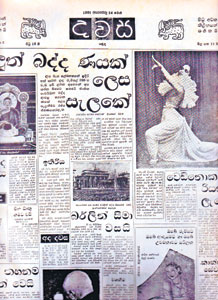
A hundred years later, a new Sinhala newspaper was born on August 14, 1961. That was 'Dawasa' published by M. D. Gunasena & Company – well known in book publishing at the time. The new company established to publish the newspaper was the Independent Newspapers Ltd.

First issue of the 'Dinamina' in 1909 The inaugural issue of 'Dawasa'

The idea of a new Sinhala newspaper was born in the mind of D. B. Dhanapala, who had by then established a name for himself as a most dynamic journalist. Having had a stint in the 'Daily News' as a writer, he was instrumental in promoting the Times of Ceylon group to start a Sinhala newspaper to compete with the only other daily Sinhala newspaper, 'Dinamina' published by the Associated Newspapers of Ceylon Ltd (ANCL) popularly known as Lake House. (Started on December 17, 1909, 'Dinamina' was bought up by ANCL founder D. R. Wijewardene in 1919).

Dhanapala succeeded in giving new vigour to Sinhala journalism with his innovative thinking through the 'Lankadipa' launched on October 29, 1947. While Dhanapala did the planning, the well-known scholar Julius de Lanerolle was editor. Dhanapala took over the editorship in 1949.

After resigning from the Times group, Dhanapala was keen to start yet another Sinhala newspaper and approached several businessmen. Though a Sinhala weekly was started ('Divaina' was its name) it did not last long. Sepala Gunasena, a director of M. D. Gunasena & Company showed interest and thus was begun the third newspaper company in the country – the Independent Newspapers group.

'Dawasa' was its first publication. It was soon followed by a Sinhala weekly, the 'Rividina' on August 20, 1960. (Its name was changed to 'Riviresa' in January 1963). An evening weekly 'Sawasa' was also begun the same year.

Dhanapala again succeeded in giving the Sinhalese reader a newspaper with a difference. A new look was given in the presentation of news, features and photographs. 'Dawasa' soon became popular with the readers who accepted the newspaper as one with independent views devoted to voicing the aspirations of the people.

The new company continued to break new ground and within six years had 16 regular publications to its credit. These included two English newspapers – 'Sun,' a daily and 'Weekend,' released on Sunday.
The newspaper group was sealed by the government on March 20, 1974 under Emergency Regulations enacted, resulting in the demise of Independent Newspapers Ltd after 13 years.

Early days of English newspapers

By the time the first Sinhala newspaper appeared in 1860, several English newspapers had been published in Sri Lanka. The 'Colombo Journal' (1832) was the first to be launched when Robert Wilmot Horton was the Governor. It was followed by the 'Observer and Commercial Advertiser (1834). The 'Ceylon Chronicle' was the next launched in May 1837, with the ' Ceylon Herald' starting publication in September 1838. These newspapers were short-lived as was the 'Ceylon Advertiser and General Intelligencer' which lasted just eight months – September 1845 to April 1846.

A few European merchants started the 'Examiner' (January 1846) which, after several changes in ownership, passed on to a syndicate of Ceylonese lawyers and its name changed to 'Ceylon Examiner.' It was recognised as the organ of the Ceylonese and had considerable influence on the Government and the bureaucracy. It was also regarded as the first English newspaper in the country that gave something to its readers other than commercial and administrative news.

'Ceylon Times' came into being in July 1846, to further the interest of the mercantile community. It became the 'Times of Ceylon' as an evening daily in 1883. The 'Ceylon Independent'(July 1888) claimed to be the paper with the largest circulation. It was selling 3,270 copies. It continued to be published for fifty years till 1937. The 'Ceylon Standard' was started in January 1898, which continued until 1907.

While these newspapers were being published in Colombo, several newspapers appeared in the outstations. The oldest newspaper outside Colombo was the 'Ceylon Freeman' founded in Jaffna in 1862. Two more weekly papers were started in Jaffna – the 'Ceylon Patriot' (1863) and the 'Catholic Guardian' (1876). In Kandy, the 'Kandy Herald' was started in 1868, but was in existence for just over a year.

Monday, July 28, 2008

Ancient Rituals in sri Lanka‘Gam Maduwa

Ancient Rituals in sri Lanka‘Gam Maduwa’

Just as much as villagers flock to the temple whenever a ‘pirith’ ceremony is held, people gather in large numbers when other folk rituals are performed. A ‘gam maduwa’, an elaborate ritual based on age-old customs and traditions would draw the entire village for an all-night outing. So will a ‘bali’ ceremony or a ‘thovil’ attract villagers in their numbers. These are community gatherings where people participate voluntarily. A ‘gam maduwa’ being an elaborate ceremony is not held very often. Being a rare event, it attracts village-folk from the surrounding villages as well.
As the name suggests, a ‘gam maduwa’ is a village affair. It is performed in a temporary shed erected for the occasion. It is of special interest to the farmers, for whom a ‘gam maduwa’ would bring in blessings of the gods for success in their agricultural activities. Others too believe that it would bring a lot of good to the village. It falls into the category of rituals known as ‘shanti karma’ and is a ritual with mass participation.
The Sri Lankan village is very much connected with agriculture. Thus folk rituals centre round customs, traditions, beliefs and other practices related to agriculture. The first portion of the harvest is offered to the gods and rice is used to offer alms thanking the gods and asking them for the protection of the next crop. Boiling of milk is also another way of hoping for a bountiful harvest.
The shed or hall built as the ‘maduwa’ is generally around 60 feet in length and 20 feet in width. It is gaily decorated with ‘gokkola’. A pandal adorns the entrance to the ‘maduwa’. Hung on it are different kinds of fruit. The erection of the hall begins at an auspicious time when a vow is made to the gods promising to have the ‘gam maduwa’ on a specific date.
The central figure in the ‘gam maduwa’ is goddess Pattini whose symbolic emblem is kept on a special dais in the centre. In front is the ‘mal asanaya’ where flowers are offered with paintings of the goddess on either side.
Other deities who are worshipped in the region are also featured.
During the nightlong ceremony verses invoking the blessings mentioning these gods are sung and numerous forms of traditional dances are performed to the accompaniment of drums.
The ‘pandam paliya’ or the torch dance is of significance where the torches keep burning throughout the night. ‘Bali’ is a less elaborate form of ritual than ‘gam maduwa’ and is basically a sacrifice to the deities. It is closely related with astrology and often a ‘bali’ ceremony is held when someone is having a bad time or is suffering from a serious illness. ‘The bali adura’ officiates using a whole heap of paraphernalia including ‘pol mal’ (coconut flowers), ‘puwak mal’ (arecanut flowers), stems of plantain trees, flowers of at least five different colours, betel, coconuts and lime. Although a ‘bali’ ceremony is held for an individual or a family, sometimes it is also planned to bless a whole village. Lots of chants are recited while offering many types of food to deities, spirits and demons. These are all done with the hope of getting some favours. It may be an appeal to cure an illness or to improve a business, which had collapsed.
The ‘bali’ ceremony begins in late evening in a specially decorated pavilion where images of deities and others are exhibited. If it is held to cure a sick person, he or she will sit or lie down in a corner. A cock is generally kept tied to an image. Dancing, chanting and drumming continue throughout the night and towards the end there is frantic dancing by the ‘bali adura’ or chief official who falls flat on the ground as the climax is reached. His assistant would quickly get near him with an ash pumpkin, which is kept on his chest and cut in two. The departure of the evil spirit is marked by the somewhat rash behaviour of the ‘adura’ who runs about pulling down the decorations and other stuff. The breaking up a branch signals the end of the whole episode. The ‘aturaya’ then leaves quite exhausted yet with the fervent hope that he would be cured.

Pics and text from Internet

---------http://www.lakbimanews.lk/education/edu2.htm

Monday, April 21, 2008

Some rivets on Titanic were substandard

Some rivets on Titanic were substandard

The tragic sinking of the Titanic nearly a century ago can be blamed on low-grade rivets that the ship's builders used on some parts of the ill-fated liner, two experts on metals conclude in a new book.

The company, Harland and Wolff of Belfast, Northern Ireland, needed to build the ship quickly and at reasonable cost, which may have compromised quality, said co-author Timothy Foecke. That the shipyard was building two other vessels at the same time added to the difficulty of getting the millions of rivets needed, he added.

''Under the pressure to get these ships up, they ramped up the riveters, found materials from additional suppliers, and some was not of quality,'' said Foecke, a metallurgist at the U.S. government's National Institute of Standards and Technology who has been studying the Titanic for a decade.

More than 1,500 people died when the Titanic, advertised as an ''unsinkable'' luxury liner, struck an iceberg on its maiden voyage in 1912 and went down in the North Atlantic less than three hours later.

''The company knowingly purchased weaker rivets, but I think they did it not knowing they would be purchasing something substandard enough that when they hit an iceberg their ship would sink,'' said co-author Jennifer Hooper McCarty, who started researching the Titanic's rivets while working on her Ph.D. at Johns Hopkins University in 1999.

The company disputes the idea that inferior rivets were at fault. The theory has been around for years, but McCarty and Foecke's book, ''What Really Sank the Titanic,'' published last month, outlines their extensive research into the Harland and Wolff archives and surviving rivets from the Titanic.

McCarty spent two years in Britain studying the company's archives and works on the training and working conditions of shipyard workers. She and Foecke also studied engineering textbooks from the 1890s and early 1900s to learn more about shipbuilding practices and materials.

''I had the opportunity to study the metallurgy of several rivets,'' McCarty said. ''It was a process of taking thousands of images of the inside of these rivets, finding out what the structure was like, doing chemical testing and computer modeling.''Seeing the kind of levels we saw in different areas, in different parts of the ship led us to believe they would have been ordered from different people,'' she said, adding this may have led to the weaker rivets.

The two metallurgists tested 48 rivets from the ship and found that slag concentrations were at 9 percent, when they should have been 2 to 3 percent. The slag is a byproduct of the smelting process.

''You need the slag but you need just a little to take up the load that's applied so the iron doesn't stretch,'' Foecke said. ''The iron becomes weak the more slag there is because the brittleness of the slag takes over and it breaks easily.''

Foecke said the main question was not whether the Titanic would sink after hitting the iceberg, but how fast the ship went down.

He believes the answer is provided by the weak rivets. His analysis showed the builders used stronger steel rivets where they expected the greatest stress and weaker iron rivets for the stern and the bow, where they thought there would be less pressure, he said. But it was the ship's bow that struck the iceberg.

''Typically you want a four bar for rivets,'' Foecke said, using the measurement for the strongest rivets. ''Some of the orders were for three bar.''

Harland and Wolff spokesman Joris Minne disputed the findings. ''We always say there was nothing wrong with the Titanic when it left here,'' he said.

When the iceberg hit the Titanic, it scraped alongside the ship. Foecke said this affected a number of seams in the bow and the weak rivets let go, putting more pressure on the strong rivets.

''Six compartments flooded. If the rivets were on average better quality, five compartments may have flooded and the ship would have stayed afloat longer and more people would have been saved,'' Foecke said. ''If four compartments flooded, the ship may have limped to Halifax.''

The company does not have an archivist, but it refers scientific questions on the Titanic to retired Harland and Wolff naval engineer David Livingstone, who also has researched the ship's sinking.

He said he largely agrees with the authors' findings on the metallic composition of the rivets, but added their conclusions that the rivets were to blame for the sinking are ''misleading and incorrect'' because they do not consider the ship's overall desgn and the historical context.

''You can't just look at the material and say it was substandard,'' Livingstone said. ''Of course material from 100 years ago would be inferior to material today.''

He said he has found no document to support the argument that Harland and Wolff knowingly used substandard material. He pointed out that the Olympic, a ship the company built at the same time using the same materials, had a long life with no troubles. The third vessel turned out in the early 1900s was attacked and sunk in World War I.

Livingstone said he is not sure why iron rivets were used in the bow and the stern but believes it may have been because a crane-mounted hydraulic rivet machine could not reach those points. He said the iron rivets were wider to compensate for the difference in strength.

Contrary to Foecke's theory, Livingstone said, the Titanic did not go down fast compared to other ships that have sunk.

He said the Titanic did not capsize _ as do most sinking ships _ but maintained an even keel until the last moment, going down after about 2 1/2 hours when the weight of the water it took on became too much.

William Garzke, chairman of the forensics panel of the Society of Naval Architects and Marine Engineers based in New Jersey, said wrought iron was commonly used at that time, but steel was the newer, stronger choice.

Garzke, who also has studied the Titanic sinking, said the two scientists made a good point about the variability of the rivets, but ''the problem is not the metallurgy of the rivets, it was the design of the riveted joints.''

He said that the company used only two rivets at the site of impact, when three would have p

Friday, November 16, 2007

Colombo-Kandy: From footpath to expressway

Colombo-Kandy: From footpath to expressway

In 1972, Ceylon Observer Features Editor Eustace Rulach satirised Sri Lanka’s road and transport system in an article titled, `Tourist Ceylon in the year 2072.’ It is about a group of foreigners travelling from Colombo by tourist coach to the Katunayake airport. Two hours later, the tired and shaken passengers clamber off the coaches. One elderly tourist tells another, “I heard my grandpa talk about this trip to the airport from the city, and that it took longer than the flight to Bangkok. My God! That was eighty years ago, and I thought he was joking!”

Our road conditions are not far different today from what they were in 1972 owing to the increasing volume of vehicular traffic. Sri Lanka’s annual loss due to faulty road systems is around Rs.200 billion, according to a survey that the Moratuwa University conducted a few years ago. Needless to say this problem will continue until the planned network of expressways linking the country’s major towns and cities are completed.

How did our grand parents and their elders cope with such situations? To begin with they did not face the transport difficulties we face today. There were four very good reasons for this: (1) life moved at a much lower pace and people travelled less (2) an excellent railway system that was almost never hampered by work stoppages or strikes (3) there was far less vehicular traffic on the highways and (4) towns were much less congested. In the very early part of the last Century, the Galle-Colombo road - say from Moratuwa to Pettah - was half the width of what the same stretch is today.

There were no motor vehicles in Sri Lanka and most parts of the world until the beginning of the 20th Century since the first petrol-driven automobile was invented only in1885. Although the Dutch (1658-1796) constructed a network of roads encircling the island’s coastal belt this country’s most important road - the Colombo-Kandy highway - was built only after the Kandyan Kingdom fell to the British.

But around 2000 years ago at the peak of the ancient Sinhala civilisation our kings did construct some excellent roads and mileposts some of which were discovered in Anuradhapura and Polonnaruwa. These however were built long before Sri Lanka’s encounter with the Western powers and the subsequent establishment of the Kandyan kingdom.

Following the European occupation of the Maritime Provinces the Kandyan Kings did not allow the building of any roadways linking the hill country with the low lands for a very good reason. The non-existence of a road network made it extremely difficult for the foreign forces occupying the coastal areas to reach the hill capital. The jungle bordering the kingdom was kept thick and only footpaths were allowed to penetrate it.
This environment was ideal for waging guerilla warfare against any invader. The policy made good dividends in an age when ox caravans, horse-back and palanquins were the principle means of transport.

At the time it took as long as 10 days to reach Kandy along the cart-track-cum-foot path from Colombo whereas today it is a matter of two-and-a-half-hour journey by motor vehicle or train.
When the British decided to open up the jungle and build a roadway it was primarily for military purposes rather than for public use. Later with the dawn of the coffee era the road began to serve commercial objectives as well.
The credit for the construction of the Colombo-Kandy road goes to Governor Sir Edward Barnes who assumed office in 1820. While the first sod was cut in 1820 and the trail was completed in 1821, the road was not open to traffic until 1825. Even then it had a few culverts and bridges that were not completed until 1833 and the metalling was not begun until 1841.

Contract labour was employed to build the part of the road which went through the low country. This work was under the direction of Captain Frazer who was noted for his lurid language. When complaints were made against him Governor Barnes responded by saying that Frazer was just the man for the job since it required a person who was willing to “dam the streams” and “blast the rocks.”

Another military officer, Major Skinner was appointed to build a portion of the Kandy Road from Ampitiya to Warakapola, just above the half-way mark. He noted in his diary that the natives with whom he had to work were “totally unskilled labourers who had never seen a yard of made road in the country, for the best of reasons that such a thing did not exist”.
The villagers that Skinner mentions were working under a system inherited from the Sinhala Rajakariya system, under which the tenant of a property might be required to do two-weeks work for the State. A similar system prevailed in England in the Middle-Ages. Since labour was not paid, it was necessarily inefficient. Even worse was that the whole labour force changed every two weeks and a new labour force had to be taught how to exactly set about working.

This system, which was abolished in 1832, was going on all along the Kandyroad though there was also a Corps of Pioneers recruited for the purpose. Skinner’s fellow officers were a cheerful hard-working crowd and it appears that some of them died due to excessive drinking rather than by accidents during road building.

A bigger menace was malaria - called ‘jungle fever’ in those days since its connection with the mosquito was then unknown.
Building the road to the hill country literally became an uphill task since every night wild elephants broke down the embankments. In addition marshes, quagmires, swamps, pools and puddles posed a major challenge to the engineers and workers. But completed the road was enabling travellers to get to Kandy within a day by horse-drawn carriage.
While the road was under construction in 1822 a pontoon bridge was thrown across the Kelani River to span it at Grandpass. This bridge carried all the traffic that passed the point until the Victoria Bridge was opened for traffic in 1895.

The Gordon Bridge across the Hingula Oya was completed in 1822 and a few other minor bridges too came up by 1825. Two other important bridges - one across the Maha Oya at Mawanella and the other across the Mahaweli Ganga at Peradeniya were both completed in 1832.
The latter was of course spanned by the famous Wedge Bridge comprising one single span of 250 feet. Although it was to be done entirely of satin-wood some milla was substituted for its lower ribs during the latter part of the construction due to a shortage of satin wood. However it did not reduce its value for it was a piece of master-craftsmanship.

This was designed on the instructions of Lt. General John Frazer based on the system of wedge bridges. The bridge was constructed in Colombo and on completion transported to Peradeniya where it was erected by Captain A. Brown without a single nut or bolt of any kind!
This too withstood all the traffic for 72 long years until an iron structure replaced it in 1905. A model of this satin-wood bridge was taken to be exhibited permanently in the South Kensington Museum in London.
After the Kandy Road was opened to the public, toll points (a modern day feature in developed countries) were established at the bridge of boats at Grandpass, Atulugama, Ambepussa Bridge, Anguruwella, Kadugannawa Pass and the Peradeniya Bridge.

No uniformity of rates prevailed in the early period and occasionally it led to confusion and exploitation of road users. To rectify this defect an Ordinance titled, “For establishing an uniform rate of tolls on the road from Colombo to Kandy...” was passed in 1841. These tolls were chargeable upon passengers, carts, carriages, cattle and other animals and goods.
There were also concessions to certain people enumerated in the Ordinance and the Government Agent was the proper authority to direct the toll-keepers in writing to permit cattle driven to grass, persons with agricultural implements or with seed grain to cultivate their land and school children to and fro, to pass a point.

The Colombo-Kandy Road ended the Hill Capital’s virtual isolation from the rest of the country. It also brought a new source of revenue to the Colonial Government as well as immense wealth to several hundred entrepreneurs with the opening up of land for coffee cultivation, soon afterwards.
The dawn of the motor vehicle era, saw a mixture of both old and new modes of transport on the Colombo-Kandy Road as elsewhere. These included what we today call ‘old crocks’ or vintage cars and buses with rubber (bulb) horns, long footboards and cranks (used for starting the engine), bullock carts, horse-drawn carriages and ox-drawn buggies.

Lake House was among the companies that operated a Colombo-Kandy bus service beginning in the 1920s. Horse drawn carriages continued to ply on our roads till about the late 1930s. However even in the mid 1950s I remember seeing as a child a few pony-drawn carriages in the Anuradhapura town.
The length of the island’s road network today is about 92700 km. The roads linking the provinces belong to the A class while those connecting the districts belong to B class. These roads are 11600 km in total length. The roads belong to the C, D and E categories are 16500 km long and unclassified roads are 64000 km.
New challenges - however - are bound to occur with the completion of expressways. . The problem however is that neither the police nor the emergency rescue services, pedestrians’ and local residents, are aware of road safety issues linked to super highways of this type.

According to Romesh Fernando, a one-time public awareness specialist at a Swedish consultancy firm, such expressways will require new facilities such as emergency phones at regular intervals to alert traffic police and emergency services. New regulations, he states, would also be necessary to facilitate the use of seat belts, speed control in designated lanes and the halting of vehicles.

www.friday.lk

Thursday, November 8, 2007

Tutankhamun's mummy to Be Displayed for 1st Time

Tutankhamun's mummy to Be Displayed for 1st Time

http://emi-argentina.blogspot.com/


The mummy of King Tutankhamun will soon go on display for the first time, exposing the bare face of the boy king, Egyptian officials have announced. The mummy will be removed from its sarcophagus and placed in a climate-controlled glass case in the antechamber of the pharaoh's tomb in Luxor in November (see Egypt map).

"I am taking [the mummy] out to show it to the public for the first time," said Zahi Hawass, secretary general of Egypt's Supreme Council of Antiquities.

The move is part of an effort to preserve the mummy, which has been in poor condition since it was first discovered, Hawass explained.

Archaeologist Howard Carter unearthed Tutankhamun's treasure-filled tomb in 1922, the first discovered with its riches so intact.

But Carter and his team partly destroyed the mummy in search of more treasures buried with the pharaoh, separating it into 18 sections, Hawass said.

Humidity and heat, much of it generated by the breath of the tomb's 5,000 daily visitors, have also taken a toll.

"Right now the mummy has no special protection from the humidity in the tomb," Hawass said. "The new case will be specially sealed to protect it from this sort of damage."

The pharaoh's remains will be partially rewrapped in linen with the face of the pharaoh left uncovered, according to Mansour Boraik, general supervisor of the Supreme Council of Antiquities in Luxor.

Officials hope the display will increase the number of visitors and generate profit for the conservation of other Egyptian antiquities.

"The 'golden boy' has magic and mystery that bring people from all over the world," Hawass said.

(Hawass is a National Geographic Society explorer-in-residence. National Geographic News is a division of the National Geographic Society.)

The mummy has been examined four times before, but it has never been seen by the public.

In 2005 Hawass opened the sarcophagus to perform a series of CT scans that allowed researchers to create a reproduction of the king's face.

(See photos of Tut's mummy and reconstructed face.)

"I was fascinated with his face," said Hawass, who noted the king's buck teeth are similar to those of the pharaoh's royal ancestors.

"Meeting King Tut face to face was very personal. … It was an important moment in my life."

Tutankhamun became pharaoh at the age of nine, ruling for only ten years in the 14th century B.C. before meeting an untimely death.

(Read: "King Tut Died From Broken Leg, Not Murder, Scientists Conclude" [December 1, 2006].)

Awakening the Curse

Exposing the mummy is likely to resurrect the myth of the pharaoh's curse, once believed to bring tragedy to those who disturb the tomb.

Most famously, Carter's sponsor, Lord Carnarvon, died shortly after entering the tomb from an infected mosquito bite.

Other tragedies were also blamed on the curse, and some experts have said ancient toxins lying in the tomb could have played a role.

"There is always mystery about King Tut, and it will never stop," Hawass said.

"Of course this will reawaken fears of the curse, as any new project involving the tomb or the mummy always does."

"I don't believe in the curse at all," he added. "But the gold, the intact tomb, the curse—all this history makes everybody fascinated by King Tut."

Saturday, October 6, 2007

Burma (Myanmar) - Sri Lanka relations

Burma (Myanmar) - Sri Lanka relations

-Daily Mirror

(S B Karalliyadda)
Although there were instances in our recorded history when Myanmar then known as Pegu, Rakkanga Desh, Burma etc: was invaded by our ancient Kings, we had strong religious/cultural and trade relations with that country. During the reign of Vijayabahu (1055-1110) Lanka faced a Chola invasion and the Pegu King Anawarahata helped us with ships, forces finance and other logistical support to defeat the Cholas. They sent us the necessary scholastic monks to establish Upasampada. An instance is recorded that during the reign of Maha Parakramabahu (1153-1156) a Lankan Princess who was on her way to Cambodia to marry a Cambodian Prince was confronted by the King of Burma, and our ruler Parakramabahu invaded Burma in retaliation. This incident occurred during the reign of King Alawunsitu in Pegu. Another incident recorded in history was the invasion by Parakramabahu, over the violation of a trade pact with Pegu. Parakramabhu’s troops entered Pegu from the Kusumiya port. Nevertheless during his reign, several high ranking priests came to Lanka and lived at Dimbulagala, when there was a situation of unrest in Burma. During the reign of Parkramabahu VI (1412-1467) the Pegu King Biyanyan sent a Buddhist delegation to Lanka. Apart from these religious and cultural relations we had matrimonial relations with this country. The matrimonial relationships were very strong and close during the Kotte, Seethawaka and Senkadagala kingdoms. The trade relations between the two countries were export of spices such as cinnamon, cardamom, pepper, nutmeg etc: Another trade that flourished was the exchange of elephants and tuskers. Our tuskers were believed to have tusks superior to any other tusks. The exports were through our ports in the North and East. Later the ports in the coastal areas such as Galle, Matara and Colombo were used for these trade purposes. It was a continuation of time immemorial friendship and goodwill that the government of Sri Lanka and Myanmar recently signed several trade agreements and a M.O.U. The Myanmar government also presented two tuskers to the Dalada Maligawa in Kandy. There are several monks here who were conferred the title of ‘Agga Maf Pandita’ by the King himself. During the Senkadagala regime Upasampada or higher ordination was twice performed here when the Sangha order had no priests who have obtained the higher order or Upasampada.

It was King Thunayama who ruled from Keulgama, Pallepitiya and Senkadagala from 1497-1594. He was from Poddalgoda Udispattu in the present Teldeniya electorate and a grandson of Dedigama Parakramabahu, and the son of Dumbara Satanbandara. Thunayama’s one son was Jotiya Situ (1460-62) who ruled from Meda Mahanuwara. He is the author of the famous Madawala inscription. Second son was Weera Wickramabahu (1543- 79) who ruled in Senkadagala. He was also known as Rankoth Pathirannehe. It was during his rule that a Portugese, General D. Gastro invaded Senkadagala with a troop of seven thousand five hundred. Wickramabahu was able to defeat these invaders and built a Viharaya in Poya Maluwa Maiwatte temple to commemorate this event. The third son was Weerasundara Bandara alias Wijesundara who was the ruler from 1582- 1585.

The Portugese called him ‘Maha Kalu Parakramabahu’. He was killed by Sitawaka Rajasingha and Rajasuriya alias Nikapitiya Bandara was placed in the Senkadagala throne. Weerasundara’s son Konappu Bandara fled to Uda Hewaheta and took refuge under the people of Hanguranketa. Konappu Bandara who became the King of Senkadagala (1593-1604) after defeating the Portugese assumed the name of Wimaladhrmasuriya I. His sister was married to Tammita Suriyabandara who was the son of Tanivallabahu, of Madampe and Kapuru Lamaethani. Suriyabandara’s one daughter Nilupamala was a Queen of Sitawaka Rajasinghe. His son was Rajasuriya alias Nikapitiye Bandara whom Rajasinghe placed in the Kandyan throne after the murder of Weerasundara Bandara. The other daughter was married to the king of Pegu. (Vidiya Bandara Gothrapataya Gnartha Pradeepa 05.02.1999) According to this matrimonial alliance Pegu King’s Queen was Wimaladharmasuriya’s sisters daughter, his niece. This may be why Wimaladhrmasuriya was able to get down Rev. Nandiwakka and other priests to re-establish the Upasmpada order in Lanka. This matrimonial alliance was strong at the time.

Tammita Suriyabandara was also well versed with Christianity and it was he who induced Dharmapala of Kotte to learn Christianity. He had free access to the Kotte palace as Dharmapala was the son of Veediya Bandara who was this nephew and the son of his brother Sakalakala Wallabha of Udugampola. Suriya Bandara was the Chief Chamberlain of the Kotte palace. He embraced Christianity as Francisco Barranto in later years. Suriya Bandara’s son Nikapitiya Bandara was appointed the King of Seetawaka in 1592 by Maha Biso Bandara alias Roma Lamaethani his rand-mother and mother of Veediya Bandana. He declared himself the King of Dambadeniya on 05.12.1616 with the backing of Hatara Korale and Hath Korale people. Later he was chased by Senarath of Senkadagala and joined the Portugese to embrace Christianity under the name of Don Phillip. He was the first Sinhala prince to embrace Christianity and the first Sinhalese to enter a European University. He entered the Coimbre University of Goa.

It was hundred years after, that King Wimaladharmasiriya II, the grand son of the first in 1597 requested the Pegu King to send a suitable delegation to establish the order of higher ordination. Dodanwela Herath Mudiyanse Headed this delegation. Thus we see the strong religious cultural and the trade relations with Burma, now Myanmar, had been in existence for thousands of years.

Friday, September 14, 2007

Shakespeare’s house and garden - The Bard’s birthplace

Shakespeare’s house and garden
The Bard’s birthplace
He was not of an age, but for all time.

-Ben Jonson, 1623

Driving over 100 miles from Central London, I joined hundreds of secular pilgrims moving down Henley Road in Stratford-upon-Avon to pay homage to the greatest and most famous of English writers and probably the most popular dramatist who has ever lived, William Shakespeare (1564-1616).

The little countryside town was peaceful with no traffic or high-rise buildings. Instead, stretches of fields and barns that were planted with fruit-trees, vegetable, herb, traditional flowers and shrubs were a beautiful sight. Wild flowers described by Shakespeare such as the ‘pale primrose’, ‘blue-veined violets’, ‘the freckled cowslip, burnet and green clover’, and ‘rough thistles’ were in bloom beside walkways and in gardens.

A visit to Shakespeare’s house helps to satisfy the curiosity about his family and background. It also reminds that although his career took him to London, his native town was of significance throughout his life.
Stratford was the place where he was born, went to school, attended church, met his wife Anne Hathaway, first saw plays, saw his children grow up, invested in property, retired and died. He inherited the house when his father died in 1601 and bequeathed it on his own death to his eldest daughter. The Birthplace became a national memorial in 1847.


Plays written by Shakespeare


Henry VI part 2
Henry VI part 3
Henry VI part 1
Richard III
The Comedy of Errors
Titus Andronicus
The Taming of the Shrew
The Gentlemen of Verona
Loves Labour’s Lost
Romeo and Juliet
Coriolanus
Cymbeline
Henry VIII
Hamlet
The Merry Wives of Windsor
Twelfth Night
Troilus and Cressida
All’s Well that Ends Well
Measure for Measure
Othello
King Lear
Macbeth
Antony and Cleopatra
Timon of Athens
The Winter’s Tale
Two Noble Kinsmen
Richard II
A Midsummer Night’s Dream
King John
The Merchant of Venice
Henry IV part 1
Henry IV part 2
Much Ado About Nothing
Henry V
Julius Caesar
As You Like It
Pericles
The Tempest


******Side view from the garden ********************************************


******Inside the Holy Trinity Church - the resting place of the Bard*************


“Good friend for Jesus sake forbear
To dig the dust enclosed here.
Blessed be the man that spares these stones,
And curse be he that move my bones.”*********************************


*******The entrance to Shakespeare Centre************************************


******Down Henley Road, Stratford*******************************************


Facebook > Fans

NASA Breaking News - Feed

Astronomy.com - News

Space Wire Top Stories Feed

Today"s Highlights Of The World

Today in History

Birthdays Today

NASA Image of the Day - Feed

NASACast Audio , To listen, Click - Feed

Medicine Net Daily News - Health News

Health News from Medical News Today - Feed

The New York Times

Crestock Daily Free Image

BBC News | Science/Nature | World Edition

BBC News | Health | World Edition

BBC News | UK | World Edition

BBC News | Asia-Pacific | World Edition

BBC News | Africa | World Edition

BBC News | Middle East | World Edition

BBC News | Europe | World Edition

BBC News | Business | World Edition

BBC News | Entertainment | World Edition

BBC News | Technology | World Edition

Sky News | World News | First For Breaking News

CNET News.com

PC World: Latest Technology News

Newsweek Top News

Guardian UK - Unlimited