Colomba Wate |
By. Pasan Fernando The launch of the first ever Sinhala mobile game 'Colomba Wate' took place recently. In this interview the Managing Director of GTS (www.gtslk.com), W.G.T. Fernando talks to the Daily Mirror about the innovative game and its future potential. Q: How did you come up with Colomba Wate? "Colomba Wate" aka "Colombo Ride" was one of my dreams that became a reality. The idea sparked when I wanted to play a mobile game with a local flavour, however there was no such games in the market. Therefore I took the initiative to draft such a game and Colombo Wate was the outcome. Q: What is 'Colomba Wate'? Colomba Wate is a game where the gamer plays the character of a taxi driver. The game's role is to pick and drop passengers in their journeys. The best part about the whole game is that the gaming environment is almost identical to a map of Colombo. We identified the prominent roads that we could use to promote Colombo to the world and focused on the roads that had a high density of commercial properties. There are over 50 roads present in the game. One of the best features of the game would be the fact that it is provided free to anyone who wants to use it. Q: Is there any commercial value in this product? Most Certainly! With the real roads embedded into the game it is possible for the real companies in those roads to place their buildings in the game to promote their business. To be fair, we have also allowed companies that are not present in Colombo to advertise in the game. We had a fair amount of responses from companies in and around Colombo for this version and we already have companies inquiring about advertising placements for the next release of this game in January 2009. Q: When everything is sold at a premium these days, why did your company decide to give this game for free? Bill Gates recently reiterated about 'Creative capitalism' where "it is necessary for corporations that have the skills to make technological innovations work for the masses. An attempt to stretch the reach of market forces so that more companies can benefit from doing work that makes more people better off" I believe that in order to promote this game, we need to make it convenient to the consumer as much as possible and not everyone has the capability to pay for such a game. Our revenue is solely made by the companies that wish to advertise with us in the game. Q: Was it smooth sailing since you started or did you have any obstacles to overcome? With no previous research conducted in this area but with a solid plan, we went about researching the gaming penetration and creating the entertaining game. The first problem we came across was in keeping the game to a minimum size. To comply with this restriction, we had to remove certain features of the game, such as the number of sound clips and the number of roads we could embed into the game. GTS employs a team of highly skilled people (past students of mine from the Faculty of Information Technology, University of Moratuwa). With dedication and a passion for perfection, we were able to produce this unique game. Q: You mentioned sound clips. What kind of sound clips do yon have and what is the reason behind including them? Sound clips put the icing on our product. Let's say the gamer is playing the game and sees a passenger in Galle Road. When the gamer picks up the passenger a sound clips is played in Sinhala telling where the passenger needs to be dropped. For example, we have one sound clip saying 'Mawa Thurstan Pinum Thatakaya lagin aralawanna' (Please drop me near the Thurstan Swimming pool). This adds value to the game as it gives a sense of added entertainment to the gamer. Q: Can you tell us more about the game and its objectives? The objective of the game is to take the passengers to their destinations, earn their hire, pay for petrol and other day to day activities. We organized a competition to select 10 top gamers with the highest scores. To be eligible for the competition a person should register on our website www.games.lk. In the game there is an option where the gamer can choose to submit their high score to enter the competition. The same username used in registration is needed to be submitted when submitting the score. This way, we are able to contact the person via email since the registration has the authentic email of each user. The top were selected on the 23rd August and had a chance to battle it out for the top 3 places during the Awards ceremony event. Q: You must be thrilled to see your efforts reach its peak? Yes, I am very proud of my team. A lot of dedication went into creating this product. There were times when we would work from 8am till 6am the next day! On the days prior to the launch we had spent 2 days at a stretch but it was all worth it in the end. Special effort and hard work was undertaken by Devinka Andrahamiadi - senior developer, Namal Fernando - creative designer and Amila Mendis - website developer. Q: GTS can be considered the pioneers of mobile gaming in Sri Lanka. What is you view on the future for the mobile gaming industry to expand in Sri Lanka? We honestly cannot predict the future, but we should prepare for it. We have a tremendous pool of talent in our country and must decide what we can do with it. Are we going to sell out our talent to foreign countries or going to use that talent to help our country reach its true potential. I honestly hope that people will use this game as an example and come up with even better ideas for mobile games in Sri Lanka. GTS is already working on the 2nd Sinhala game 'Aba Keliya' for Jackson Anthony's historic film 'Aba' which is creating new records in the film industry. It will also be the first film in Sri Lanka to have a mobile game based on the film. |
Monday, September 8, 2008
Colomba Wate


Is “HAPPINESS” an individual thing?
| Is “HAPPINESS” an individual thing? |
| Daily Mirror ********* |
| By Krishni Gunawardena – Counsellor / Therapist
Though there are many do’s and don’ts of being happy, I believe happiness is a very individual thing. As we know well what brings happiness to one person may not bring happiness to another. But for most people this essence of ‘ feeling good’ could be simpler than they think…… If someone were to ask you what would make you happy, what would you say? ‘Having a house of my own’ or getting a good school for my son …or even ‘losing my weight by 5 kilos…’ Perhaps not. Although some people dream about material things that would make our lives easier, research have shown that, people actually spend less time in the pursuit of such things. Recent reports tell us that ‘happy genes’ we inherit account for a good 50 % of how we feel. So lucky are the people who have happy parents and ancestors!! In the same way people inherit ‘unhappy genes’ too. That could be one of the reasons why some people confess ‘everything is going smoothly for me but I still feel down very often’ Studies also show that about 10% account to our circumstances such as where we live or how steady we are financially, for our happiness. It says the remaining 40% is influenced by the ‘internal activities’ we engage in and this is the area we people can truly do something to change how we feel. Field of positive psychology has expanded over the past 10 years and techniques have been identified to show ‘internal activities’ have an effect on our sustained levels of happiness. However, obviously different strategies will suit different people. So you may find that some fit your goals and personality better than others. You may try one or all five of the suggestions given below but the important thing is to find methods that engages you and gives you pleasure and meaning in life. This again will depend on many things such as your upbringing, social and cultural background and other factors of your environment that helps you to be in your present mindset. Sugessions
For some people engaging in acts of kindness is one thing which boosts their happiness. Helping people in what ever way you can wins you more appreciation and makes you feel capable and strong. It’s also good to vary your good deeds to prevent it becoming routine. This suggestion is more suitable for those who don’t have major issues weighing in their minds. 2. Don’t compare Sometimes our level of contentment is related to self comparison and most of us tend to compare our selves with other people. Some measure their achievements, salary and even their weight against who have achieved more, who are richer or slimmer than them. If you do it in a constructive manner, it may inspire you, but if you often compare yourself with others, you may be in a constant state of dissatisfaction. 3. Have your ideal self For some people imagining an ideal self increases her/his well being and helps to push away regrets. Imagining about positive topics relating to you and making mental notes of a vision of your best possible self will bring about results to bring happiness closer to you. 4. Learn to enjoy The process of enjoying allows us to get the maximum amount of pleasure from an event, by focusing only on that event. It’s good to live in that moment and enjoy it, when we experience it. It’s about paying attention to what you enjoy, slowing it down and stretching it. Whether it be watching a movie, eating a chocolate or making love it’s good to live in that moment and enjoy it to the fullest… My friend Shoba while watching a movie, at the most intense moment would turn to me and say ‘ oh ! my Board meeting tomorrow….. !’ which could be quite a spoiler. 5. Your relationships Most psychologists agree, of all the ways that we can increase our happiness,the best way is through our relationships with others. Relationships must be nurtured and enjoyed not just known and put away. Here again making friendships/relationships is an individual thing. Some people feel safer to stick with long time friends while others thrive on making new friends. Making new friends and connecting with them could be an adventure and a challenge too. Again this depends on your personality type. The important thing is to enjoy the friends whom you love. |
 Happiness is something we all seek. Pursuing the secrets of happiness is centuries old, sometimes having roots to the faith you have perhaps in your religion, traditions and family patterns.
 1. Carry out good work
Saturday, September 6, 2008
Pirith Dashana, By, Kassapa Thero, Only on Star Lanka Online,
MAHA PIRITHA ***LIVE********
*******Listen
* Click Here to Listen From,
Star Lanka Online :
*******Watch
* Click here to Watch On U-Tube >>>
TNL TV's Pirith Chanting
>>>> These two programs are
Different versions.
Kassapa Thero
**************************************
Kassapa Thero with crew. Los Angeles in California, America, . He is the one , Everyday we can watch on " TNL",'s Pirith , where the right corner of others on the screen.
Now, He lives in Dharmavijaya Buddhist Vihara , Los Angeles, U.S.A. Before that He lived in Hunupitiya Gangaramaya and also in the Gunarathna Mudalinda Pirivena in Hittatiya, Matara as a small monk.Still we can see him on TNL Television in Sri Lanka everyday before the end of transmission
Tuesday, September 2, 2008
Is Dial Up Connection Good To Use Internet ?
What Kind Of Internet Connection We Have To Use ? So, "whether Dial-Up connection is better or not" , is shouting in the mind of all the internet dreaming people.
According to a web report, I've found out this information, regarding our internet speed.
64 kbps connectoon - max. downloading speed will 8kbps
128 kbps connectoon - max. downloading speed will 16 Kbps
256 kbps connectoon - max. downloading speed will 32 Kbps
512 kbps connectoon - max. downloading speed will 64 kbps
1024 kbps connectoon - max. downloading speed will 128 kbps
2048 kbps connectoon - max. downloading speed will 256kbps
*due to 1:8 ICS ratio method
I've used Dial-UP internet connection for years and I know all the unbearable actions , a user have to face. Then I advised all the dial up users, give up that connection, don't tell any one to buy it. It costs more money, time and less result. There are many methods to use internet including WiMax. It's better to be late than never.
Sunday, August 24, 2008
Roomassala - the mystery mountain
Roomassala - the mystery mountain
 |
| Japan Peace Pagoda |
|
|

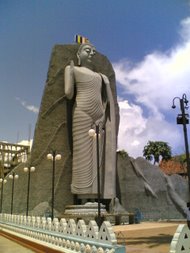
Historical mountain Roomassala stands majestically in the vicinity of Galle harbour along Galle- Matara road. The pagoda built recently by a Japanese Buddhist glistens in the morning sun.
The mountain violates the continuity of the southern coastal belt. Many devotees, Hindus and other tourists throng this mountain to discover it’s mysteries and fantasies derived from the epic of Ramayana by Valmiki.
When I went there I felt that it is an ideal location to spend my leisure time peacefully. There are so many stories woven around the Roomassala Mountain.
It’s said that the life reviving medicinal herb Sanjeevanie grows here but so far no one has found it. But in Ramayana it is mentioned that sanjeevanie could heal Lord Rama and his army.
M. D. Somadasa Kariyawasam, a researcher on the subject, recalls that Ramayana is about the war between Lord Rama of Bharatha Desha, that is India, and king Ravana of Lanka, over Seetha, the most beautiful woman at that time in the history of the world, the wife of Lord Rama, abducted by Ravana and kept hidden at Seetha Eliya in Nuwara Eliya.
Lord Hanuman led a Vanara Sena (a monkey army ) to rescue Seetha, and the Vanara casualties were so great, and even when Lord Rama and Lakshmana were seriously injured, in the battlefield sanjeevanie was needed to revive them.
This hurb is said to have, the magical powers of reviving the dying and rejuvenating life. Hanumantha who leapt across to the Himalayas to pluck the herb sanjeevanie, in a hurry, pulled the whole section of Samantha Kuta where the herb grew, brought and dropped it near Galle.
| |

But the folklore says it was only a part of Samantha Kuta that fell near Roomassala. But there is no evidence of the other part of the mountain that was supposed to have fallen. So it’s logical to think that the entire mountain is intact.
People in Roomassala say that when a pooja is in progress on top of Roomassala Mountain, there prevails an eerie atmosphere in the whole area. In addition to the medicinal herbs endemic to this mountain, it is said that even the gravity here is different from other parts of the country.
| |

The Viharadhipathi of the Vivekarama temple on top of Roomassala, Ven Aththiligoda Saddathilaka thero told me that it is impossible to take any medicinal herbs and material away from the mountain.
Those who tried to do so are said to have got lost.In Roomassala, hardly do fathers and children meet each other. In the evenings their fathers go to the sea and return only the next morning and by that time the children have gone to school.
Fishermen believe that a mystic power works for them as they always yearn for the blessings of the Lord Rama and Hanuma. It helps them to get a good catch.
Ravana, mighty emperor of Lanka
Ravana, mighty emperor of Lanka
Ravana ruled Lanka thousands of years ago and was the last in the dynasty that ruled Lanka for thirty seven years from B.C. 2254 to 2517. Mighty Ravana Emperor was the head of all tribes such as Raksha, Yaksha, Deva Etc. who ruled in Lanka from Lakegala, present Laggala to the east of the Knuckles range of mountains towards the Meemure village. Ravana was the foe of Rama as depicted in the Sanskrit epic Ramayana. Ravana is the eldest son of a Brahama sage Vyshrava.
The mother was Kaikeshi, the daughter of Daitya tribe king Sumali. Thus Ravana had been related to both Brahma and Daitya tribes. Ravana had six brothers and two sisters. His brothers were Kubera, Vibeeshana, Kumbakarna, Kara, Dushana and Abiravan.
| |

The sisters were Kumbi and Supernika. Kara was the ruler of North Lanka upto Kosala kingdom which was under Ravana. Ravana was a genius gifted with extraordinary talents and physical strength. For these reasons Ravana was known as Dashamuka (ten faces) Dashagreeva (ten heads) Dashakanda (ten throats) and twenty hands signifying his great war power and the ability of using various weapons.
He knew the Thriveda and all the philosophy and rules of Kshastriyas applicable in ruling a country. He became the Commander of the troops of his maternal grandfather Emperor Sumali head of the Daitya tribe. At that time Lanka was under his brother Kubera’s rule. At a time when Kubera was out of Lanka, Ravana invaded Lanka and also, took Kubera’s queen Vidovathi as his queen.
Their father Vyishrava who knew about the capabilities of his eldest son advised Kubera not to go to war with his eldest brother. Thus Ravana became the mighty Emperor of Lanka. About two hundred millions of years ago geographically Sri Lanka was linked to India.
Lanka and India were situated as one country. At that time India, Australia and Antartica continents were known as Condivana and formed one mass of land area. In the course of millions of years due to natural causes such as seismic earth quakes, ocean currents, winds and drifts this land mass got pushed further and emerged as separate continents and countries.
| |

The South of India was pushed to North due to these natural disasters and due to an earth quake formed a range of mountains which is known as the Himalayas today. A land mass that emerged after these natural evolutions formed Lanka. The bridge that was built to cross to India was washed by these tsunamis and sank in the sea. Even today the parts of the bridge could be seen to the South of Talaimannar buried in the deep sea. According to “Buduguna Alankaraya” Hanuman in the Ramayana epic came to Lanka over this bridge.
“Wandureku pinu muhuda Etharawa ya no he inda giyela Ram he benda mese veda me lova deviyan theda”
A larger mass of land area belonging to Lanka also sank into the sea. This land mass is the area from Palk Strait to Gulf of Mannar that buried the ancient city of Kudiramalai too under water. Modern science prove such phenomena as natural from time to time. This incident goes back to thousands of years when Vijaya Landed here in 544 B.C. and the commencement of our chronicle Mahavansa.
Who is Ravana
Ravana was the ruler of all tribes in Lanka then known as Yaksha, Raksha, Naga, Deva; Ravana’s queen was Mandodari the daughter of Mayasura Apsara. She was brilliant and a kind hearted woman. Besides this queen he had a harem of women. They had seven sons Indrajit, Prahasta, Atkaya, Akashyakumara, Devantaka, Narantaka and Trisara. Ravana becomes a mighty Emperor as he ruled over seven continents from Lanka.
They were the modern South America, Southern Europe, Himalaya including the Hindukush mountain range and continents up to Madagaskar (Dr. Suriya Gunasekara -Rivira 24.04.2007). Even today there are temples devoted to Ravana in India, Burma, Thailand, Afghanistan etc; Votsakan in Thailand, Ellora caves in Maharashta, Yakshagana in Karnataka are some such temples.
Rama Seeta cultural event is held in these countries annually and the ceremonies conclude after burning an effigy of Ravana. In the Cleveland museum in Ohio America there is a drawing of ten headed Ravana been burnt. One can imagine how they dread this mighty Emperor. “Sevul Sandesaya” poem 94 states that there is a picture depicting Rama Ravana war drawn in the Seethawaka Kovil.
“Diya dam Ravulu yuda saha Bharata yudada
Manaram Kanda Kumaru pera kala dig yudada”
The history of Ravana is written in several languages such as French, German, Japanese, Spanish, Portugese, Dutch, Hindi, Sanskrit, Sinhala and Tamil. Ravana flag was the sun and moon flag with a drawing of Ravana in the centre.
The flag was carried to the war front by the people of Hewaheta which belonged to then Mayarata. This flag which was in possession of Vilvala Raja Maha Viharaya is now in the Kandy museum. Ravana lived in Lakegala which is also identified as Laggala, Lankapabbatha, Lankagiri, Samudra Malaya Samudragiri etc. Rasavahini” identifies this rock as Lanka Pabbatha. Prof. Senarath Paranavithana is of the view that Lanka derived its name from the Lankagiri mountain rock. Dr. Sudath Gunasekara of the SLAS one time secretary to a Prime Minister and a native of Meemure says that it is the highest bare rock out crop in the world.
Taprobane the name which Lanka was first named is derived from Ravanadeepa. Thus it appears that Lanka derived its name from Lakegala rock of where Ravana was the ruler. Laggala is situated in the centre of Lanka between 80-46 degrees to the East and 7.3 to the North. It is said that Ravana calculated the time to his domain according to the hour of sun rise and the shadow falling on the Lakegala rock. This was thousands of years before we adopted the Greenwich Mean Time. The splendour of this area is described in a folk poem prevalent in the area.
“Epita kanda kalu pahane keleya
Mepita konata laggala meemureya
Desiya dekkak usa athi Gomareya
Hodai parakasa Laka Meemureya”
Legends of Ravana
Lankavatara Sutra one of the most important sacred texts in Mahayana mentions that the Buddha preached this sutra to a king who ruled in Lankapura Malaya pradesha.
There are several places associated with Ravana in these mountain ranges. Where Ravana bathed is Rasella. The water flows through Ravana Oya to join Mahaweli river. Udurawana and Yatirawana are two villages associated with Ravana. Seethakotuwa in Minipe is the place where Ravana kept Seetha captive.
Ravana went to Seethakotuwa in his plane which was known as Guruluvahana. The place where the plane landed is known as Gurulupotha. Where they bathed is Rathna-Ella originating from Hunnasgiriya range of mountains. This waterfall could be seen from the hear-pin, bends when travelling to Mahiyangana.
It is rumoured that Seetha was kept captive here for nearly a year. It was from here that she was taken to Seetha Eliya in Nuwara Eliya. Rawana’s administrative capital was Ravana Kotte. This is identified as a place in the South East quarter in the Southern sea near Kirinda. Ravana had a fortress - Kuda Ravana Kotuwa between Yala and Kumana.
Though his palace is sunk in the sea some parts of it could be seen when tidal waves subside in the sea. It was in Seetha-Eliya where Hanuman met her. When Rama’s troops came in search of her, Ravana took her to a place in Bandarawela 4500ft above sea level which is today known as Ravana-Ella. This place is visible from Ella Rest House. A pond where Seetha bathed also could be seen here.
Maligatenna in Welimada was another place where Ravana had a palace. Though it is a paddy field today the ancient granite pillars and bricks are yet visible. There is evidence to believe that the war mentioned in Ramayana which resembled the Trojan Greek war, had taken place in the Uva mountain range. The charred stone cravings and rocks provide evidence to the fact that lethal weapons were used in this war. The dents and boulders where Rama’s firearms stuck are seen today.
The crevices in the stone rocks further indicate that there had been some mass destructive activities in the area. Before Seetha was taken away she lived in a place called Ganakamada which was covered by a sand dune. Roomassala Kanda in Galle is a place associated with this legend. When Lakshman was wounded in this war Hanuma was sent to the Himalayas to bring a certain medicinal herbs.
Hanuma forgot the name of the herb and brought a huge land mass which had lot of medicinal herbs. A portion of this fell into the sea near Roomassala and the area was known as Roomassala Kanda henceforth and there are a lot of medicinal herbs here even today.
Might of Ravana
In the early periods, the Sinhalese lived in mountainous areas. According to Ramayana, Ravana travelled in this mountainous area in a plane known as Pushpaka. It could accommodate two hundred passengers. The seats of the king were made of gold and silver. There were two toilets and a kitchen in this plane (Rivira 22.04.2007 Dr. Suriya Gunasekara). According to Lankavatara Sutra, Ravana went in this plane to invite the Buddha. Dandu monara and Gurulu yanaya were the planes used when Ravana flew alone.
These planes were wind powered. Hence these places of landing were known as Wariyapola, Wariyagala etc; Ravana was blessed by Lord Shiva with the power of Mayavi Shakthi which empowered him to go by air, remain invisible create fires, create water falls, shoot thousands of arrows in a war etc: In the Lankavatura Suthra, the Buddha at the invitation of Ravana had visited Lankamalaya alias Lakegala and preached the Lankavatara Sutra. On a request made by him the Buddha placed his foot print on the rock. Huen San, a Chinese traveller of the Seventh century in his records mentions that Lankavatara Sutra was delivered on the Lankapabbatha rock.
Far Hian another traveller in 411 B.C. mentions that the foot prints of the Buddha were found in a place North of Anuradhapura the then capital and another print on a mountain about fifteen leagues away.
Ravana was not only well versed in the Thriveda but also on all other occult sciences and had a knowledge of divine weapons and sorcery. Mr. Arisen Ahubudu in a letter to the Irida Lankadeepa of 28.01.2007 states that Ravana was a renowned physician specialising in paediatrics.
There are seven books written in Sinhala by Ravana. These books have been translated in to Sanskrit. To fulfil a desire of his queen (dola duka) pregnancypica Ravana wrote “Kumara Bhat Chikithsa” a book on children’s diseases. Legend says that there was a herbal garden on top of Lakegala. Ravana possessed a special gift of a sword given by Lord Shiva known as “Chandrahas”.
This sword could be used as a weapon to win all the wars. Ravana was a classical dancer who danced paying homage to Lord Shiva. Ravana was such a clever musician that the Lankavatara Sutta mentions that when he went to invite the Buddha he played a violin with a bow made out of diamonds.
The tunes supplied by his flute to the Lankavatara Sutra were Sabhanya, Rishaba, Gandara, Daiwata, Nishada, Madyma and Kaishika etc: Ravana in late life gave the Empire to his son Abiraman and became the Lord of Gods, Sura, Asura and humans. Valmiki in his Ramayana mentions an incident to show how mighty Emperor Ravana was. King Karthi Veerya Arjun had gone to river Narmada to bathe with his queens. The Queens had seen Ravana bathing in the same river and objected to his presence. Ravana took the river water to both his hands and stopped the water from flowing.
His rule in Lanka
Though Ravana usurpered the kingdom from his brother Kubera, he was a just and righteous ruler. When reciting the “Sthotra” to Lord Siva his thundering voice could frighten the listeners. He was named Dasaguna or Dasagreeva at birth. Sri Lanka flourished with wealth and happiness during his rule to the extent of using vessels of gold to eat and drink and hunger was unknown.
According to Ramayanaya, Ravana had two other queens besides Mandodari. Ravana was against the caste system and there were no barriers of caste in Lanka at the time. How this mighty emperor fell from grace is a lesson to all the rulers. His downfall started with his virility that made his promiscuous sex habits.
He used force on Vidowathie while she was performing a rite to Siva. She cursed Ravana and committed suicide by jumping into a pyre. In another occasion he used force on a Apsara - Ramba by name. She happened to be Ravana’s brother Kubera’s son’s wife. She pleaded with Ravana not to molest her as she was his grand-daughter and a teenager more than twice below his age. Kubera on hearing this incident cursed Ravana and predicted that he will lose his ten heads if he behaves this way again after this incident. This was the reason why abducted Seetha was safe during her stay in Lanka.
Tha place where Ravana was cremated is identified as Padavigampola close to Rambukkana in the Kegalle District. (Kegalu vitti Page 56 Sabaragamuwa P.C.) The government should plan to promote tourism in these places associated with legendry Ravana.
Knuckles range where seventeen species out of the twenty seven species of birds found only in Sri Lanka, Ravana Ella in the Uva and the range of Uva mountains Meemure Laggala are some of the places where eco tourism and Ravana tourism could be promoted. Ravana fans from all over the world could visit these places if such tour programs are arranged.
Number13: Hoodoo, myth or fact?
Number13:
Hoodoo, myth or fact?
What’s your lucky number? I will hold a bet with you. It can be anything but the 13. For whatever reasons, this fear for number 13 is deeply rooted in us from our younger days as an unlucky and evil number. In Russia this number is known as the devil’s dozen.
Have you ever thought about this weird belief? For instance, from where was it originated and why do people believe in the magic of this number! This phobia is medically known as Triskaidekaphobia (deriving from Greek tris=three, kai=and, deka=ten. The dictionary defines it as an irrational fear of the number 13.
But where did it begin? Is it possible that the folklore associated with the number 13 has become a demonized numeral precisely because it was sacred in pre-Christian times? Think about it. Number 13 was a number central to certain traditions because it reflected a pattern which could be seen to exist in man, nature, and the heavens.
For instance, there are 13 major joints in your body. There are 13 lunar cycles in a solar year, and the moon travels 13 degrees across the sky every day. Six circles placed around a seventh central circle is a model of geometric efficiency and perfection in the second dimension that has been known to mathematicians for ages. But this same configuration in three dimensions consists of 12 spheres arranged around one central sphere, making 13 in all. It’s all confusing, isn’t it?
Beginning
Let us begin from the very beginning. There is a biblical reference to number 13. Judas, the apostle who betrayed Jesus, was the 13th guest to the Last Supper. Still to this day it is considered among many Christians that it’s very bad luck for thirteen people to sit down for dinner together. It is believed that one of the dinner guests will die within the year.
| |

“How Did It Begin?” by R. Brash (Pocket Books, New York, 1966) mentions the Last Supper but also says: “There is a less superstitious and more rational explanation which says that statistical surveys showed insurance companies that of any group of 13 one person would die within less than 12 months.”
Donald Dossey, a renowned Australian folklore historian traces the fear of 13 to a Norse myth about 12 gods having a dinner party at Valhalla, their heaven. In walked the uninvited 13th guest, the mischievous Loki. Once there, Loki arranged for Hoder, the blind god of darkness, to shoot Balder the Beautiful, the god of joy and gladness, with a mistletoe-tipped arrow.
“Balder died and the whole Earth got dark. The whole Earth mourned. It was a bad, unlucky day,” says Dossey. Thomas Fernsler, a scientist in the Mathematics and Science in USA, says the number 13 suffers because of its position after 12. According to Fernsler, numerologists consider 12 a “complete” number.
There are 12 months in a year, 12 signs of the zodiac, and 12 gods of Olympus, 12 labors of Hercules, 12 tribes of Israel, and 12 apostles of Jesus. In exceeding 12 by 1, Fernsler said 13’s association with bad luck “has to do with just being a little beyond completeness.
The number becomes restless or squirmy.” Fernsler continues, It seems clear that, to the primitive mind of early man, number 13 was a mystery. He stopped at 12. So persistent are these old instincts that even today, we stop at 12x12 in our multiplication tables, though there is absolutely no reason whatever why we should do so. 
We also find Charles A. Platt, the Mathematician, writing in 1925 saying that the reason 13 is considered unlucky is that a person can count from 1-12 with their 8 fingers, two thumbs and 2 feet, but not beyond that, so the number 13 is unknown, hence frightening and unlucky.
(Strangely, this idea discounts the use of toes or other body parts in counting.) Again, the symbolism of thirteen comes into mind when we learn of Osiris (the Egyptian god of life and death) who was murdered by his brother Typhon. Isis, Osiris’ wife and sister collected his body with intent to restore Osiris back to life.
However, Typhon stole Osiris’ body and cut it into fourteen pieces and scattered them about the earth. Isis continued her quest to revive her beloved, but when she reclaimed thirteenth body parts, the last one fell into the Nile and was eaten by a school of fish.
Coming down to more recent times, triskaidekaphobes quote the Apollo 13th ill-fated mission to the moon, as proof to bad effect of 13. The spacecraft Apollo 13, named “Aquarius exploded at 1:13 (1313 military time) on April 13, 1970.
The never-ending theories will go on and on. So, let’s skip to the next question.
Effects
What are the consequences of this superstition, socially and economically? This fear of 13 is strong in today’s world. According to Dossey, more than 80 percent of high-rises lack a 13th floor. Many airports skip the 13th gate. Many airlines skip a row 13, going straight from 12 to 14. Hospitals and hotels regularly have no room number 13. On streets in Florence, Italy, the house between number 12 and 14 is addressed as 12 and a half.
In France socialites known as the quatorziens (fourteeners) once made themselves available as 14th guests to keep a dinner party from an unlucky fate.
Some people won’t eat out on the 13th. Some don’t like to begin extended journeys on the 13th. In some forms of motor sport, for example Formula One, there is no number 13 car.
In many cultures, getting married on any day of the week that falls under number 13 is highly discouraged. Microsoft plans to skip Office 13 for being “an unlucky number,” going directly from Office 12 to Office 14. After 13 years of being the richest man in the world, Microsoft chairman Bill Gates lost this title, according to Forbes magazine’s 2008 list of the world’s billionaires.
A new Belgian carrier, Brussels Airlines, has been forced to change its logo following complaints from superstitious passengers. The 13 dots making up the stylized ‘b’ brought a flood of complaints about the “unlucky” design. The airline said it was taken aback by the strength of feeling and felt obliged to respond.
Princess Diana died when her car hit the thirteenth pillar of a tunnel in Paris, on August 31, 1997.
It’s an endless list.
Finally, let me ask you a straightforward question. Are you adamant about your fear of number 13? For example, would you consider living alone on floor marked 13 in unit 13? Ask any scientist.
He cannot offer you any solid proof, but will say it is simply a superstition phobia. Yet, for centuries, the scary combination of the number 13 has signified misfortune to many across this world. Although the West is famous for scientific technological wizardry and education, the number 13’s superstition still has a powerful hold on many aspects of everyday life.
It seems to be that even concern authorities and governments recognize the power of this number and willing to bend the rules. Perhaps numbers do have their strength. That may be the reason why even to this day, the superstition lives on.
So, before answering the question, give it a little more serious thought.
----- The Sunday Obserever
Michelle Obama interview:
I’m nothing special
 More than a year before her husband was declared Democratic candidate, Michelle Obama was already hard at work on his behalf. The setting: the Chit-n-Chat coffee shop in Waukee, Iowa, population 9,213. Percentage of population that is white: 97.7. The subject: values. Hers and his. ‘I married my husband,’ she told the crowd, composed equally of reporters and supporters, ‘because we shared the same Mid-Western values: keep your word, work hard, treat others with respect.’
As a topic, it’s a little disappointing (who would ever come out in favour of shirking work?). I had hoped for a little more of, ‘He’s a man, just a man’ - the speech in which she ribs her lionised husband for being so inept at the banal details of daily life - but those jokes, she told me later, have gone a little flat. Once you have done them, you can’t keep doing them. That, and having been chided by the New York Times for assuming that the American public does, in fact, see Barack Obama as a god (though his mantle has slipped a little now). ‘No harm, no foul,’ Michelle Obama said of the criticism - though she admitted to subsequently toning down the irony. ‘If the joke is clouding the point, let’s just get to the point.’
Of his wife, Barack Obama has said, ‘She is smart, funny and thoroughly charming. If I ever had to run against her for public office, she would beat me without too much difficulty.’ Watching her easy way with the crowd, you can see what he means. She writes her own speeches, speaks without notes, doesn’t seem uptight or anxious about being liked, and makes jokes about herself. Moreover, she looks the part of the elegant working mother she was until just over a year ago, when she cut back on 80 per cent of her $212,000-a-year job with the University of Chicago hospital system in order to concentrate on her husband’s campaign.
After the Chit-n-Chat speech, I sought out the sole black woman in the room, a distinguished-looking elderly lady who had watched Obama’s performance with a small, enigmatic smile. Willie Glanton, it turned out, was the first African-American woman elected to the Iowa state legislature - and a hardcore Hillary Clinton supporter, until Barack and Michelle Obama came along and swept her off her feet. What, I wondered, did she like so much about Michelle Obama?
‘She’s normal,’ Glanton answered, with a mischievous twinkle in her eye. ‘She stands by her man.’
Normal. Certainly not a word that applies to Hillary’s spouse, Bill Clinton. Nor, frankly, is it a word that would have applied to Teresa Heinz, John Kerry’s oddly flinty wife, or Cindy McCain, who once stole painkillers from the charity for which she worked. Or even the icy Laura Bush, who can barely contain her contempt for the media in her rare public appearances. But, again and again, it is a word that resurfaces with regard to the Obamas.
‘This is probably my 20th interview on the subject, so I’ve really been forced to think about what makes Barack and Michelle unique,’ said Michelle’s older brother, Craig Robinson, who works as the head basketball coach at Brown University in Providence, Rhode Island. ‘And I think it’s that they come closer to being like us than any of the other candidates. They’re not extremely wealthy or lifelong politicians hungry for power. They seem like normal, honest people who are doing this for the right reasons.’
Michelle Obama arrived for our photo shoot at the Chicago Cultural Centre wearing black leggings, a flowy tunic top and flat shoes, and looking a little tired. Apparently the senator had surprised her by arriving home for a rare visit the night before. Given her somewhat fierce reputation, I was a little surprised by her easygoing attitude to the clothes for the shoot. ‘I think you all should decide,’ she said, shrugging. ‘I can be comfortable in anything.’ (On the rare occasion she finds a moment to shop, she says, she is drawn to Giorgio Armani or MaxMara for suits.)
Then the time came to do her hair. After half an hour with a curling iron, the hairdresser presented her with a mirror.
Obama looked at the intentionally messy hairdo with alarm. ‘The hair is not working,’ she said, fingering a lank lock with alarm. ‘I look like I just got out of bed.’
A few feet away, Ingrid Grimes, Obama’s make-up artist, shook her head and muttered. Grimes met the Obamas four years ago, became a friend, and has been doing Michelle’s make-up on special occasions ever since. She knows her style inside out. And this was not it. ‘Her natural style is classic and elegant,’ she later told me. ‘She doesn’t like a lot of fuss.’ More important, and as we were witnessing, Michelle Obama does not have a problem saying no. ‘It’s partly her intellect,’ Grimes said. ‘She is a person who is comfortable in her skin. She’s clear and direct without ever being over-emotional.’
Even her brother, who has said, ‘Michelle doesn’t like to play games, because she can’t stand to lose,’ calls Michelle one of his best friends. ‘She might seem intimidating at first because she’s so smart, but my sister is a very warm and sympathetic person. When the chips are down, she and my wife are the people I talk to.’ And for the record, it’s not that Michelle can’t stand to lose. She doesn’t like to see anyone lose. ‘I’m competitive,’ she said, ‘but I’d rather see everyone win.’
When we sat down together a few minutes later, the subject of normality came up almost immediately. ‘I say this not to be modest, but there are so many young people who could be me. There’s nothing magical about my background. I am not a supergenius. I had good parents and some good teachers and some decent breaks, and I work hard. Every other kid I knew could have been me, but they got a bad break and didn’t recover. It’s like I tell the young people I talk to: the difference between success and failure in our society is a very slim margin. You almost have to have that perfect storm of good parents, self-esteem and good teachers. It’s a lot, which is why Barack and I believe so passionately about investing in education and strengthening institutions.’
Daily TelegraphWorry lines? It’s because I’m so old
-------The Island
 A survey shows that women need to fight ageing from 28 onwards.
At what age do women think they are over the hill? It’s a question that has troubled some of the world’s brightest minds for years, and now, finally, we have an answer Sit down. Brace yourselves. Take some deep breaths. Women start to slather anti wrinkle creams on their face at the grand old age of 28.
Twenty-eight! One has barely even got a foot on the housing ladder or had a chance to kiss a few frogs by that age. Life, one might think, has only just begun at 28. And if a woman of that age thinks they look ancient, what hope one a decade older? I mean, gosh, don’t they start getting old so young nowadays?
As a woman of 28 years (and 41 days), you might hope that I am grown-up enough not to take such surveys seriously, especially as this particular one was carried out by the people at Olay Regenerist, who obviously have absolutely no interest at all in wanting to make us feel older, younger.
But loath as I am to admit it, I do take it seriously. All the marketing for brands such as Olay and L’Oreal and Nivea has, over the years, insidiously seaped into my skin like the moisturiser I slavishly slather all over myself morning, noon and night, in an impossible attempt to see off a process that is happening all the time.
"Start young",, the magazine beauty editors tell you, and I probably started the moment I stopped being a child. I have gone to bed covered in night cream and eye serum for years. Now I search weekly for crow’s feet. I stand in front of my mirror trying to work out if my breasts have started to sag yet. I look for laughter lines. If do have wrinkles, they will only be from worry.
Never mind that these companies are blatantly selling a lie - witness recent accusations that L’Oreal had whitened Beyonce’s skin in an advert, the same company previously having been rapped on its Photoshopped knuckles for faking Penelope Cruz’s eyelashes in a shoot for a mascara. No matter that I am staring at a model in a magazine advert for some unguent or other who has skin so smooth I am pretty sure it is biologically impossible. I still buy it, and I am not alone.
The average woman spends £483 a year on anti-ageing creams, though there are potions on the market that cost three times as much for one tub alone. Someone, somewhere, is laughing.
Whereas once you bought a simple cleanser, toner and moisturiser, today there is a dizzying array of products available to any woman - and man, actually - walking into the local chemist.
In one, I found hundreds of bottles of products with names such as collagen skin remodeller, age fitness face cream, omega AOX serum, ultralift deep wrinkle Pro x and double plump.
I don’t know what any of it means - nobody does, surely - but blinded by terrifying words and names, we buy it all anyway. And it is not just our faces that must suffer from this anti-ageing onslaught - one high-street brand now sells anti-ageing shampoo and conditioner, despite the fact that your hair is actually dead.
Really, it’s enough to age you. Do any of these creams really make us look younger?
No - they just work by making you feel older. And when you spend your life trying to turn back the clock, you only end up missing what is staring at you in the mirror - and that’s a face which is probably not half as bad as the beauty companies would have you believe.
Daily TelegraphIrritable Bowel Syndrome: a passing problem
 As many as one in five adults in this country, most of them women, suffers from a condition that is not just painful but socially debilitating.
Many sufferers of IBS are often too embarrassed to socialise
Irritable bowel syndrome (IBS) is the kind of non-specific, non-fatal condition that busy GPs can easily dismiss but, with symptoms ranging from stomach cramping to diarrhoea or constipation, bloating, excessive wind and incontinence if there is no lavatory nearby, it can be a colossal problem.
"It is excruciatingly embarrassing," says Lyn Brooks, a lawyer in her thirties who has had IBS for seven years. "At a dinner party recently I was trying so desperately hard to hold in my wind that I was soon doubled up on the floor. People thought I was drunk."
Some sufferers, not surprisingly, become afraid to leave home, losing careers, friends or even lovers. The internet is alive with IBS support groups where people can unburden themselves anonymously. One woman recounts crouching in a school playing field at night, terrified she would be caught on CCTV; another recalls how she fainted from stomach cramps, bringing the New York traffic to a halt.
If you have these symptoms, it is important to get a diagnosis from your GP as they may signal other illnesses such as Crohn’s disease. Although there is no magic cure for IBS, and its causes are not fully understood, a GP may be able to prescribe medications such as anti-spasmodics. Most experts agree, however, that self-help is the best approach.
Probiotics, the good bacteria that help the gut to function healthily and are now added to many foods, may help. According to the Gut Trust, an IBS charity, not all probiotic products are equal, so it is important to choose one that contains enough active ingredients to make a difference. There is less scientific evidence that pre-biotics, which feed the good bacteria in the gut and are also added to many foods, make a difference to IBS.
Fizzy drinks, acidic or spicy foods and caffeine can all trigger the condition, so it may help to identify the culprit (keep a food diary) then cut it out. Skipping meals or wolfing your food on the hop - something most busy, stressed or weight-conscious women do regularly - can exacerbate the dishwasher tummy feeling, which is why doctors advise eating regular meals and taking the time to sit down and actually chew your food. Drinking two litres of water a day can also help, by moving the food steadily through the gut.
Another major IBS trigger is stress. "When I left my consulting job to study cranial osteopathy," says Martha Allen, 40, "the symptoms virtually vanished." The mind-body link is hard to prove in clinical trials but it makes intuitive sense: think of nervous butterflies in your stomach or a child who develops a tummy ache when anxious.
One IBS sufferer in an online support group tells how she was about to stay the night with her new boyfriend for the first time when she was stricken with stomach cramps and had to dash home, leaving him flummoxed.
According to the Gut Trust, people with IBS often swear that de-stressing therapies such as massage, aromatherapy, acupuncture or reflexology helped. At the very least, such therapies may provide the understanding and support that most IBS sufferers badly need.
BEATING IBS
Eat probiotics Yakult drinks or Multibionta supplements contain the right active ingredients.
Skip the All-Bran Limiting insoluble fibre, for instance, in bran cereals or high-fibre breads, may help.
Massage Rub almond or grapeseed oil into your abdomen in slow, circular, clockwise movements. For constipation add one or two drops of marjoram, rosemary or fennel essential oils. For diarrhoea try camomile, lavender or neroli.
Get your oats For wind and bloating, eat porridge and linseeds (up to one tablespoon per day) for breakfast.
Daily Telegraph