"Star Lanka Online" Our NEW Web site And Web TV Channel Launched

TFGE , The Future Global Educational Center Has Launched
the official web site, called
*** Star Lanka Online Dot Com ........................

www.starlankaonline.com will be completed in very near future....

*** Star Lanka Online TV Channel,..................

Just One Click ahead ...

Now you can watch "Star Lanka Online TV" channel broadcasts from Matara, Sri Lanka in most part of the day. Still we are keeping a test transmission also. There is a link right side of your hand to watch our TV channel. You can watch (Click On the Box) live channel on this site without going to another site to watch the TV. and also recorded parts, following the below link.

Place your Own Ad Here

Sunday, September 30, 2007

Lakbima Online's POLITICS of the week

Federal? What federal?

No sooner than news broke that the UNP was dropping its federal idea, party leader Ranil Wickremasinghe was flooded with phone calls. Despite phrasing their questions in diverse ways, all enquirers got a stock answer: “We always supported the devolution of power but we never mentioned the word ‘federal’. It was Chandrika who introduced this word ‘federal’. Subsequently, this government resurrected the word and used it to level allegations against us. But we never said ‘federal’. The last power sharing proposal that we put forward was rejected. Therefore, we are trying to put forward a new proposal. That’s all there is to it.”
It was Lakshman Kiriella who later reported to Ranil that TULF leader V Anandasangaree had publicly expressed shock at the UNP’s latest position on power sharing. “Why should we bother ourselves over something stated by a man who is not shocked that Mahinda Rajapaksa’s Government is killing Tamils?” replied Ranil.

Blood brothers

While President Mahinda Rajapaksa herded a delegation to New York to attend the UN General Assembly sessions, the UNP started an email protest against them by circulating an electronic letter titled ‘Blood Brothers’. The email contained, among other things, information about threats on Sunday Times Defence Correspondent Iqbal Athas, allegations about the MiG-27 deal and details of human rights violations in the country. It’s believed that this email made its way into many inboxes, including those of international leaders.

A close shave

As President Rajapaksa was readying to address the UN General Assembly on Wednesday, he received a telephone call from Human Rights Minister Mahinda Samarasinghe (who was in Geneva to attend sessions of the UN Human Rights Council). The Minister told him that an attempt to have a resolution passed against Sri Lanka in the Human Rights Council had been defeated. “Loku deyak,” responded the President. “I am very happy. I can now address the UNGA with confidence.” Campaigners had tried for two weeks to have the resolution passed at the Human Rights Council, even calling Sri Lanka a graveyard and submitting statistical and other data related to disappearances, abductions and killings. But Samarasinghe and his team maintained staunchly that much of their information was flawed. Later, Sri Lanka’s Office of the Permanent Representative to the UN insisted that a resolution had never been on the cards.

American PR advisors this time?

The People’s Campaign to Alleviate Public Suffering’ — a UNP effort to distribute propaganda leaflets at 400 weekly fairs — is now in full force. On September 22, Ranil Wickremasinghe was spied at the Negombo weekly fair, a sheaf of papers in hand. While he was giving out the leaflets, a man carrying a child in his arms approached him. “Sir,” he said, “I can no longer afford to buy milk powder for my child.” What did Ranil do next but hoist the child into his own arms (much like American Presidents often do)! Not that this helped bring down the price of milk powder but...
Later, Ranil was also approached by a woman who cried that the rising cost of living was unbearable and that she could not afford to eat. The Opposition Leader hurriedly looked around for his security officer, to get some money for the woman. Ever the handyman, Johnston Fernando quickly intervened - supplying a thousand rupee note for Ranil to gift the woman.

How are you?

Defence Secretary Gotabhaya Rajapaksa came face to face with Ranil Wickremasinghe at Chief Government Whip Jeyaraj Fernandopulle’s house. Both were there to pay their final respects to Fernandopulle’s mother, who had passed away. Fernandopulle quickly pulled Gotabhaya to the same sofa on which Ranil was seated. The Presidential brother, sporting a wide smile, put his hand out and asked the Opposition Leader: “How are you?” Without missing a beat, Ranil replied (also with a smile): “Making your life difficult.” Gotabhaya laughed. The pair had a brief conversation after which the Defence Secretary left.

Hot protest against Arbour’s visit

The National Patriotic Movement met in Borella on Wednesday, headed by Gunadasa Amarasekera. They debated heavily about the forthcoming visit of Louise Arbour, the UN High Commissioner for Human Rights. It was finally resolved that the NPM would pile onto the streets in protest against her arrival. The NPM’s Manel Mal Movement also met the same day under the auspices of Convenor, S L Gunasekera. They named 2008 as the Year for Defeating the LTTE by Strengthening the Armed Forces. They also decided to make sure that every soldier received a greeting card on 1 January 2008, offering them best wishes. Wimal Weerawansa, Gomin Daysiri and Upali Jayasekera also attended.

Just another UNP trick

The JVP Politburo met on Tuesday at their Battaramulla party headquarters, chaired by Somawansa Amarasinghe. During the meeting, they received information that Jeyaraj Fernandopulle’s mother’s funeral would be held the same afternoon. Consequently, they decided to limit their discussions to urgent matters so that they could attend the funeral.
The JVP first spoke about the two weeks of public meetings they had been holding. All of them agreed that they had been quite successful and resolved to organise many more in future.
Afterwards, they spoke about reports that the UNP had shed the federal idea. They shared the opinion that this was just another UNP trick. “This a complete sham,” held Vijitha Herath. “The UNP just wants to lose its federal label. They have absolutely no intention of giving up the concept. Not to leave the devolution of power.” “It’s one of their new conspiracies,” agreed Wimal Weerawansa. “This was obvious from both of the UNP’s rag sheet newspapers last weekend. There was nothing in those two papers supportive of us. So, it isn’t out of love for us that they are going down this path. We must be careful. The UNP is eyeing our 37 seats.”
Herath added: “Ravi Karunanayake has said the US Ambassador had come rushing to meet Ranil Wickremesinghe the moment the UNP made its announcement about shedding federalism. The US Ambassador went running there because the UNP is a buddy of the West. The UNP will never distance itself from the West. It’s the same with this federal story.” Somawansa pitched in that nobody takes Ranil seriously.
The Politburo then spoke about the forthcoming visit of Louise Arbour, the UN High Commissioner for Human Rights. “This woman is coming to Sri Lanka on the Government’s invitation. The Government still hasn’t learnt a lesson. They brought Allan Rock here. He gave misleading information to the world about Sri Lanka. Then they got down John Holmes. He said Sri Lanka is a very dangerous place and the Government called him a terrorist. There’s no sense in bringing people here and blackguarding them after they’ve left. They must have some foresight and not let them come here at all.”

Is it the 10% ?

The blue and red satakayas are wishing each other: Tikiri Kobbekaduwa Governor,Central Province, hands over an envelope to recently appointed National List MP Basil Rajapaksa during the Bandaranaike commemoration held last Wednesday (Sept 26) at the Horagolla Samadhi.
Pic by Sisira Hemakumara

My, aren’t we chummy?

On-again off-again friend of the Rajapaksas - Anura Bandaranaike - met Basil Rajapaksa for a chit chat during the week. There was, in fact, a general (and uncharacteristic) overflow of goodwill between the Rajapaksas and Bandaranaikes last week. On Wednesday, Basil attended functions at the Bandaranaike Horagolla Samadhi to mark the joint S.W.R.D. Bandaranaike and Sirimavo Bandaranaike commemmoration. The function had been organised by Sunethra and Anura Bandaranaike. Chandrika couldn’t make it to the event because she was abroad.
“Basil,” said Sunethra, upon seeing him. “It’s the first time I’m seeing you in national dress. Very smart!” She then recounted an anecdote about her father. “My father once went to a dog show dressed in a full suit, complete with tie and coat. Someone asked him why he didn’t have on a national suit instead. My father replied that he had worn western dress because he was there for a dog show!”
Not long after his swearing in, Basil also had a round of discussions with foreign diplomats. Among them were the High Commissioners of India and Pakistan, World Bank Resident Representative Naoko Iishi and the head of the European Union’s Delegation to Sri Lanka Julian Wilson.

Tick, tock...tick, tock Lankan time

Tick, tock...tick, tock Lankan time
--Lakbima Online
By Dilini Algama

Finally, exams can be spoken of in the past tense. The computer may now be switched on for frivolous reasons of chatting and checking mail other than for assignments and searching the internet for information about Joseph Conrad and other such writers that students don’t read voluntarily.
If I stay up till 2:00 a.m. in the morning it’s for the pleasant reason of having read an ‘unputdownable’ book or having gone through a magazine till then and not because I had to memorize the differences between one confounded theory and another.
Half the stress is from keeping to exam time tables, studying one thing when you really feel like studying something else.

Time...

There are times when you don’t want to study at all and all you want to do is to go wake your parents up from their afternoon nap because the house is too quiet and you want some noise even if it’s the sound of two annoyed people throwing pillows at you while threatening to take much pleasure in breaking your limbs.
All this makes me wonder whether humans were ever really programmed to work according to schedules. Back when we had to work according to the school time table it never really did cross our minds that at 12:40 p.m. we would have Social Studies and History.
We just knew that at 1:20 p.m. it would be over.
The honking and bad words in morning traffic make me say a rather vehement ‘no’. If the bus stops somewhere for a long while, passengers will look at their watches, even give them a good shake (as if that would help things) and look about sighing to catch the eyes of someone who’s doing the same thing.
The clock hung on the back wall of our church is not for the convenience of the congregation, although brave souls will turn back to look at it, but for the pastor giving the sermon; it’s because he can see from the pulpit that really, he should have finished the sermon fifteen minutes ago.
But see, even pastors don’t like to work according to schedules. They do not like time frames and restrictions being the free souls that they are. They want to go on and on ceaselessly and the more watch-regarding the congregation becomes the happier they are.
Try scheduling choir practices at any given time, just to see what will happen. Of course I can let you know what will happen just here.
If you ask the choristers to come to church at 6:30 p.m. the first chorister will only appear at about 7:30 p.m. and the last will slowly walk up the isle at about 9:00p.m. and that too will be the choir leader.
And an hour and a lot of bickering later choir practice will finally start. Annoyed parents will be told that they can collect their children at 11:00 p.m. and even after 12:15 a.m. choristers will still be belting out Christmas carols and sleepy, yawning parents will be seen outside talking to each other about the importance of proper scheduling.
You can even take nature for an example of not sticking to schedules.
Now it rains when it shouldn’t and doesn’t when it should and half the dams built to catch water could substitute for cricket grounds. Of course, this is not entirely the fault of the weather, you see, I’m pretty sure that the weather anchors have a hand in this.
There they are all nicely saying that it’ll rain ‘tehmoreuw’ in ‘kilambeuw’ and that probably works as a summoning charm. If they were to say that there’ll be bit of a ‘droi’ spell, well a dry spell it’ll be. You can even take the TV actually.
Programmes will go on for ages past their scheduled times. Teledramas will take more than their allotted thirty minutes to finish. Another thing is that most of the childrens’ favourite programmes like Robin Hood and other such things were totally dispensed with whenever there was some minister giving a special speech.
That was so unfair, especially when you were a child who already had a wooden sword, crudely constructed yes, yet a wooden sword it was, under your bed and plenty of garden foliage to drape around yourself (and itch later for). Watching the prince of thieves was really the highlight of the week (meaning Robin Hood, that is).
See? Schedules are just not done. Man wants to be free, but then he also wants to be Brad Pitt and he can’t. So there are certain things man has to live with. Schedules will never be followed. I’ve been to weddings where bridegrooms have been over an hour late to get to church and we are talking about the guy who does not have to be late to make an impression. It is the bridegroom. Choir leaders will be late.

Alien concept

Sermons will go on. Favourite programmes will be scrapped to show uninteresting human beings spraying spit onto microphones and emitting speech as a by-product. And of course, this is all because someone very pompously declared that things should be different.
They give out TV schedules with Sunday papers saying that they’ll show some programme at a certain time and people come to expect it. Someone thought it would be a good idea to spread the good word that choir practices will be held at a certain time.
You see, that’s where it has all gone wrong. You must never give anyone the opportunity to expect things. Because if you fail to deliver, then you have failed to deliver and you don’t want to be in that position.
You were never meant to be in that position anyway. Scheduling is probably an alien concept to the human population. It was probably brought down to us in one of those flying saucers that some believe in and some don’t. Or possibly it was something that was in that box which Pandora opened and may be it got away with the rest before the lid closed down on hope, although how hope survived there with all that evil is beyond my comprehension. But then many things are. And scheduling is possibly one of them.

Arthur C. Clarke His ultimate legacy - space elevators

Arthur C. Clarke His ultimate legacy - space elevators

--Lakbima Online

Clarke was born in Minehead, Somerset, England, and as a boy enjoyed stargazing and reading old American science-fiction magazines (pulp magazines, many of which made their way to England in ships with sailors who read them to pass the time). After secondary school and studying at Huish’s Grammar School, Taunton, he was unable to afford a university education and got a job as an auditor in the pensions section of the Board of Education.
During the Second World War, he served in the Royal Air Force as a radar specialist and was involved in the early warning radar defence system which contributed to the RAF’s success during the Battle of Britain. Clarke actually spent most of his service time working on the Ground Controlled Approach (GCA) radar, as documented in his semi-autobiographical novel Glide Path. GCA did not see much practical use in WW-II, but after several more years of development, it was vital to the Berlin Airlift of 1948-49. He was demobilised with the rank of Flight Lieutenant. After the war, he earned a first-class degree in mathematics and physics at King’s College London.

A ‘Clarke’ orbit

In the postwar years Clarke became involved with the British Interplanetary Society and served for a time as its chairman. His most important contribution may be the idea that geostationary satellites would be ideal telecommunications relays. He was the first in the world to propose this in a paper privately circulated among the core technical members of the BIS in 1945. The concept was later published in Wireless World in October of that year. Clarke has also written a number of non-fiction books describing the technical details and societal implications of rocketry and space flight. The most notable of these may be The Exploration of Space (1951) and The Promise of Space (1968). In recognition of this a geostationary orbit is sometimes called a ‘Clarke’ orbit. While Clarke had a few stories that appeared in fanzines between 1937 and 1945, his first professional sale appeared in Astounding Science Fiction in 1946; Loophole was published in April, and Rescue Party, was published in May. Along with his writing, Clarke worked briefly as Assistant Editor of Science Abstracts (1949) before devoting himself to writing full-time from 1951. Clarke also contributed to the Dan Dare series, and his first three published novels were for a juvenile audience.
In 1948, he wrote The Sentinel for a BBC competition. Though the story was rejected, it changed the course of Clarke’s career. Not only the basis for 2001, The Sentinel introduced a more mystical and cosmic element to Clarke’s work. Many of Clarke’s later works feature a technologically advanced but prejudiced mankind being confronted by a superior alien intelligence. In the cases of The City and the Stars, Childhood’s End, and the 2001 series, this encounter produces a conceptual breakthrough that accelerates humanity into the next stage of its evolution. In 1953 Clarke met and quickly married Marilyn Mayfield, a twenty-two year old American divorcee with a young son. They separated permanently after six months, although a divorce was not finalized until 1964.
He has lived in Sri Lanka since 1956, immigrating when it was still called Ceylon, first in Unawatuna on the south coast, and then in Colombo. Clarke holds citizenship of both the UK and Sri Lanka. He has long been an avid scuba diver and a member of the Underwater Explorers’ Club, and living in Sri Lanka has afforded him the opportunity to visit the ocean year-round. It also inspired the locale for his novel The Fountains of Paradise, in which he describes a space elevator. This, he believes, will ultimately be his legacy, more so than geostationary satellites, once space elevators make space shuttles obsolete.
His many predictions culminated in 1958 when he began a series of essays in various magazines that eventually became Profiles of the Future, published in book form in 1962. A timetable up to the year 2100 describes inventions and ideas including such things as a global library for 2005.
Early in his career, Clarke had a fascination with the paranormal, and has stated that it was part of the inspiration for his novel Childhood’s End. He has also said that he was one of several who were fooled by a Uri Geller demonstration at Birkbeck College. Although he has long since dismissed and distanced himself from nearly all pseudoscience, he still advocates research into purported instances of psychokinesis and other similar phenomena.

Record

In the early 1970s he signed a three-book publishing deal, a record for a science-fiction writer at the time. The first of the three was Rendezvous with Rama in 1973, which won him all the main genre awards and has spawned sequels that, along with the 2001 series, formed the backbone of Clarke’s later career. In 1975, his short story The Star was not included in a new high school English textbook in Sri Lanka because of concerns that it might offend Roman Catholics even though it had already been selected. The same textbook also caused controversy because it replaced Shakespeare’s work with that of Bob Dylan, John Lennon, and Isaac Asimov.
In the 1980s Clarke became well known to many for his television programmes Arthur C. Clarke’s Mysterious World and Arthur C. Clarke’s World of Strange Powers. In 1988, he was diagnosed with post-polio syndrome and has since needed to use a wheelchair most of the time. Clarke was the first Chancellor of the International Space University, serving from 1989 to 2004, and Chancellor of Moratuwa University, Sri Lanka, from 1979 to 2002.

Courtesy BOOKWORLD

Google docs adds presentation app

Google docs adds presentation app

By Jennifer LeClaire - Lakbima Online

Google Docs, a Web-based platform for creating, sharing, storing, and publishing documents, has offered capabilities for word processing and creating spreadsheets, but has been missing a major piece of the Microsoft Office puzzle — until now. Last week Google added business presentation software, the element that many analysts said was preventing the Web-based office suite from contending with Office on a larger scale.
Google’s business presentation software attempts to answer Microsoft’s PowerPoint with a Web-based twist. The application lets users create simple Web-based presentations that co-workers can update and view from their own computers.
“From student groups to sales teams, people are turning to the Web for help improving both personal and group productivity,” Sam Schillace, director of engineering for Google Docs, said in a statement. “Putting documents in the cloud surrounded by easy-to-use features for collaboration and sharing can save people hours of inefficiency and frustration and even enable new ways of working together.”

Natural addition to docs

The way Google sees it, presentations are a natural addition for Google Docs because they are usually created with the intention of being shared. Web-based, collaborative presentations eliminate the need for users to manage and compile group members’ input in separate attachments, and make it possible for multiple users to view a set of slides while a moderator controls the presentation.
“Most people don’t make presentations for themselves. So it wouldn’t be like a document you would use as a record or a spreadsheet. Presentations are inherently documents intended to be shared,” said Paul DeGroot, an analyst at Directions on Microsoft. “If Microsoft is correct that collaboration is a key driver, then solutions like Google Docs may be a better fit for many organisations.”
A demo Google posted on YouTube illustrates the new application in action. The business presentation features are still in simple, early stages, the company admitted, but the Google Docs team is making them available now. Google said updates and improvements will continue to roll out over the coming months.

Real-time collaboration

But right out of the virtual box, Google’s business presentation software offers many capabilities. Users can create and keep presentations in one place on the Web that is accessible anytime, from any Internet-connected computer.
In addition, users can manage, update, and share presentations with colleagues by sending an e-mail invitation to edit the presentations together online and in real-time, or contribute at different times to the same presentation.
Moreover, users can present and control slide shows for all viewers over the Web, with no special setup required, and chat with viewers in real-time via the integrated chat functionality. In addition to this, Google Docs lets users import existing presentations and control permissions on created presentations to make them available to the general public or to selected individuals.

Microsoft Office killer?

Along with going head-to-head with other Web-based applications, Google Docs is competing with Microsoft’s SharePoint, a collaborative Web portal that is a free component of Windows Server.
DeGroot said that Microsoft’s solution is expensive and doesn’t lend itself to interorganization sharing. “Companies developing Web-based applications are, to some extent, limiting the effectiveness of Microsoft’s most important Office strategy, which says Office tools are a great way to collaborate and communicate,” DeGroot said.
“The difficulty there is that Microsoft’s strategy really lacks a Web element,” he concluded. “Google’s solutions are inherently collaborative inside and outside of an organization.”
sci-tech-today.com

Hackers control PCs

Hackers control PCs

By Jim Finkle - Lakbima Online

A few weeks ago Candace Locklear’s office computer quietly started sending out dozens of instant messages with photos attached that were infected with malicious software.
She was sitting at her desk, with no sign that the messaging software was active. By the time she figured out what was going on, several friends and colleagues had opened the attachments and infected their computers.
It took eight hours for a technician to clean up her computer. But because the malicious software worked so secretly, she’s still not convinced that all’s clear.
“I’d like to think that it’s gone. But I just don’t know,” said Locklear, 40, a publicist in San Francisco. “That’s what is so frustrating.”
Computer security experts estimate that tens of millions of personal computers are infected with malicious software like the one that attacked Locklear’s machine. Such programs, generally classified as malware, attack companies along with consumers. Some are keyloggers, recording every key stroke that the user enters — sending valuable bank account information, passwords and credit card numbers to hackers. In July, hackers used keylogging software to gather passwords to databases at the U.S. Department of Transportation, consulting firm Booz Allen, Hewlett-Packard Co and satellite network company Hughes Network Systems, according to British Internet security software maker Prevx Inc. And other malware programs turn PCs into “zombies,” literally giving hackers full control over the machine. The zombies can be instructed to act as servers, sending out tens of thousands of spam emails promoting counterfeit medications, luxury watches or penny stocks without the PC owner ever knowing about it.
The computer that controls the zombies — known as the command and control center — is able to change the text of the spam depending on what his or her customer wants to sell.
Monster Worldwide Inc (MNST.O) said last month that confidential contact information of millions of its job seekers was stolen by criminals who used zombies. Contact data for 146,000 job seekers using the official U.S. government jobs Web site was also taken. Monster said it would beef up its security, but even with enhanced protection there are no guarantees.
Security experts say that while companies and consumers need to be vigilant to protect themselves against Internet-borne threats, determined criminals are hard to beat. “I hate to scare people, but there is never 100 percent (security),” says Gadi Evron, a researcher with Internet security firm Beyond Security. “If you want to know for sure, never do anything with your computer and never connect to the Internet.”
Evron has organized conferences between government and industry researchers to fight hackers who set up botnets, or networks of millions of zombies. He said the picture painted by some presenters was depressing.
“The problems are not getting solved. They are getting worse,” he said. “The bad guys are making a lot of money.”
Still, he and other security experts recommend that PC users take basic precautions, including installing up-to-date security software, keeping current with updates that software providers distribute over the Web, and backing up files. There’s a wide range of PC security software available, including ones that were recently updated or about to be introduced by BiDefender, CA Inc (CA.N), Check Point’s Zone Alarm, F-Secure Corp, Kaspersky Labs, McAfee Inc (MFE.N), Microsoft Corp (MSFT.O), Prevx Corp, Symantec Corp’s (SYMC.O) Norton Security and Trend Micro Inc (4704.T).
More important than security software, users need to monitor their own behaviour. The bulk of malware is installed on computers by users who either click on a Web link or on a file that is attached to an email or instant message. PC users can greatly reduce the risk of infection by only visiting familiar Web sites and avoiding unknown attachments.
“You won’t know you are infected until one day your ISP turns you off or restricts access or money starts disappearing from your bank account,” said Adam O’Donnell, a senior research scientist with Cloudmark, which sells anti-spam software.
- Reuters

Resolving Lanka’s ethnic issue still a distant dream

-The Nation' News

Resolving Lanka’s ethnic issue still a distant dream

Playing his best role as Master in the fine art of doublespeak, President Rajapaksa explains his two pronged strategy of simultaneously pursuing the diametrically opposed goals of war and peace to audiences at the UN General Assembly

“Any negotiated settlement to the ethnic issue would not be worth the paper written on, unless terrorism is eliminated by military means” – Gotabhaya Rajapaksa, Defence Secretary- on the eve of the UN sessions. His statement was in sharp contrast to what his brother President Rajapaksa said in his address to the UN assembly when he emphasized that, “ his regime was committed to a negotiated and honourable settlement of the ethnic war”

The fine art of doublespeak came into vogue last week as both the government and the opposition grappled with contentious issues, possibly with the same objective-that of securing power for themselves in the immediate future.

The government’s posturing was enacted in far away New York where President Mahinda Rajapaksa was attending the 62nd General Assembly of the United Nations. Although the state media made much of the fact that the President was one of the few heads of state speaking on the inaugural day of the sessions, Rajapakse’s attention lay elsewhere: on the many human rights groups keen to embarrass him on the world’s stage.

At his address to the United Nations itself, Rajapaksa was not in a compromising mood. Speaking in Sinhala to a sparse audience, he declared that terrorism anywhere is terrorism and that there was no such thing as ‘good’ terrorism. He made the case that his regime had ‘liberated’ the east of the country but stopped short of asserting that he would opt to do the same for the north.

Rajapaksa did say however that his government’s thrust in the East was part and parcel of a strategy to convince the Liberation Tigers of Tamil Eelam (LTTE) that the latter could not win a war against the military. He emphasized that his regime was committed to a negotiated and honourable settlement of the ethnic issue.

Even if that was for the consumption of international audiences who were keen to ascertain the President’s thinking, the real doublespeak came in the behind- the scenes meetings, where the President was busy repairing the damage caused by months of negative publicity-some of it due to his own government’s bungling, the rest of it engineered by LTTE propaganda.

There were meetings with United Nations General Secretary Ban Ki Moon as well as Indian Foreign Minister Pranab Mukherjee, but the icing on the cake was meeting Eric Solheim, formerly the chief broker of talks with the LTTE, and now Norway’s Minister of International Development. It was the perfect photo opportunity for Rajapaksa to smile for the cameras and announce to the world that the government is willing to talk to the Tigers yet again!

Then there was Sri Lanka’s expensive and expansive Foreign Minister, the much travelled Rohitha Bogollagama, reiterating that Sri Lanka was committed firmly to a negotiated settlement of the ethnic war, pooh-poohing any suggestions that a military option was being pursued.

Of course, all this must be taken with a pinch of salt because the ‘ground situation’ as they say, is somewhat different from what is said and done in the plush conference halls in New York. And proof of that came from none other than Defence Secretary and presidential sibling Gotabhaya Rajapaksa.

On the eve of the UN sessions, Rajapaksa (Jnr.) was to say that any negotiated settlement to the ethnic issue would not be worth the paper it is written on, unless terrorism is eliminated by military means. Such a sentiment would enjoy considerable support in the south of the country, in the context of the now redundant Ceasefire Agreement (CFA) entered into by the LTTE and the Ranil Wickremesinghe administration.

So, that leaves us with the all important question: what exactly is the government’s policy vis-a-vis the ethnic crisis? Will it attempt to stamp out terrorism-and therefore the LTTE militarily, and then opt to negotiate? Is this a practical option to pursue? Or, will it adopt a two-pronged strategy of aggressively pursuing war while adopting the peace stance at international fora?

The government itself is probably searching for answers to this dilemma. The hawks in the establishment would dearly love to annihilate the LTTE, but their hands are tied due to international pressure, the lack of funds for military spending, and the sheer enormity of the task. Nevertheless, this seems to be the more favoured option, at least at this moment in time.

If that was the poser for the Rajapaksa regime, even the opposition United National Party (UNP) appears to be in a quandary about its stance on a negotiated settlement. This caught the limelight when UNP stalwart Ravi Karunanayake said this week, that his party was considering options other than a federal solution to devolving power to the minorities, under any proposed power sharing agreement.

This statement was significant for several reasons. Firstly, although Karunanayake says the UNP is willing to consider ‘other options’, he does not say whether these options offer more or less devolution than the federal model. Secondly, these sentiments come from Karunanayake, and not from the leadership of the UNP or in the form of an official communiqué from the party.

Now, it is well known that the UNP is assiduously courting the leftist Janatha Vimukthi Peramuna (JVP) these days, and that the JVP is playing hard to get, but making noises to the effect that it could consider joining forces with the UNP, if the latter is more flexible in its policy towards the national question. It is also known that the ‘F’ word, federalism, is anathema to the JVP.

Therefore, Karunanayake’s statement appears to be an attempt by the UNP to test the waters with the leftists. But already, it has sent alarm bells ringing with the much respected moderate Tamil politician, V. Anandasangaree calling on the UNP to be cautious in its decision making.

It would be a sad day for this country, if the UNP which in recent times has steadfastly stood for negotiated peace through maximum devolution of power to the minorities, was to now suddenly embrace a more nationalist stance solely with the short term objective of coming to power. It would be an extremely short sighted move that could prove disastrous for the country in the long run.

Both the government and the opposition therefore appear to be playing to the gallery of public opinion, because both factions are keen to secure power: the government, to retain it in the face of a surge of unpopularity brought about by economic burdens being heaped on the public, and the opposition eager to regain control after being a dozen years out of office, and sensing a window of opportunity.

The net result though, is that any resolution of Sri Lanka’s burning issue of ethnic division appears to be as distant as ever.

****

On the Offensive on All Fronts


On the Offensive on All Fronts

Several diplomatic efforts, including high level official visits, were made to South East Asian countries, to curb the Tigers from using these places for procurement and shipping of arms and ammunition, to the north and east.

These efforts paid off, as these countries employed greater vigilance to stem the flow of weapons to Sri Lanka, in the recent past.
Besides these efforts, the government has sought to promulgate Emergency Regulations (ER), to make it an offence, not only to procure such material, but also to aid and abet, as well as fund such procurements.

Govt. plugging the gaps
Under fresh regulations, titled Restriction on the Procurement of Certain Items, President Mahinda Rajapaksa has made it an offence for any Sri Lankan national, resident here or overseas, from procuring, aiding or abetting or providing financial assistance under these regulations. Upon conviction after trial by the High Court, a person is liable to Rigorous Imprisonment for a term between three months and five years, and a fine not exceeding Rs. 500,000.

Under the category of weapon systems, weapons and ammunition, military aircrafts, naval ships, armoured vehicles, artillery, naval and air defence guns, aircraft guns and accessories, missiles and rockets, all types of grenades, all types of firearms, pistols, machine guns, automatic rifles, 40 mm grenade launchers, 40 mm RPGs and mortars (60mm, 81 and 82mm) have been listed as prohibited items and equipment.

Armoured vehicle spares, submerged vehicles or underwater vehicles, explosive detection equipment, digital jamming devices, infrared illuminators, GPS equipment, inclusive of aviation GPS and laser designators have been prohibited under the category miscellaneous items and spares. Laser Range Finders and Radar Range Finders and Thermal Image Devices are also in this list of prohibited items that, however, could be procured with Defence ministry approval.

Under special equipment, all types of radars and radar spares, all types of parachutes, night vision devices and beta lights, while all types of military switches used for booby traps and IEDs and ISF electric and ISF percussion igniter switches have been prohibited. The list could be further enlarged by the Defence Secretary in the interest of national security, preservation of public order and the maintenance of essential services and supplies.

So, it appears that the government is leaving no stone unturned to throttle the Tigers in every conceivable sphere, and is going hammer and tongs, to defeat the LTTE on all fronts.

Alive to the fact that the LTTE, taking a beating on the battle field, is likely to turn its guns on key defence and economic installations in areas outside the north and east, the Government has set up high security zones (HSZ) around key places such as the Colombo Port, the Katunayake International Airport and the adjacent Sri Lanka Air Force base, to name a few HSZs. The Government has set up these HSZs under ERs promulgated recently. (See Katunayake HSZ map).

Army draws first blood in Wanni
Militarily, this has been a significant week, as the security forces launched separate operations on what has been an impregnable forward defence line (FDL) along the Kilali-Muhamali-Nagakovil axis.

The military claims that 20 Tigers were killed as against two soldiers, in the pre dawn attack on Kilali, when small groups of soldiers from the 4 CLI, broke into the area and destroyed eight bunkers.

The LTTE, however, concedes the deaths of four Tigers and claims an unknown number of dead soldiers were removed by the military, which returned to base after three hours of fighting. The pre dawn attack on Sunday at Nagarkovil, where the military is quite strong, did not produce the desired results, while five Tigers were killed in another attack on the Muhamalai FDL. Intercepted LTTE messages revealed that an LTTE area leader Ravi disappeared during the confrontation.

The LTTE is trapped in an area of 6,500 sq. kms., due to the ongoing operations by the security forces. The Tiger strength is in the region of 3,000 cadres, including 1,800 on Jaffna FDLs along this axis, and 1,200 Sea Tigers.
The August 11 and October 11 attacks last year by the Tigers and the security forces respectively, saw each side that attacked first pay the bigger price.

This week, the attacks by the security forces, were swift and as a result, the casualty count was far below that observed on either side, in the two major attacks last year.

The LTTE is blaming the army for initiating the ground attack with battle tanks, in Kilali, while the army maintains that the Tigers fired 120mm and 81 mm mortar rounds during the attack.

The attacks up north, were launched Sunday, despite setbacks in Thampanai, in Mannar, till late Saturday (22), when the Tigers rained artillery and mortars and attacked the military’s FDLs killing Captain Alagiyawanna and three soldiers and injuring 32 more. Several Tiger cadres were also killed during the confrontation, and the military claims it captured three bunkers.

The security forces had broken into the FDL in Periythampane, from the direction of Vilathikulam. The battle was co-coordinated by Wanni Special Forces Commander Maj. Gen. Jagath Jayasuriya and Brig. Jagath Dias, on the instructions of Army Commander Lt. Gen. Sarath Fonseka. The eastern flank of the A-9 Road, was guarded by the newly created 57 Brigade that faced a major debacle recently and subsequently, came under Jagath Rambukpotha. The army had advanced about two kms. beyond Periyathampanai, since March this year, when operations in the Mannar region commenced.

Meanwhile, the Army Chief had earmarked another operation on Monday, to target the LTTE in the Giant Tank area, popularly called Yodhawewa in the Mannar region. The second Commando Brigade and the 10 Gajaba Regiment were deployed for the attack. According to battle plans, the elite forces and the infantry troops were detailed to capture a row of bunkers west of Yodhawewa area, from where the LTTE launched attacks on security forces and vehicles on the Vavuniya- Mannar main supply route. Amidst stiff resistance, the security forces managed to capture seven bunkers during the battle.

Three soldiers were killed and 22 others injured in the confrontation, when security forces stormed the LTTE bunkers, killing around 30 Tigers. Capt. Thushara Wettasinghe lost a leg when he stepped on an anti personnel mine. Capt. Wettasinghe, a valiant officer, was awarded the Veera Vikrema Vibhushana for his galantry during the Thoppigala battle.

Strategies and Tactics
The modus operandi of the security forces was likely to succeed in the Mannar region via the Wanni jungles, but in approaching the northern Jaffna FDLs, a new approach may have to be devised.

The military began its operations by systematically clearing the Tigers off their habitat. Initially, small groups, including elite forces, penetrated the jungles. This is in contrast to previous efforts of sending battle tanks and columns of soldiers, who were vulnerable.
This ‘Eelam War IV’ saw the military put its artillery, mortar launchers and multi barrel rocket launchers into good use, while ground troops specialized in jungle warfare, penetrated Tiger territory.

Military aircraft kept pounding rebel positions and destroying Tiger assets with the support of ground and electronic surveillance.
Even last week, as we reported, air sorties were carried out on an LTTE base consisting of large arms and ammunition dumps, which had also harboured the special Imran Pandiyan “regiment” of the Tigers.

Navy rules the waves
On the part of the Navy, on several occasions, Fast Attack Craft (FACs) have intercepted Tiger craft carrying reinforcements and supplies, while Offshore Patrol Vessels (OPVs) have helped destroy Tiger vessels laden with arms and ammunition. This was the case just a fortnight back, with three ships destroyed in the space of 24-hours.

This week, the Navy, on Thursday (27), launched an attack on a flotilla of Sea Tiger boats from Nayaru area cruising towards Podwakattu. During the confrontation, in the sea off Trincomalee, the Navy destroyed three Sea Tiger craft, killing an unknown number of cadres onboard. A naval rating was killed and several others injured in this battle that lasted nearly four hours.

All out War on Terror
With the Navy destroying nearly a dozen LTTE ships loaded with arms and ammunition, the government has also moved to cripple the LTTE’s procurement of weapons, weapons systems, spares and ammunition at the first instance, by introducing new ERs.

Internationally, too, the Tigers procurement mode has been placed on low gear after a spate of arrests of LTTE operatives in the US, UK, Thailand, Indonesia, Australia and France, among other countries.
On the ‘KP’ affair, this is how Senpathi reported on September 16:

“Top officers in the Sri Lankan Defence establishment are convinced that the Americans, who conducted an undercover sting operation, had planned to take it to its logical conclusion.”…
“In August 2006, the FBI netted in 11 people, including Sri Lankans and foreigners, involved in procuring weapons. But, they had deliberately kept out Pratheepan Thavarajah’s name in the press release, for fear that he would become a fugitive.

The US, which has been working closely with the Indonesian authorities, was able to take over Thavarajah, who was grilled by Indonesian authorities for a week. Some officers feel, a similar pattern would befall Kumaran Pathmanathan, as the US authorities would want to get at the bottom of the LTTE network. This would help unravel the network of other terrorist organizations, they believe.”

As expected, President Mahinda Rajapaksa, during his address to the UN General Assembly on Wednesday, was quick to connect the local efforts to root out terrorism, with the international campaign to uproot the menace.

“Terrorism anywhere is terrorism. There is nothing good in terrorism. Sri Lanka has taken an upfront position in the global community’s efforts to deal with terrorism. We have become party to 11 out of 13 UN Conventions for the suppression of the various acts of terrorism,” said President Rajapaksa.

Though the President made a boast of signing 11 of the 13 UN Conventions on terrorism, he may have forgotten the international fall out just last September, after a five-member Bench of the Supreme Court dismissed the Sinharasa application based on the UNHCR determination on his case. (Please see relevant box story)

****

Military Matters - The Nation' News

Buoyant Ranil poised to strike in November

Politics - The Nation' News


Buoyant Ranil poised to strike in November

Has the main opposition, the United National Party, woken up to reality? This is the question being posed by many, in the aftermath of the remarks that were made by Colombo District UNP Leader Ravi Karunanayake last week. At a press briefing on Tuesday, Karunanayake announced the UNP’s desire to stick to the unitary nature of the Constitution when devolving power to the strife ridden northern and eastern provinces of the country.

Earlier, the UNP notwithstanding the ideas expressed by various other political entities such as the JVP and the JHU, advocated federalism as a solution for the country’s ethnic conflict. Surprisingly, however, the UNP has now thought it fit to go along with the thinking of what appears to be that of the majority, following the military successes achieved by the UPFA government recently, which had the backing and the blessings of a larger segment of the majority community.

UNP’s latest stance
Though Karunanayake made it more or less official, the UNP’s latest stance was first made public by Moneragala District UNP Parliamentarian Ranjit Madduma Bandara at a TV talk show telecast two weeks ago. In fact, Athuraliye Rathana Thero who represented the JHU, asked for clarification from Madduma Bandara when he announced that the UNP stands for a unitary constitution.

The UNP’s latest stand could be construed as a significant departure from its original position. The UNP, which was in power for a short stint from 2002 to 2004, was part and parcel of an agreement signed between the government and the LTTE, whereby it advocated federalism as the solution to the ethnic question. The agreement spelt out that the government in power (the UNP) and the LTTE agreed on a federal solution to the ethnic crisis which plagued the country.

Under the auspices of the Norwegian facilitators, the UNP government entered into the Oslo Declaration in December 2002, whereby the LTTE too committed itself to a federal solution. The declaration was attested by Minister G.L. Peiris on behalf of the Sri Lankan Government and LTTE theoretician Anton Balasingham on behalf of the LTTE. The statement issued by the Norwegian Government on the occasion stated thus: “Responding to a proposal by the leadership of the LTTE, the parties agreed to explore a solution founded on the principle of internal self-determination in areas of historical habitation of the Tamil speaking peoples based on a federal structure within a united Sri Lanka. The parties acknowledged that the solution has to be acceptable to all communities.”

Having attested the agreement, the LTTE demanded something which went beyond the federal structure to facilitate an interim administration through the Interim Self-Governing Administration (ISGA) proposal, which could be described as a step towards separatism.

At the November 2005 presidential election, people saw a paradigm shift in the LTTE’s stand when the self-proclaimed sole representatives of the Tamils in the north east and elsewhere in the country imposed a boycott on the election, which gave an edge to UPFA candidate Mahinda Rajapaksa over UNP candidate Ranil Wickremesinghe.

Presidential election
The general perception among the people was that if the LTTE favoured a federal solution and was yearning for peace in the country, it would not have resorted to such action, which defeated the very idea conceived in Oslo in 2005.
The 2005 presidential election campaign saw more communal sentiments being expressed by the UPFA, while the JVP, obsessed with nationalism, embarked on a virulent campaign against the UNP candidate. The JVP’s verbal abuse and unfounded allegations against the UNP also helped to fan communal emotions among the general public, which propelled Mahinda Rajapaksa to the helm of politics in the country.

Mangala Samaraweera and company, who advocated federalism under the guidance of former President Chandrika Kumaratunga and a seasoned campaigner of the ‘Sudu Nelum’ programme by which they propagated a just solution for the ethnic crisis, also went along with the JVP for mere political advantage. The end result was disastrous for the moderate Tamils, by which the country was dragged into a senseless war.

The UNP’s latest position would have sent shock waves through moderate Tamils who had faith in it as a party which cares for all, including the minorities. It could alienate the moderate Tamils from the UNP, which could have severe implications for the party in the long run. It would certainly leave the UNP with no option but to turn towards the LTTE or a proxy of the LTTE which would make a fresh political bid in the south, mainly in the Colombo District to rally the support of the Colombo-based Tamils who hitherto voted with the UNP, come what may. However, others say that the UNP would be the best option for them, being the best out of the worse.

The UNP’s latest thinking is that this may be the only way forward for the party, given that a President who believes in communal politics is in power. As to whether the UNP is making a mistake by the shifting of its policy is yet to be seen, though political commentators are forecasting a dismal future for the party as far as minority support is concerned. However, this could be a mere political exercise by the UNP to test the waters and see how it would fair with the Sri Lankan electorate if it shifts its stance on the character of the country’s Constitution.

JVP stance
As it stands today, it appears that the UNP is trying to overcome a certain short-term problem politically. Some think that the present shift would help the party to solicit the support of the JVP, which had reached breaking point with the government over a number of issues. JVP Leader Somawansa Amarasinghe recently announced that the JVP does not have a personality problem with the UNP and that it was opposed to the UNP only due to its policy, which was obsessed with federalism and its international network, which works against the interests of the country.

The UNP is now poised to discuss this matter at length in a meeting with the party’s apex Working Committee and Political Affairs Committee, which is likely to include the latest amendment to the party’s policy framework after deliberations. Senior UNPers were taken aback for a while when they first heard of the party’s new policy shift, since they did not perceive the motives behind the move. However, party leader Ranil Wickremesinghe had reportedly told some of his close associates that the UNP did not advocate federalism as a policy at any stage and invited the people to read the presidential election manifesto of 2005, to get a hang of the UNP’s thinking on devolution of power while others think that politics is always a game of hoodwinking the people. It is their fervent opinion that the present shift is more temporary than permanent, until the UNP rides back to power, after which it would turn back to its original policy of advocating federalism as a policy to solve the present crisis.

What’s in a name?
The reactions of the Political Affairs Committee and the Working Committee over the UNP’s latest major policy shift are yet to be seen. It would most likely sail through the two policy-making bodies of the party without much heartburn for Wickremesinghe since most of the members in the Working Committee are ready to accommodate the point of view expressed by the leader.
UNP National Organiser S.B. Dissanayake is of the opinion that whether it is unitary or united, the UNP is committed to extensive devolution to resolve the ethnic crisis. In his view, the name makes no difference since it has a good example to cite in the Indonesian Aceh Province. He states that the party at no stage emphatically stated that it would only support a federal solution.

The thinking of the more affluent class in the UNP is that all these are mere political exercises to throw a veil over the masses to focus their attention on something else since the party is not quite ready to overthrow the government at the next Budget in November.

The sentiment expressed by a senior UNPer was, that it is very unlikely the UNP would try to do so now. He was of the opinion that the time was not right and the conditions were not conducive for such a move.

Nevertheless, the UNP is still toying with the idea of overthrowing the government at the second reading of the Budget and if the numbers are right, the opposition would ask for a division in Parliament. However, it appears that the government is mindful of the fact and is vigilant about the UNP’s political manoeuvering, which would otherwise take the government by surprise.

Dilemma
It is learnt that at present the UNP is having a dialogue with the JVP, but the JVP is in a dilemma and does not want to show the country that it is in truck with the UNP in the exercise of toppling the government.

The JVP is yet to take a decision as to whether it would vote with the Budget or not but the very likely scenario is that it would not, since most of the measures taken by the government during the recent past have been termed by the JVP as measures that go against the well-being of the people.

Besides, the UNP is in the process of adjusting itself to suit the conditions put forward by the JVP, and create an environment conducive for it to allow the UNP to come back to power. The Wickremesinghe administration in the UNP is ever-ready to do whatever the JVP wants in its pursuit of power.

The UNP, which imposed a ban on its members with regard to mentioning deadlines for overthrowing the government, is working stealthily towards achieving its goals. Wickremesinghe is buoyant these days and his attitude has instilled confidence in the people who are close to him. His aim is to make a joint effort by soliciting assistance from everybody possible to topple the government. The question is whether the government is ready to face the showdown in November.

Challenge
In fact, President Mahinda Rajapaksa challenged the UNP to topple the government, if possible, at the next Budget. Though the President did issue a challenge to the UNP, he too was not sure as to what would happen at the Budget.

Against this backdrop, having Basil Rajapaksa in Parliament is an additional advantage for the President. Basil Rajapaksa would definitely put his heart and soul into salvaging the waning image of the government and try to keep the government members intact to face any eventuality in Parliament.

Although the government has mismanaged the economy and brought more misery to the poor over the past two years owing to many factors, some of which were beyond its control, the work undertaken and completed in the east is somewhat commendable. After having liberated the east from the clutches of the LTTE, the government embarked upon massive development projects to win the hearts and minds of the people of the east.

On top all this, it is also exploring the possibility of fully implementing the 13th Amendment to the Constitution to create separate provincial councils for the north and the east. The northern council will operate under a special Advisory Council appointed by the President until such time that elections are held for the north. The Advisory Council will be empowered to function as the board of ministers and all the powers specified in the 13th Amendment to the Constitution are likely to be discharged through the so-appointed Advisory Council.

In the east, the government is envisaging holding elections and restoring democratic norms for the people to choose their own elected representatives.

The hitch at present is the presence of armed groups headed by Karuna Amman operating without any hindrance. This is the major problem faced by the people of the east, and it also threatens democratic principles being implemented there. However, the government’s plan to bring forth a good deal for the people who have undergone immense suffering due to the separatist war in the east have been successful so far, with the Muslim community being given its share to get effectively involved in the process.

Catastrophic condition
In general terms, the country is facing a catastrophic condition economically and otherwise with the oil prices skyrocketing in the world market. The projected loss of the Ceylon Electricity Board (CEB) for the year 2008 is estimated at a staggering Rs. 48 billion, which would drastically increase soon enough since world oil prices are expected to reach the US$ 100 mark per barrel very soon.

Given these circumstances, economists are predicting a dismal future for the county under any government in power if Sri Lanka doesn’t push for a negotiated settlement to the ethnic problem and increase its productivity, while creating an environment conducive to foreign investments.

**********************************************

Policy shifts or policy shows -

Policy shifts or policy shows -


  • President explains two-track policy to UN amidst confusion and contradiction
  • UNP explains about-turn on F-word, but issues strong attack on 'blood brothers'
  • JVP, Mangala group also take steps towards political realignments

By Our Political Editor


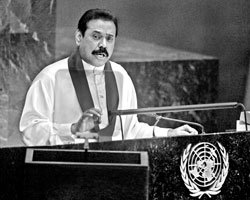
President Mahinda Rajapaksa addressing the UN General Assembly sessions in New York on Tuesday

It is strange but true. Some of the key stakeholders in the country's festering ethnic conflict -- the Government, the main Opposition United National Party (UNP) and even their protagonists, the Liberation Tigers of Tamil Eelam (LTTE) -- were making fresh policy pronouncements this week.

It comes after more than a five-year long ceasefire that remains only on paper. An undeclared Eelam War IV is raging. In the light of all this, more military and political wars are inexplicably a certainty. President Percy Mahinda Rajapaksa is for both war and peace. "We launched military operations," he told the 62nd United Nations General Assembly sessions in New York on Tuesday "to convince them (the Tiger guerrillas) that it would not be possible to obtain a military victory." Paradoxical enough, the same message he gave the UN was delivered to Rajapaksa and his own Government just four days earlier.

United States Ambassador, Robert O' Blake, declared, "The tactical successes should not tempt the Government to re-consider whether Sri Lanka's conflict can be won by military means." The US is an important member of the Donor Co-chairs who are underwriting the peace process together with facilitator Norway, Japan and the European Union member countries.

"Our goal remains a negotiated and honourable end," declared Rajapaksa setting out the second of his dual track policy at the UN. To achieve this, he pinned his hopes on the All-Party Representative Committee (APRC) by saying it is "working successfully towards it." However, there were growing new doubts over such a possible success. Barely 24 hours before Rajapaksa had spelt out his two-track war cum peace policy to world leaders and diplomats, Opposition Leader Ranil Wickremesinghe sprung a surprise. His United National Party will no longer insist on a federal solution to the conflict.

A two-page document released on Thursday explained the UNP's position. It said, "there must be a credible power sharing between the national government, Regional/Provincial Councils and Local Authorities. The Centre must identify the powers needed for the national government and parliament." The document, which was a reiteration of UNP policy, did not refer to any settlement based on a federal system.

In moving away from that previous position, UNP front liner Ravi Karunanayake was to claim that the word "federal" was put to use by the media and not by the UNP. Even if he or his party believed that would absolve them from any blame, the ploy was too transparent.

In doing so, the UNP seemed to try to harmonise itself with the position taken by the Janatha Vimukthi Peramuna (JVP). The JVP is opposed to any federal system. Like the UNP now, the JVP has stood for maximum devolution within certain confines. It was only last Sunday that JVP leader Somawansa Amerasinghe declared in a signed article written exclusively to The Sunday Times that "in our view the UNP is not capable of mobilising its membership or following on a programme of action. That is why their slogans are hollow. There is no meaningful action to back those slogans."

Here was Wickremesinghe responding in his own way to the assertions proving again that there are no permanent enemies in politics. That naturally means that the APRC, already faltering would flounder further. Thus, the question remains whether they will be able to work successfully towards any acceptable political package.

It was The Sunday Times sister paper Lankadeepa that ran the story of the UNP dropping its previous commitment to a federal solution. Interesting enough the JVP politburo was in session that day. Its leader Somawansa Amerasinghe was to say that Wickremesinghe's remarks were aimed at "getting our 37 votes." He said it was his understanding that an APRC political package to end the ethnic conflict, to be announced in November, would be within the framework of the 13th amendment to the Constitution. He said the Human Rights and Disaster Management Minister Mahinda Samarasinghe had visited Norway and was engaged in a secret exercise to resume peace talks between the Government and the LTTE.

JVP parliamentary group leader Wimal Weerawansa was stronger in his criticism of Minister Samarasinghe. He said he (Samarasinghe) had not given up his agenda to work towards becoming Foreign Minister. He failed once before, during the last Cabinet re-shuffle despite asking two leading Colombo-based envoys to espouse his case. He was now trying to play the role of a Kapuwa (broker) to revive peace talks in the hope that he would be made the Foreign Minister.

Weerawansa said it was a "crying shame the way some ministers stooped to any level to achieve their personal ends." Weerawansa was also critical of the upcoming visit by UN Human Rights Commissioner Louise Arbor. He said the Government had not learnt its lessons after the visits of Allan Rock and Sir John Holmes. JVP's foreign affairs spokesman Vijitha Herath said that if the UNP was unable to defeat the Government during the budget, UNP leader Wickremesinghe would be in "great trouble".

A discussion on the JVP's stance on the budget could not be concluded. The meeting had to be adjourned early since two of their members - Wimal Weerawansa and Vijitha Herath - were to represent the JVP at the funeral of the mother of Minister Jeyaraj Fernandopulle.

The UNP dropping the federal system of governance in finding a solution to the ethnic problem also caused some minor ripples in the Sri Lanka Freedom Party-M faction. Its convenor Mangala Samaraweera was in Galle when he read the news in the Lankadeepa. Later, he sought a meeting with UNP leader Wickremesinghe. There, the latter explained the nuances and gave him a copy of the two-page document which the party was to release later.

Samaraweera, it turned out, was satisfied that the UNP stood for maximum devolution though there was no express reference to a federal system. That exclusion, it was pointed out, did not mean any dilution in the UNP's approach to resolve the conflict, it was pointed out.

Though it was Ravi Karunanayake who was tasked to explain the UNP's position on 'federalism', it became clear that the Party was making a major re-alignment. The UNP has, clearly decided that there is an urgent need to win back the support of the southern voters, which largely eroded because the UNP was perceived as a party that took a soft-line on the LTTE.

The fact that one of the biggest debacles inflicted on the LTTE, the breakaway of the Karuna faction, was done politically, and largely due to the UNP's pursuit of peace talks from 2002-2004 has been lost on the southern polity. The fact that LTTE Leader Velupillai Prabhakaran himself indicated that he engineered the North and East boycott of the 2005 Presidential Elections to get Ranil Wickremesinghe defeated was because of the UNP Leader's "trap" for the LTTE through an international safety net, is also lost on the south.

In addition to this, what Defence Secretary Lt. Col. (Ret.) Gotabhaya Rajapaksa says, almost grudgingly, that the UNP has come to drop 'federalism' because of the military successes over the LTTE, and its popularity with the southern masses, seems to have some truth in it.

The UNP Leader was to later explain the party's sudden decision to drop the F-word from their own vocabulary. He said the party had not been using this word - federalism - in recent years. They are for power-sharing, and in their previous proposals they have not used that word. When he was asked by some ; what of the Oslo Communiqué, and whether the UNP has jettisoned that as well, he replied in the negative, and said that the Oslo Communiqué only referred to "exploring federalism".

Even more significant was the typed note released after the party felt that Ravi Karunanayake had not explained the party's position adequately. In that 'special statement', the UNP quoted its leader as saying the Party opposes separatism, and that while terrorism requires a "military response", the causes that lead to separatism require a "political solution".

It went further to say that a negotiated settlement should be based on renunciation of violence, human rights and democracy - and even acknowledged the concerns of some sections of the majority Sinhalese that devolution will lead to separatism. The party seemed to stick to its international safety net principle, which Prabhakaran called a "trap" for the LTTE, but what was equally striking was the fact that it even questioned whether the Province must be the unit of devolution for the future. "If new units of devolution are being demarcated, it should be based on political, social and economic criteria", it said.

Clearly, the UNP was aiming at winning back the lost ground of the Sinhalese vote-base in the long-term, and the JVP's support in the immediate. Menawhile, the LTTE, in a statement a day ahead of Rajapaksa's UN address, took to task the remarks made by Retired Lieutenant Colonel Gotabhaya Rajapaksa, the all powerful Defence Secretary, that "We cannot establish permanent peace in the country by winning only half or two third of the war against terrorism… President Rajapaksa cannot implement the desired political solution to the north and east conflict unless LTTE terrorism is defeated 100 per cent."

The LTTE said, "Two important facts can be gleaned from this statement (of the Defence Secretary's) that was clearly endorsed by the President himself. Firstly, that the GoSL intends to intensify the war in the north and secondly that the APRC was a façade to fool the international community."

Thus, on three key fronts - the Opposition, the LTTE and even the international community - President Rajapaksa and his Government appear to have moved into a cul de sac. Its own initiative or the lack of it has prolonged the political process. The new turn of events is making matters worse. The political process is not moving hand in hand with the ongoing military thrust. It is moving faster.

The glitter of the Big Apple, or New York, and the glamour of brushing shoulders with the world leaders and diplomats would no doubt be a lifetime experience for most of nearly 85 members of the Sri Lanka delegation. The piece de resistance, the address by President Rajapaksa, in the afternoon of UNGA inaugural alas was bereft if anything new or striking. Of course, there were a few asides.

One was a pot shot at the West in general, and probably the George W. Bush Administration, in particular. Rajapaksa declared: "Guided by the principles of Buddhism, we have long respected the rights of our fellow human beings. Therefore, it had not been necessary for us to experience global wars or the deaths of millions to, learn to recognize their value. My country has no record of inflicting misery on fellow human beings for the purpose of empire building, for commercial advantage or for religious righteousness."

The other was a lament on the issue of human rights - a subject on which the Government has come under severe international criticism. In turn, Government Ministers have also been heaping strong criticism on senior UN officials who came to Colombo to speak with Government leaders on the same subject. The last was on Sir John Holmes, the UN Under Secretary General. If Prime Minister Ratnasiri Wickremanayake called him "uncivilised," his Ministerial colleague, Government Spokesman and Chief Government Whip, Jeyaraj Fernandopulle branded him a "terrorist".

And on Monday, President Rajapaksa lamented at the UN that the "tool" of human rights was being used to victimize Sri Lanka. He said "…human rights are too important to be used as a tool to victimize States for political advantage. It is essential that international action to facilitate compliance with human rights standards is fair and evenhanded. Human rights have to be protected and advanced for their own sake, not for political gain."

The remarks would have been more credible if those front liners in the Rajapaksa Government did not brand the UN human rights officials with wild titles and hurled ugly remarks. Barely a day after President Rajapaksa and his usually large entourage had arrived in New York, than the UNP circulated a four-page document titled "Blood Brothers" to foreign missions at the UN. It said, "through this second pamphlet Blood Brothers we bring you another sordid account of the tightening grip of Rajapaksa Incorporated on Sri Lanka's polity, economy and society and the country's rapid descent into failed state status.

A potentially rich and prosperous country is today as a result of the machinations of the blood brothers facing - massive defaults in governance, a ruined economy, violation of human rights, hundreds of thousands of displaced people, a highly militarized state, widespread corruption, and the pauperisation of the people through daily increase in the prices of food, fuel and transport."

Here are some highlights of the "Blood Brothers" document:

* Democracy at Grave Risk: Serious allegations are now being made that Mahinda Rajapaksa's narrow win at the Presidential Elections in November 2005 was as a result of his "bribing" the LTTE to order its instruction to over 600,000 Tamil voters under LTTE control in the North not to vote."

* Appointment of Basil Rajapaksa: In callous disregard of democratic conventions and practice, misusing the immunity accorded to an Executive President, and in a show of unmatched arrogance of power, Rajapaksa has had the effrontery to appoint his brother Basil a Member of Parliament. He is being tipped to head an important Ministry.

* Harassment of the Judiciary: An attempt has been made to influence the decision of Magistrate (Ms Darshika Wimalasiri) on the matter of granting bail to a Minister's (the infamous Mervyn Silva) son Malaka, by threatening the Magistrate's mother on the night before the bail decision was to be given.

* Peace through WAR: While his Foreign Minister, "BOGS" (name Bogollagama shortened) preaches of a negotiated political solution to the national problem, Mahinda Rajapaksa's brother the Defence Secretary (Gotabhaya Rajapaksa), orders his troops to wage all-out war.

* Media Freedom: The Sunday Times published a report by its Defence Correspondent Mr. Iqbal Athas, on the irregularities connected to the purchase of MiG 27 jet fighters from Ukraine. Subsequent to this report, Mr. Iqbal Athas' security was withdrawn and he received death threats. Senator Jopesph Biden, Chairman, Committee on Foreign Relations, United States Senate, Joel Simon, Executive Director of the Committee to Protect Journalsits, had written to President Rajapaksa drawing his attention to the intimidation of Mr. Iqbal Athas.

There were a number of other unrelated developments too. Mangala Samaraweera had to skip the Janarala by the National Congress in Moneragala on Friday. He appeared before the Sri Lanka Freedom Party's Disciplinary Committee with a battery of six lawyers. The five-member Committee is headed by Power and Energy Minister, John Seneviratne. Samaraweera's lawyers argued that the Disciplinary Committee was not properly constituted. They argued that it was appointed by the SLFP Central Committee which in itself was illegally constituted.

His lawyers are to now submit written objections on October 15. A ruling on this is expected two days later. Thereafter, the Committee will decide the next date for its sittings. Questions were raised whether Samaraweera was still opting to be in the mainstream SLFP, despite his breakaway faction, to which Samaraweera had responded that he went for the inquiry because he respected the SLFP Constitution. That answer still did not seem to answer the question, whether he still opted for membership of the mainstream SLFP headed now by President Mahinda Rajapaksa.

Policy shifts or policy shows -

Policy shifts or policy shows -


  • President explains two-track policy to UN amidst confusion and contradiction
  • UNP explains about-turn on F-word, but issues strong attack on 'blood brothers'
  • JVP, Mangala group also take steps towards political realignments

By Our Political Editor


President Mahinda Rajapaksa addressing the UN General Assembly sessions in New York on Tuesday

It is strange but true. Some of the key stakeholders in the country's festering ethnic conflict -- the Government, the main Opposition United National Party (UNP) and even their protagonists, the Liberation Tigers of Tamil Eelam (LTTE) -- were making fresh policy pronouncements this week.

It comes after more than a five-year long ceasefire that remains only on paper. An undeclared Eelam War IV is raging. In the light of all this, more military and political wars are inexplicably a certainty. President Percy Mahinda Rajapaksa is for both war and peace. "We launched military operations," he told the 62nd United Nations General Assembly sessions in New York on Tuesday "to convince them (the Tiger guerrillas) that it would not be possible to obtain a military victory." Paradoxical enough, the same message he gave the UN was delivered to Rajapaksa and his own Government just four days earlier.

United States Ambassador, Robert O' Blake, declared, "The tactical successes should not tempt the Government to re-consider whether Sri Lanka's conflict can be won by military means." The US is an important member of the Donor Co-chairs who are underwriting the peace process together with facilitator Norway, Japan and the European Union member countries.

"Our goal remains a negotiated and honourable end," declared Rajapaksa setting out the second of his dual track policy at the UN. To achieve this, he pinned his hopes on the All-Party Representative Committee (APRC) by saying it is "working successfully towards it." However, there were growing new doubts over such a possible success. Barely 24 hours before Rajapaksa had spelt out his two-track war cum peace policy to world leaders and diplomats, Opposition Leader Ranil Wickremesinghe sprung a surprise. His United National Party will no longer insist on a federal solution to the conflict.

A two-page document released on Thursday explained the UNP's position. It said, "there must be a credible power sharing between the national government, Regional/Provincial Councils and Local Authorities. The Centre must identify the powers needed for the national government and parliament." The document, which was a reiteration of UNP policy, did not refer to any settlement based on a federal system.

In moving away from that previous position, UNP front liner Ravi Karunanayake was to claim that the word "federal" was put to use by the media and not by the UNP. Even if he or his party believed that would absolve them from any blame, the ploy was too transparent.

In doing so, the UNP seemed to try to harmonise itself with the position taken by the Janatha Vimukthi Peramuna (JVP). The JVP is opposed to any federal system. Like the UNP now, the JVP has stood for maximum devolution within certain confines. It was only last Sunday that JVP leader Somawansa Amerasinghe declared in a signed article written exclusively to The Sunday Times that "in our view the UNP is not capable of mobilising its membership or following on a programme of action. That is why their slogans are hollow. There is no meaningful action to back those slogans."

Here was Wickremesinghe responding in his own way to the assertions proving again that there are no permanent enemies in politics. That naturally means that the APRC, already faltering would flounder further. Thus, the question remains whether they will be able to work successfully towards any acceptable political package.

It was The Sunday Times sister paper Lankadeepa that ran the story of the UNP dropping its previous commitment to a federal solution. Interesting enough the JVP politburo was in session that day. Its leader Somawansa Amerasinghe was to say that Wickremesinghe's remarks were aimed at "getting our 37 votes." He said it was his understanding that an APRC political package to end the ethnic conflict, to be announced in November, would be within the framework of the 13th amendment to the Constitution. He said the Human Rights and Disaster Management Minister Mahinda Samarasinghe had visited Norway and was engaged in a secret exercise to resume peace talks between the Government and the LTTE.

JVP parliamentary group leader Wimal Weerawansa was stronger in his criticism of Minister Samarasinghe. He said he (Samarasinghe) had not given up his agenda to work towards becoming Foreign Minister. He failed once before, during the last Cabinet re-shuffle despite asking two leading Colombo-based envoys to espouse his case. He was now trying to play the role of a Kapuwa (broker) to revive peace talks in the hope that he would be made the Foreign Minister.

Weerawansa said it was a "crying shame the way some ministers stooped to any level to achieve their personal ends." Weerawansa was also critical of the upcoming visit by UN Human Rights Commissioner Louise Arbor. He said the Government had not learnt its lessons after the visits of Allan Rock and Sir John Holmes. JVP's foreign affairs spokesman Vijitha Herath said that if the UNP was unable to defeat the Government during the budget, UNP leader Wickremesinghe would be in "great trouble".

A discussion on the JVP's stance on the budget could not be concluded. The meeting had to be adjourned early since two of their members - Wimal Weerawansa and Vijitha Herath - were to represent the JVP at the funeral of the mother of Minister Jeyaraj Fernandopulle.

The UNP dropping the federal system of governance in finding a solution to the ethnic problem also caused some minor ripples in the Sri Lanka Freedom Party-M faction. Its convenor Mangala Samaraweera was in Galle when he read the news in the Lankadeepa. Later, he sought a meeting with UNP leader Wickremesinghe. There, the latter explained the nuances and gave him a copy of the two-page document which the party was to release later.

Samaraweera, it turned out, was satisfied that the UNP stood for maximum devolution though there was no express reference to a federal system. That exclusion, it was pointed out, did not mean any dilution in the UNP's approach to resolve the conflict, it was pointed out.

Though it was Ravi Karunanayake who was tasked to explain the UNP's position on 'federalism', it became clear that the Party was making a major re-alignment. The UNP has, clearly decided that there is an urgent need to win back the support of the southern voters, which largely eroded because the UNP was perceived as a party that took a soft-line on the LTTE.

The fact that one of the biggest debacles inflicted on the LTTE, the breakaway of the Karuna faction, was done politically, and largely due to the UNP's pursuit of peace talks from 2002-2004 has been lost on the southern polity. The fact that LTTE Leader Velupillai Prabhakaran himself indicated that he engineered the North and East boycott of the 2005 Presidential Elections to get Ranil Wickremesinghe defeated was because of the UNP Leader's "trap" for the LTTE through an international safety net, is also lost on the south.

In addition to this, what Defence Secretary Lt. Col. (Ret.) Gotabhaya Rajapaksa says, almost grudgingly, that the UNP has come to drop 'federalism' because of the military successes over the LTTE, and its popularity with the southern masses, seems to have some truth in it.

The UNP Leader was to later explain the party's sudden decision to drop the F-word from their own vocabulary. He said the party had not been using this word - federalism - in recent years. They are for power-sharing, and in their previous proposals they have not used that word. When he was asked by some ; what of the Oslo Communiqué, and whether the UNP has jettisoned that as well, he replied in the negative, and said that the Oslo Communiqué only referred to "exploring federalism".

Even more significant was the typed note released after the party felt that Ravi Karunanayake had not explained the party's position adequately. In that 'special statement', the UNP quoted its leader as saying the Party opposes separatism, and that while terrorism requires a "military response", the causes that lead to separatism require a "political solution".

It went further to say that a negotiated settlement should be based on renunciation of violence, human rights and democracy - and even acknowledged the concerns of some sections of the majority Sinhalese that devolution will lead to separatism. The party seemed to stick to its international safety net principle, which Prabhakaran called a "trap" for the LTTE, but what was equally striking was the fact that it even questioned whether the Province must be the unit of devolution for the future. "If new units of devolution are being demarcated, it should be based on political, social and economic criteria", it said.

Clearly, the UNP was aiming at winning back the lost ground of the Sinhalese vote-base in the long-term, and the JVP's support in the immediate. Menawhile, the LTTE, in a statement a day ahead of Rajapaksa's UN address, took to task the remarks made by Retired Lieutenant Colonel Gotabhaya Rajapaksa, the all powerful Defence Secretary, that "We cannot establish permanent peace in the country by winning only half or two third of the war against terrorism… President Rajapaksa cannot implement the desired political solution to the north and east conflict unless LTTE terrorism is defeated 100 per cent."

The LTTE said, "Two important facts can be gleaned from this statement (of the Defence Secretary's) that was clearly endorsed by the President himself. Firstly, that the GoSL intends to intensify the war in the north and secondly that the APRC was a façade to fool the international community."

Thus, on three key fronts - the Opposition, the LTTE and even the international community - President Rajapaksa and his Government appear to have moved into a cul de sac. Its own initiative or the lack of it has prolonged the political process. The new turn of events is making matters worse. The political process is not moving hand in hand with the ongoing military thrust. It is moving faster.

The glitter of the Big Apple, or New York, and the glamour of brushing shoulders with the world leaders and diplomats would no doubt be a lifetime experience for most of nearly 85 members of the Sri Lanka delegation. The piece de resistance, the address by President Rajapaksa, in the afternoon of UNGA inaugural alas was bereft if anything new or striking. Of course, there were a few asides.

One was a pot shot at the West in general, and probably the George W. Bush Administration, in particular. Rajapaksa declared: "Guided by the principles of Buddhism, we have long respected the rights of our fellow human beings. Therefore, it had not been necessary for us to experience global wars or the deaths of millions to, learn to recognize their value. My country has no record of inflicting misery on fellow human beings for the purpose of empire building, for commercial advantage or for religious righteousness."

The other was a lament on the issue of human rights - a subject on which the Government has come under severe international criticism. In turn, Government Ministers have also been heaping strong criticism on senior UN officials who came to Colombo to speak with Government leaders on the same subject. The last was on Sir John Holmes, the UN Under Secretary General. If Prime Minister Ratnasiri Wickremanayake called him "uncivilised," his Ministerial colleague, Government Spokesman and Chief Government Whip, Jeyaraj Fernandopulle branded him a "terrorist".

And on Monday, President Rajapaksa lamented at the UN that the "tool" of human rights was being used to victimize Sri Lanka. He said "…human rights are too important to be used as a tool to victimize States for political advantage. It is essential that international action to facilitate compliance with human rights standards is fair and evenhanded. Human rights have to be protected and advanced for their own sake, not for political gain."

The remarks would have been more credible if those front liners in the Rajapaksa Government did not brand the UN human rights officials with wild titles and hurled ugly remarks. Barely a day after President Rajapaksa and his usually large entourage had arrived in New York, than the UNP circulated a four-page document titled "Blood Brothers" to foreign missions at the UN. It said, "through this second pamphlet Blood Brothers we bring you another sordid account of the tightening grip of Rajapaksa Incorporated on Sri Lanka's polity, economy and society and the country's rapid descent into failed state status.

A potentially rich and prosperous country is today as a result of the machinations of the blood brothers facing - massive defaults in governance, a ruined economy, violation of human rights, hundreds of thousands of displaced people, a highly militarized state, widespread corruption, and the pauperisation of the people through daily increase in the prices of food, fuel and transport."

Here are some highlights of the "Blood Brothers" document:

* Democracy at Grave Risk: Serious allegations are now being made that Mahinda Rajapaksa's narrow win at the Presidential Elections in November 2005 was as a result of his "bribing" the LTTE to order its instruction to over 600,000 Tamil voters under LTTE control in the North not to vote."

* Appointment of Basil Rajapaksa: In callous disregard of democratic conventions and practice, misusing the immunity accorded to an Executive President, and in a show of unmatched arrogance of power, Rajapaksa has had the effrontery to appoint his brother Basil a Member of Parliament. He is being tipped to head an important Ministry.

* Harassment of the Judiciary: An attempt has been made to influence the decision of Magistrate (Ms Darshika Wimalasiri) on the matter of granting bail to a Minister's (the infamous Mervyn Silva) son Malaka, by threatening the Magistrate's mother on the night before the bail decision was to be given.

* Peace through WAR: While his Foreign Minister, "BOGS" (name Bogollagama shortened) preaches of a negotiated political solution to the national problem, Mahinda Rajapaksa's brother the Defence Secretary (Gotabhaya Rajapaksa), orders his troops to wage all-out war.

* Media Freedom: The Sunday Times published a report by its Defence Correspondent Mr. Iqbal Athas, on the irregularities connected to the purchase of MiG 27 jet fighters from Ukraine. Subsequent to this report, Mr. Iqbal Athas' security was withdrawn and he received death threats. Senator Jopesph Biden, Chairman, Committee on Foreign Relations, United States Senate, Joel Simon, Executive Director of the Committee to Protect Journalsits, had written to President Rajapaksa drawing his attention to the intimidation of Mr. Iqbal Athas.

There were a number of other unrelated developments too. Mangala Samaraweera had to skip the Janarala by the National Congress in Moneragala on Friday. He appeared before the Sri Lanka Freedom Party's Disciplinary Committee with a battery of six lawyers. The five-member Committee is headed by Power and Energy Minister, John Seneviratne. Samaraweera's lawyers argued that the Disciplinary Committee was not properly constituted. They argued that it was appointed by the SLFP Central Committee which in itself was illegally constituted.

His lawyers are to now submit written objections on October 15. A ruling on this is expected two days later. Thereafter, the Committee will decide the next date for its sittings. Questions were raised whether Samaraweera was still opting to be in the mainstream SLFP, despite his breakaway faction, to which Samaraweera had responded that he went for the inquiry because he respected the SLFP Constitution. That answer still did not seem to answer the question, whether he still opted for membership of the mainstream SLFP headed now by President Mahinda Rajapaksa.

Heavy casualties as battles in north intensify

Heavy casualties as battles in north intensify

  • LTTE adopting different tactics - new skirmishes in East and alleged plans to attack Jaffna
  • Security forces launch operation from Mannar and achieve two major objectives

By Iqbal Athas


An Army armoured vehicle on patrol in Silavathurai. Pic by Saman Kariyawasam

For the past eight days the Security Forces have continued a major thrust from their defended localities near the Western seaboard town of Mannar. Though it is premature to discuss details related to the aims and objectives since the offensive is ongoing, a look at the overall scenario in the North, including the Wanni, reveals a stark picture.

The military thrust northwards, along the landmass west of the Giant's Tank and the seas of the Gulf of Mannar began on Monday September 24. The troops are advancing in the direction of Viduthaltivu. It was only last week that I disclosed that the Tiger guerrilla activity in this coastal village was causing concern for the security establishment. This was after intelligence reports that the guerrillas were using hideouts in the neighbouring southern Indian state of Tamil Nadu to stockpile military hardware.

They were smuggling them across the shallow Gulf of Mannar. Like all their previous offensive operations, the Security Forces have not given a name to the ongoing thrust. They have carefully avoided it to prevent creating the impression that the operations are offensive in nature and pre-planned - a move that would draw adverse comments from the Sri Lanka Monitoring Mission (SLMM) that they constituted ceasefire violations. Yet, the fact that the ceasefire since February 2002 now remains only on paper is well-known.

For over a week now, the mood in areas west of Vavuniya town has changed. From some 16 miles away, within the defended localities near Periya Thampanai, ambulances loaded with wounded soldiers whiz past towards Vavuniya with their sirens wailing. The more serious cases are air lifted in helicopters to hospitals in Anuradhapura. Some of them are moved to Colombo later.

The troops are meeting heavy resistance. But they are trying to push ahead. Direct contact with their enemy is still limited. Mines and booby traps planted on their approach route caused most of the injuries. They moved cautiously to clear them when mortar barrages from the guerrillas keep falling in rapid succession. The official count has been placed at two soldiers killed and 20 more wounded. However, senior military officials in the area whom I spoke on the telephone said the figures were much higher.

On the day when this offensive was launched (Monday September 24) troops also staged attacks on the guerrillas from many other fronts. South of the Wanni, it included the general areas of Mannar, Vavuniya and Weli Oya. In one such offensive at Tampanai, an officer of the Sri Lanka Light Infantry (SLLI) has gone missing with conflicting reports about his fate. Some eye witnesses had claimed they saw him fall wounded due to mortar fire whilst others suspect he was captured. In the encounters that ensued at Tampanai, two soldiers were reported killed and 31 wounded. Attacks on guerrilla positions have also continued in Kilaly, Muhamalai and Nagerkovil areas. In Muhamalai a soldier was killed when they attacked and destroyed a guerilla bunker.

It is not immediately clear whether attacks on other guerrilla positions took place. Yesterday, Mi-24 helicopter gun ships of the Air Force were strafing several positions both north and south of the Wanni sector. On Friday Air Force jets bombed several locations in the general area of Mullaitivu. In the encounters at Kilali, according to official figures from the military two soldiers were killed and 18 wounded. Despite the string of attacks on other locations, the focus of the Security Forces, it became clear, was the thrust northwards from the general areas of Mannar.

This thrust assumes significance for a number of reasons. The recent Security Forces re-capture of Silavathurai and Arippu areas, military officials claimed, has denied them a staging area to plan attacks on the City of Colombo and suburbs. This is besides using the area as a facility to unload military hardware and medical supplies smuggled across the Gulf of Mannar. They claimed that securing the area, setting up a Police Post in Silavathurai and adopting other security measures, have provided more depth in protecting Mannar and its environs.

But a greater significance lies in securing a swathe of land north of Mannar, along the coast. Preventing guerrilla boat movements across the Gulf of Mannar, thus restricting logistics supplies is just one reason. However, a more important reason in securing a substantial stretch along the western seaboard (north of Mannar) would be the great advantage it affords the Security Forces. This is in preventing the exodus of refugees to South India - a serious cause for concern for both the Central Government in India as well as the State Government in Tamil Nadu. Hence, achieving the twin objective of blocking the induction of supplies into Sri Lanka and preventing an outflow of refugees will bolster the Government's plans to step up the military offensive against Tiger guerrillas in other areas in the Wanni and the North.

This naturally imposes considerable pressure on the Liberation Tigers of Tamil Eelam (LTTE). Unlike in the East, where it had not dominated territory and consolidated its position, the Wanni, the focus of major military thrusts, remains different. Having taken advantage of the Ceasefire Agreement of February 2002 that conferred a vast landmass for them in the Wanni, over the years the LTTE had built up a vast infrastructure.

They include their own "tax collection machinery, a police service, a judiciary, prisons, an administrative structure" and other measures that have prompted the guerrillas to say they were virtually a "State in waiting." Hence, the battles in the Wanni are so different from those in the East. They are not battles to keep or lose territory but to defend a successful structure they have efficiently built up during more than five years of the ceasefire. This is why they have offered fierce resistance to prevent any incursion by the Security Forces.

This is why slowly but surely some of the ground realities are changing, at least for the Tiger guerrillas. Conversely they have become a puzzle for the State intelligence agencies. The biggest question for them is whether the guerrillas would soon cross the threshold from maintaining a stricter defensive posture to assume an offensive role. Though it may not assume conventional proportions, there are increasing signs the guerrillas may be moving in this direction.

One is a move to destabilise the Government-controlled Jaffna peninsula. Intelligence sources say there has been a marked increase in the infiltration of cadres into the peninsula through Thanankilappu and Ariyalai, across the Kalmunai Point that is separated by the Kilali lagoon. The guerrillas, they say, have been continuously monitoring Naval movements in the area. The guerrillas have also been positioning artillery at Kalmunai Point and neighbouring Nagathevanthurai that lay in the tongue-shaped stretch of land south of the peninsula.

There has also been infiltration of guerrilla cadres to the outlying islands. "Even if the build-up is not to stage a conventional style attack, which is difficult for them, the plans may be to trigger off improvised explosive devices and other attacks to cause instability," warns an intelligence source familiar with guerrilla plans in the North. He says this is mainly to distract the Security Forces whose focus now remains the North, particularly the Wanni region.

Coupled together with reports that the guerrillas are planning attacks on both economic and military targets in areas outside the North and East, the threat in the peninsula has to be viewed seriously, says the source. Here again, the idea is to distract the attention of the Security Forces by creating situations where they will have to deploy elsewhere. Contrary to claims that the guerrillas have lost their capability to carry out such attacks, the same source adds, "it only takes one or two of them (the guerrillas) to trigger off some thing." We will need large numbers to keep them on the hop. That means we have to continue at a very high level of alert all the time, he points out.

In the light of this, there are other significant developments too. Though still not on a highly worrying scale, small numbers of guerrillas have become active in all three districts of the East - Trincomalee, Batticaloa and Ampara. In Trincomalee there have been reports of guerrilla intelligence cadres moving around in the Trincomalee town and Tampalagamuwa areas. They are also said to be active in Kumburupiddy, Kandalkadu and Kantale where groups had infiltrated civilian settlements.

For the first time since the re-capture of Toppigala in July this year, small groups of guerrillas had also returned to the Batticaloa district. They were reported to be moving around in Kokkadicholai and Vavunativu. Since troops moved into Toppigala, the guerrillas stepped up increased intelligence activity in Ampara. Guerrilla cadres have also had a string of skirmishes with commandos of the Police Special Task Force (STF).

Besides the very logical move of again distracting the attention of the Security Forces to the East, the guerrilla activity there, though small but growing, portends other serious problems. Main among them is a gradual build-up by the guerrillas, though under pressure in the Wanni, to destabilise the area. This is to achieve the twin objective of stalling the Government's ambitious development programme for the East as well as make it difficult for the conduct of local, and thereafter, the Provincial Council elections in the East.

The onerous task of holding Batticaloa, the pivotal district, has thus fallen on the Special Task Force. This is after Security Forces deployed in that area were gradually re-deployed for operations in the North. In the past weeks, even those who had retired from the STF have been re-called and offered placements in the district with attractive incentives. This is whilst the security establishment has set in motion an unpublicised move to gradually remove armed paramilitary groups from operating in the area.

In this backdrop, one of the key players, Karuna alias Vinayagamoorthy Muralitharan has left Sri Lanka. During his stay of over an year, he not only enjoyed heavy protection but also visited camps of his cadres in the East. He also visited the political offices of the Tamil Makkal Viduthalai Pulikal (TMVP), his political party that has several offices in the East. Karuna's group was accused of a number of killings, kidnappings and abductions. Some of them were political whilst others were reportedly for extortion of vast amounts of money.

The move to rid the east of armed groups will be no easy task for the Government since the arms they carried were enormous in number. Thus, even if the paramilitary cadres that backed the Government would no longer be active, a process that will be largely time consuming, a bigger question would be how their arms are to be collected. If past experience is anything to go by, some of them may be sold to the underworld of criminals for a price - a further sophistication of the underworld modus operandi which has changed long years before from clubs and iron rods.

The military thrust near Mannar came just one day ahead of President Mahinda Rajapaksa's address to the 62nd session of the United Nations General Assembly in New York. He spoke on Tuesday afternoon (September 25). In a speech that clearly endorsed the view of his brother and Defence Secretary, retired Lieut. Col. Gotabhaya Rajapaksa, he said, "terrorism any where is terrorism. Sri Lanka has taken an upfront position in the global community's efforts to deal with terrorism….."

He said, "Solutions sought for conflicts in various countries, must be indigenous. Otherwise, even if the international community is appeased, people in countries saddled with conflicts will not be satisfied. This will be a blow to democracy." Barely two weeks earlier, Defence Secretary Rajapaksa had declared that the Tiger guerrillas have to be defeated "100 per cent" for peace to return.

Also a day ahead of President Rajapaksa's speech to the UN, the LTTE issued a lengthy statement to set out its position vis-à-vis a number of issues. The statement said it was clear from the remarks made by Defence Secretary, Gotabhaya Rajapaksa, that the Government intends to intensify the war in the North. Secondly, it said, that the All-Party Representative Committee, which is formulating political proposals to end the ethnic conflict, was a "facade to fool the international community." Thus, the LTTE summed up its stance.

A rejoinder on what is to follow came again yesterday. That was also from Lt. Col. (retd.) Gotabhaya Rajapaksa, the Defence Secretary. He declared that the date for the end of the separatist war was not far off. The occasion was a ceremony at the Headquarters of the Sinha Regiment at Ambepussa where troops were remembering their dead colleagues. Their next of kin of those who died were present to hear the Defence Secretary make the pledge. That can only mean more fighting with Tiger guerrillas is a certainty in the coming weeks.

Friday, September 28, 2007

Snakes of Sri Lanka - 11

Snakes of Sri Lanka - 11

----The Friday' News Paper

Yellow Bellied Sea Snake (Pelamis platurus) Badakaha Muhudu Naya

The only known pelagic specie of sea snake and the sole specie of the genus Pelamis, this snake are easily identified by its characteristic bright yellow underside which could well be an adaptation to protect it from predators for it provides adequate camouflage against the water when seen from below. This snake has a dark dorsal colouration and some may have spots on their tail. Such a colouration would come in handy while ambushing fish. It is a relatively small snake with a slender body and prominent caudal fin, which is in fact its modified tail. This snake is nearly incapable of terrestrial locomotion.

It is a very powerful swimmer but can also float. It prefer the continental shelf but and is occasionally recorded far out in the open ocean which would explain its wide distribution. This snake is capable of cutaneous respiration (directly absorbing oxygen from water) and can remain submerged for up to 3 hours. It is highly diurnal and often spends the night on the seabed. This snake is highly docile in nature and most likely to ignore fishermen who may handle it with impunity.

This specie feeds exclusively on fish. It ambushes its prey which it kills relatively quickly using its highly potent venom.

This snake is viviparous. The brood size is small and within the range of 2 to 10. It does not seem to have a definite breeding season and its reproductive habits vary along its wide distribution. Apparently those that inhabit Sri Lankan waters tend to give birth between January and March when the seas are calm during the inter monsoon phase. The gestation period of these snakes is uncertain and most possibly in the area of 5 to 6 months.

Upon birth, neonates measure between 220-260mm. This snake grows to a maximum length of around 100cm and reaches sexual maturity when over 60cm long.
The lethal venom possessed by this snake is capable of killing a human being within 2 hours.
The venom is neurotoxic yet only a handful of fatalities have been attributed to this snake.
Unfortunately in Sri Lanka specimens that get accidentally caught in fishing nets are occasionally sold as “exotic eels.” There have been cases where people have died after consuming flesh and foetuses of this snake.

This snake can be identified at a glance due to its unique and distinct yellow ventral colouration. Found in the Indian Ocean, Australia, New Zealand, and northern Pacific Ocean from Japan to the western coast of North America. It is an abundant specie with a low risk designation.
A fairly common specie in Sri Lankan waters, often found around the continental shelf. May venture close to the beaches where it often gets caught in fishing nets.

Buff-Striped Keelback (Amphiesma stolata) Aharakukka

A small snake with a slender body and elongated, sharp snout, the Buff-Striped Keelback’s body is often light brown or buff with darker stripes. Its underside is greenish brown or pale brown and head uniformly light brown. The colour of this snake may vary from greenish brown to olive brown. Its slender body is well equipped for high speed movements which it requires during hunting and evasive action while its colouration gives it superb camouflage.

This snake is reputed as one of the most inoffensive of snakes. Many of its local names convey its innocent nature. Often it is referred by the locals as the “the snake that cannot kill” in their native tongues. This snake is diurnal by nature but may hunt at night if highly rewarding. Often frequenting near puddles and areas where frogs take refuge but very rarely enters the water itself. Humans frequently come in contact with this snake and in response it will dart out of danger and hide itself in neighbouring vegetation. If captured it will make no attempt to escape and will not attack even if viciously molested.

This snake feeds almost entirely on frogs. Its preference for frogs is due to the fact that unlike mammals frogs put up little or no resistance once captured. However this snake itself is preyed upon by many larger and fierce snakes, due to its small size and inoffensive nature.

The reproductive habits of this snake vary considerably due to its wide distribution. Mating takes place during the hot months prior to the monsoonal rains during which the snake reduces its amount of activity. In most areas this is between April and June and in Sri Lanka it is between February and May. As soon as the frequency of showers increases and the sporadic showers intensify these snakes emerge from their hiding places in their thousands. The eggs develop within the females for around two months and are ready for discharge by August. The clutch is usually between 4 and 10 but females are capable of producing up to 14 eggs. The female incubates the eggs for another 30 to 35 days until hatching.

Hatchlings of this specie on average measure 150mm. These snakes immediately start to feed on large insects, lizards and earthworms and are in turn preyed upon by large frogs, birds and other reptiles. Those that manage to survive their first year double their length. During the second year of life these snakes continue to grow at a rapid rate and reach sexual maturity when they are three years old. By then they measure on average 45-50cm. Females are generally longer than males. The longest males seldom exceed 55cm while females often reach 60cm or more with occasional lengths of 70cm. This snake is non-venomous.

The lateral light brown or buff stripes which run along the entire body length of this specie often give away its identity at a distance. Its comparatively large eyes are also a good indicator.

Distributed in South Asia, South East Asia, Southern China and Taiwan.
A common and ubiquitous snake in Sri Lanka with a near island wide distribution except for the extreme north and highest peaks of the central hills. It is commonly found around paddy fields, cultivated areas and marshes. If an area has a healthy population of frogs the chances are that there is an equally healthy population of this snake. This snake is becoming exceedingly rare in urbanized areas and fails to thrive in such places most possibly due to lack of suitable prey.

The Greenwich Royal Observatory - Timekeeper to the world

The Greenwich Royal Observatory
Timekeeper to the world

-- Friday' News Paper

Greenwich is a lovely peaceful village about 15 miles from Central London on the south bank of the River Thames. The village is famous for the buildings of the National Maritime Museum, the Royal Naval Academy and the Royal Observatory sitting on a beautiful hilltop in Greenwich.

The observatory building was built by the great British architect of the 17th century, Sir Christopher Wren in 1675. Parts of the old observatory are now a museum and called the Flamsteed House.

Thousands of visitors who arrive at the Greenwich observatory can see the big clock-face showing the Greenwich Mean Time (GMT) and the Greenwich meridian marked on the ground from which the longitude is measured.
The Flamsteed House has now put up a millennium e-clock showing the time, date and year with an accuracy of a millionth of a second.

What is a Meridian?
A meridian is an arbitrary north/south line chosen by an astronomer. With a telescope or quadrant positioned on a meridian, the astronomer can measure the exact moment the stars and planets cross, or transit the sight of the instrument.

By comparing thousands of observations taken from the same meridian, it is possible to build up an accurate map of the night sky. In the past many meridians have been used by astronomers, Greenwich was recognised as the home of the Prime Meridian, or Longitude 00 in 1884.

Centre of Transit
Circle
Latitude: 51” 28’ 38” North
Longitude: 0” 00’ 00”

Courtesy: Encyclopaedia Britannica

A view of Central London (background) and the Maritime/Naval buildings
from Greenwich

Reflector 40’, the largest telescope at the time

GMT clock and British units of length and weight specimens

Edmond Halley
(1650-1742 AD)

Edmond Halley’s Tombstone:
The Latin Inscription reads:
“Beneath this gravestone, Edmond Halley, unquestionably the most eminent of the astronomers of his age rests peacefully with his dearest wife so that the reader may know what kind and how a great man [Halley] was, read his various writings in which he dignified, embellished and strengthened almost all the arts and sciences.
And, therefore, as he was a man so greatly cherished by his fellow-citizens during his lifetime, so let a grateful posterity venerate his memory. Born in the year of our Lord 1656. Died 1741/2. This stone was consecrated to excellent parents by to devoted daughters in the year 1742.”

Myanmar: Military response to snowballing public protests

Myanmar: Military response to snowballing public protests
- Daily Mirror
By Col R Hariharan (retd.)

After seeing the massive participation in the public protest led by the monks against the military regime, in which as many as 100,000 people of Yangon took part on eighth continuous day on September 25, 2007, the military regime slapped a dawn to dusk curfew in the capital and moved in troops. With the stage set to confront the defiant monks, the troops prevented them today from getting out of the Shwedagon pagoda, the holiest Buddhist shrines in Myanmar. Troops have been stationed in strength to control such movement of monks in Sule pagoda and other vantage points in the city.

The monks’ action has highlighted the cause of the democratic struggle in Myanmar particularly when world leaders had assembled at the UN General Assembly. The mounting public protests have set off a lot of activity in diplomatic circles not only in Washington and Beijing, but also in the UN.

The US President George W Bush speaking at the UN called upon all nations to “help the Burmese people reclaim their freedom” and announced fresh sanctions against the ruling junta, their supporters and families by slapping a visa ban and targeting the assets of people related to the regime. This is of significance because in the past the US had been a favourite destination for the education of the children of ruling elite.

Though the monks had tried to keep their protests free from politics, the agitation assumed political overtones when on September 22, 2003 about 1000 protesting monks met pro-democracy movement leader Aung San Suu Kyi behind a security barricade at the gates of the house where she is kept under arrest.

The faint hope of the people that the military regime was going soft by allowing the protestors to see Aung San Suu Kyi was belied when no marchers were allowed near the house on the following days.

The All Burma Monks Alliance had exhorted the people to speedily form a Peoples Alliance led by the clergy to fight against military despotism, their common enemy in a statement issued on September 21, 2007. The strongly worded statement called for a peaceful struggle against ‘the evil military dictatorship till its complete downfall.’ It said the Alliance would take the initiative to speed up the formation of ‘a disciplined and united people’s alliance. The military regime perhaps made up its mind to order the troops to curb the protest marches after this call from monks to the public. With the imposition of curfew and restricting the movement of monks the regime has now made it clear that it would tolerate no more marches.

How will the regime react if the monks come out in defiance in large numbers? This is a question waiting to be answered in the coming days because that would decide the future of the fate of the democratic struggle as a whole.

According to what is purported to be the minutes of a high level briefing of battalion commanders in October 2005, the Myanmar War Office had assessed ‘agitation through its citizens’ as one of the three ways in which the US might “invade” Myanmar to topple the regime.

The other options in this assessment were: invasion in alliance with insurgents and ceasefire groups or through a multination led invasion. (And Thailand, the strategic ally of the US on Myanmar border was considered the “nearest enemy” in this document.) If this report is correct, the regime has every reason to react strongly to the current agitation of monks even though its political contours or line up are not clear.

So it is not surprising the regime is, not only seeing, but believing the escalation of the public protests as a US inspired plot to bring down the regime as it coincided with the UN General Assembly meeting. This belief could cloud its assessment of the actual situation.

There should be no doubt about the regime’s capability to let loose the security forces to crush the protestors as it did in 1988 when 3000 protestors were killed. However, taking such an action now, after nearly two decades, might not be as simple as it was then. The world and in particular the strategic neighbourhood of Myanmar has changed with Myanmar having better relations with not only China, but also India and the ASEAN. The ambition of the regime’s mentor and friend China, which were local in 1988, has now become global. So it will be different strokes now in every direction.

The China card


China has proved to be a trusted ally who had baled out Myanmar in the UN Security Council early this year. Though the regime had taken action to broaden its relations with India and ASEAN (particularly Thailand) within the ruling junta the China lobby has considerable influence. So the military junta would not want to take any precipitate action that might antagonize China.

So far the reaction from China to the developing situation had been muted, with the stress on maintaining “stability” in Myanmar. But it might not be so if the situation turns bloody and China is saddled with the embarrassing job of once again defending the regime globally, particularly when China is already doing it for the regime in Sudan. However if the regime’s survival is threatened as it happened after the 1990 election, the regime is likely to come down heavily to silence the protestors. In such a setting, the Chinese response would be carefully calibrated upon how quick and successful the regime is in silencing the protests and cleaning up the after effects rather than solely upon international sensitivities.

China holds the vital reins of economic, trading, military, and developmental sectors of Myanmar in its hands. Many of the officers have undergone military training courses in China. Myanmar’s weapon systems are mostly Chinese. Considering its overwhelming interests in Myanmar, China would prefer a client regime than an uncertain democratic regime which is more likely to become the darling of Washington. China has been cultivating an international image and has been making conciliatory noises with its neighbours including India. China has to see the Olympics safely through, as it expects it to boost not only the international image but also its national self image. In spite of all this, China is likely to leverage its influence in Myanmar only when it is directly benefitted.

In other words, China is not going to play the game according to what Washington or the EU desires but on its own terms. However, we can expect China to present the visage of a rational and balanced power in handling the Myanmar issue even though it may not toe the Western line.

There is a large ethnic Chinese population involved in trading activity in many Myanmar towns. There had been some reports of anti-Chinese protests. The protest marchers also had converged outside the Chinese embassy on one or two occasions. However, this is unlikely to be a major issue in the overall anti-government protests if the Chinese make the right moves. After all, even if a democratic government comes to power, it needs a friendly rather than hostile China on its borders. The Chinese are likely to factor this in giving shape to their Myanmar policy.

INDIA - Will Lord Ram again bring back BJP government?

Will Lord Ram again bring back BJP government?

By M.S.Shah Jahan

"Party workers should be prepared for an early poll to the Lok Sabha. Left parties' opposition to the Indo-US nuclear deal and Tamil Nadu's ruling party's attempt to destroy Ram Sethu would bring a radical change in the Indian politics”. Advani claimed that the Lok Sabha polls could take place in 2008. Lashing out at the Centre for questioning the existence of Lord Ram in an affidavit before the Supreme Court, he said Prime Minister Manmohan Singh and UPA chairperson Sonia Gandhi should apologise for hurting the religious sentiments of Hindus.

The Congress government that has been batting - or battling against the Left parties over the Indo-U.S. civilian nuclear deal, all of a sudden finds itself trapped before the arrow wielding Lord Ram.

To Mr. Advani this is a Ram sent golden opportunity and he lambasted the government in Tinnevelly and Bhopal like Yuvaraj Singh hit sixers after sixers in Durban, and Cape Town. The way Communists are confronting with the center, accused of being instigated by China and Russia, it is believed by many that the government will face an election in summer 2008 instead of 2009.

The Marxists argue that the nuclear deal is less favourable to India and more to US. But one has ample reasons to wonder whether the indigenous Congress is less patriotic than the foreign doctrine Marxists who decorate their office with pictures of Lenin and Carl Marx not Gandhi and Nehru. The intensive campaign carried out by the Left by organizing road shows and rallies right from Bengal to Kerala made people wonder whether they are in the opposition. They also sent their best known faces to countless TV stations to articulate the Left’s point of view on the matter.

The latest in this tidal red wave is, the upcoming compilation of the CPM General Secretary’s articles and views on the nuclear deal in the form of a book. Marxists are masters in propaganda by nature. But the government’s response to Left propaganda is lukewarm.

The Vishwa Hindu Parishad along with allied Hindu groups succeeded in primarily bringing the Ram issue to the centre stage of national politics, by showing force across the country and causing complete disruption of traffic and daily life in most cities. The true beneficiary of this agitation is undoubtedly the BJP, which having tasted electoral success after the Babri Masjid demolition and the Godhra massacre and the ensuing riots, once again wants to bring Hindutuva – on which it finds itself more comfortable, rather than raising issues like cost of living, flood relief, corruption and jobless when it goes to the electorate.

Having used the potent mix of religion and pseudo-secularism the BJP feels now the Ram Sethu issue will help in uniting the Hindu vote to rally behind the party.

On the day the whole country was witnessing an agitation on this very issue, the government, through the Archeological Survey of India told the Supreme Court that the Ram Sethu was not a man made structure and that there was no proof of the existence of the mythological figure of Lord Ram except in some texts, by making it far more emotive than what a one day agitation would have otherwise done.

The BJP is raking up this statement as an example of the disregard by the UPA for the largest religious block in the country, but with elections at least 6 to 18 months away, how relevant this issue will remain is debatable. It seems the largest opposition block is looking for divine intervention for its quest for power. They have succeeded earlier, will they now is yet to be seen. What is Tamilnadu Chief Minister M.Karunanithi’s contribution to this squabble? In a way he is the one who let this controversy go deeper. Sethu Samuthram Project is more or less DMK’s life time goal.

While keep telling that the bridge is defined officially as Adam’s Bridge, in an angry mood, he crossed the mark saying, ‘there was no historic proof of Lord Ram's existence.

There was also no proof of Lord Ram having constructed a bridge and being an expert in engineering. You tell me whether Rama lived. There was no person in the name of Lord Ram’. This made the slumbering BJP dog to stand up like a horse. Karunanithi is an atheist by nature being a follower of E.V. Ramasamy Nayakkar, known as Thantahi [Father] Periyaar, who declared that those who believed in god were fools. He considered the Ram epic as a symbol of North India’s Aryan domination over Southern Dravidans. He held Ram processions where he hit Lord Ram’s statue with slippers. Actor M.R. Radha, father of Annamalai fame actress Radhika of a Singhalese mother, was too an ardent follower of Periyaar and he staged many dramas, propagating Periyaar’s progressive thoughts, condemning superstitions and age old customs and rituals, including one drama called ‘Keemayanam’ that despised the mythology of Ramayanam.

When reporters asked Karunanithi whether his vote bank would be affected because of Ram issue, he replied ” in the general election after the demise of Annadurai, Periyaar, in the hands of whom Ram suffered a lot, supported us and we won with big majority”. Besides, Ramayana has many versions and contradictions but what wrote by Valmiki is accepted as the best. Funnily one Ramayana says Lord Ram’s father King Dasaratha had 10,000 wives. Oh Ram, is it feasible? If so how did he divide his time for 10,000 nights of 27 years? India is a country in which still many in rural areas are ignorant that Mrs. Indira Gandhi had died, as per a survey some time ago. When it is so, how can we expect people from North India, 3,000 miles away, to know about the coast that could be stretched to Lanka thousands of years ago? How many days Lord Ram’s travel group would have taken to reach the place under primitive travel condition? From where did they bring the necessary materials and laborers? Could Hindi speaking Northerners have interacted with Tamil only speaking workmen? In Hindi there is a slang ‘doing Lanka’ – means burning.

Ramayanam says Lord Hanuman burnt Lanka with fire in his tail, and also the followers argue that in Sri Lanka there is a place called ‘Sita Vanam’ [forest] where Sita Devi was kept in isolation. It could be. But in Lanka there is no trace of being burnt by Lord Hanuman. Another question arises that King Ravana who is described to be pious and ardent devotee of Lord Siva, will immorally abduct another man’s wife?

Amulya Ganguli a political analyst wrote in the New Delhi News Net on the 22nd instant, that Ram Sethu issue could lead to Hindu vs Hindu clashes. ‘”The BJP's Ayodhya agitation was based on the propagation of the belief that the Mughal emperor, Babur, had built the Babri Masjid at the site where Lord Ram was born. Similarly, the Ram Sethu issue is based on the conviction that this 'natural formation' comprising coral reefs and sand banks, which is also known as the Adam's bridge in the Palk Strait, is the mythical bridge built by Ram's simian militia when the Hindu deity went to Sri Lanka to rescue his abducted wife, Sita, from the demon king Ravana. There is no Muslim involvement here Romila Thapar, well-known historian in her book 'Early India', says that 'the conflict between Ram and Ravana probably reflects an exaggerated version of local conflicts, occurring between expanding kingdoms of the Ganges plain and the less sedentary societies of the Vindhyan region ... the transference of events to a more southerly location may have been the work of editors (of the Ramayana) of a later period, reflecting an expanded geography, as was possibly also the case in the depiction of Lanka itself as a city of immense wealth'.

Even Vajpayee government took up Sethusamudram project with the insistence of Vaiko and the DMK. Though no fund was allocated, papers were readied and in no place it mentioned that the bridge built by Lord Ram should be spared. There was plenty of stone throwing that tensed the country, between both sides especially from the DMK front and the BJP, the party once late minister Maran described as ‘not untouchable’ before joining their cabinet, which has become untouchable now. The Center’s decision to withdraw affidavit from the court clearly showed their reluctance to burn the candle in both sides that is with the Marxist on nuclear issue and the BJP on Ram. But Lord Ram has not let down the Congress too.

The Left is now softening its stance on nuclear issue fearing an immediate election might give a swing to BJP. Therefore they have become the spokesmen for Sethusamudram project and demand it should go on regardless to any objection from any back ward quarter. Responding to a statement by Mr. Advani over possible mid-term polls, Mr. Prakash Karat, General Secretary of Communist Party of India (Marxist) said. “Advani has a direct connection with divinity. The general elections would be held in 2009 only”. This angered Advani and he in turn attacks the Left too mercilessly. The BJP leader, who wanted the destruction of a Mosque to win an election, now wants a groundless bridge to be restored to win election. In the mean time Tamilnadu government has declared a full day strike on Monday 1st October to show the state’s solidarity on Sethu Samuthram demand.

The Congress is also aware that the community of scientists and historians will be outraged if the party endorses the saffron brotherhood's assertion that the 1.7 million-year-old 'bridge' is man-made - or monkey-made. All the religions have some revered beliefs - miracles that can not stand scientific tests. To believe or not is one’s contention. But it is not one’s business of pushing it down others' throats.

Democracy, democracy, no it is oil, oil in Myanmar

Democracy, democracy, no it is oil, oil in Myanmar - Daily Mirror

As thousands of Buddhist monks chant 'democracy, democracy' in Myanmar, which many still fondly remember as Burma, 'oil, oil' must be the words being uttered by world leaders contemplating on what to do with or how to respond to events unfolding in the poverty-stricken Asian country.

Who says that it is humanity's concern for fellow human beings that leads to humanitarian intervention? The plight of an oppressed people matters only when it serves the intervening power.

No country wants to risk sending its military to free the oppressed in another country unless economic benefits are associated with such a move.

The situation in Myanmar certainly warrants international intervention. Myanmar's people cry for freedom — freedom from oppression of the junta which is corrupt to the core. But there won't be a military intervention — a la Operation Iraq Freedom. One of the justifications the Bush administration offered in defence of its illegal invasion of Iraq was that the people of Iraq was being oppressed and needed to be freed. But such claims were nothing but an attempt by an arrogant superpower to add a veneer of morality to its preposterously immoral acts.

The people of Myanmar also want democracy. Why is there no attempt to build an international coalition to militarily intervene in Burma and introduce democracy? For 42 years, Myanmar has been under the sway of the military, but the efforts of the international community in restoring democracy in that country are shamefully wanting. In other words, there have been no genuine efforts. There will never be as long as Myanmar's junta is protected by C-China, a nuclear power and rising superpower. The letter C before China could denote anything but the word 'communist', the politically loaded adjective with which it used to strut about at world fora. The words 'capitalist' or 'compromising' could be ideal alternatives.

Any US or Western unilateral attempt to militarily intervene in Myanmar, like they did in Iraq and the Balkans before that, will trigger a major conflict, because for China, Myanmar is too dear a property to be handed over to the West on a platter.

China and Russia have expressed their opposition to tough new measures against Myanmar in the face of ongoing crackdown on Buddhist monks and political activists.

President George W. Bush addressing the United Nations on Tuesday called for new sanctions on Myanmar's ruling junta and urged global pressure for democratic reforms to end the junta's decades-old "reign of fear". But the measures he announced — a tightening of existing economic sanctions and expanding a visa ban on the top leadership — appear cosmetic. Economic sanctions will certainly increase the woes of the poverty-stricken people of Myanmar, which was once regarded as the rice bowl of Asia. Today, its per capita income is a measly $175 dollars, much less than neighbouring Bangladesh.

Myanmar's military leader General Than Shwe, a 70-year-old psy-op expert, could give his daughter a six-rope diamond necklace as one of the wedding gifts, but many Myanmar people live below the poverty line. They have access to electricity only two hours a day, although Myanmar is blessed with an accursed liquid — oil — the hunt for which is the prime cause of many modern-day conflicts.

The West, with its eye on oil, will not act tough. If it does so, it will only increase the junta's ties with China. The people of Myanmar say soon China will own Myanmar. They call China 'Big Daddy'. In an interview with the New York Times last year, one woman called China a good friend of the Myanmar government, not its people. "They are like brother and brother-in-law," she said of the two governments.

The energy rush

The junta feels more secure than ever because they know all big powers want a share in the oil pie. In the 1990s, huge pockets of natural gas were found in Myanmar which also has vast reserves of offshore oil.

The discovery of oil and gas changed the way regional and global powers looked at or dealt with Myanmar. It is true that since the energy rush, the western and regional powers have been criticizing Myanmar for its human rights record. But such criticisms end at lip level. They are not converted into tough meaningful actions, like the way Saddam Hussein's Iraq had been subjected to, at the cost of half a million deaths of Iraqi children, for 12 long years. Instead of any military action on humanitarian grounds, all regional and global powers jostled to sign oil and gas deals with Myanmar. Even India, the largest democracy in the world, abandoned its policy of supporting the democracy movement in Myanmar. Even as the Buddhist monks were taking to the streets in protest last week, India's Energy Minister was in Myanmar, negotiating multi-billion dollar gas deals.

China, of course, has the biggest share in the pie. It is planning to build a major plant at Sittwe, to send oil not only from Myanmar but also from Middle East to China via a new pipeline.

The Bush administration has been trying to edge out China. It knows it cannot do this with its military might. So it is whipping up international action and supporting the democracy movement led by Aung San Suu Kyi, the Nobel Peace laureate who has been spending the past 17 years under house arrest. Last year, at the APEC summit in Hanoi, President Bush failed in his effort to get the Asian Pacific states to back his move to condemn the junta, because, besides China, countries such as Singapore, Malaysia, Indonesia Australia, Thailand and Canada, did not want to antagonise the Myanmar regime and lose their business interests. China, especially, regards the region as its domain. Southeast Asia is to China what the Middle East is to the United States. It will not allow other big powers to dominate the region. As things stand today, China feels its interests are best served under a military junta.

China probably feels that a democratic Myanmar can produce a set of rulers who will soon pay obeisance to Washington in return for green bucks. Until and unless the Chinese are certain that democracy will produce a pro-Beijing regime, they will protect the junta, come what may.

But this does not mean, China and the Myanmar junta have blocked the other players from entering the energy sector. Yes, the Untied States, Britain and France are all there. Incidentally, it is these three countries which this week assumed moral high ground to condemn the Myanmar military and called for tough international action.

Since Myanmar liberalized its investment code in late 1988, it has attracted its largest foreign investments in the energy sector. Among those companies that have signed oil and gas exploration contracts with Myanmar are France's Total SA, Chevron of the United States, Malaysia's Petronas, Thailand's PTT Exploration & Production PCL, Daewoo of South Korea, Rimbunan Petrogas Ltd of British Virgins Island and UNOG Pte Ltd of Singapore. Myanmar has also signed deals with companies from India, Australia, Canada and Indonesia.

Russia also a major player

France this week called on Total SA to withdraw from Myanmar. But Britain and the US have avoided similar measures. France could do that because Total's investment in Myanmar is an insignificant portion of its global operation. But US oil giant Chevron, formally Unocal, cannot emulate Total. Chevron is developing Myanmar's Yadana offshore gas field. Britain, meanwhile, ranks as the second largest investor in Myanmar, its former colony.

It is not only China and the West that play oil politics. Russia is also a major player. Last year the number two in Myanmar's military junta visited Moscow and signed a series of gas and oil contracts with government and private investors. Russia is also a major arms supplier to Myanmar.

The speed with which the junta signed these deals with foreign companies have led to allegations by the Myanmar people that the ruling cabal — a 12-member State Peace and Development Council — are enriching themselves by allowing multinational corporations to ruthlessly exploit the country's national wealth.

Incidentally, it is the junta's decision to increase the fuel prices by 500 percent that led to the present protests by the monks.

So it is once again oil politics that shapes international and Myanmar's politics. Myanmar's pro-democracy movement is being crushed and the junta is having a hearty laugh at the failure of the United States and other big powers to prevail on them.

Generational challenge of global climate change

Generational challenge of global climate change

By Robert Blake
Ambassador for United States of America in Sri Lanka & Maldives

On September 27-28 in Washington, D.C., the U.S. will host the Major Economies Meeting on Energy Security and Climate Change, an initiative based on the fundamental premise that climate change is a generational challenge that requires a global response. This meeting is the first in a series of gatherings that will include 17 of the world’s major economies, developed and developing, as well as the United Nations. Combined, all participating countries represent about 85 percent of the global economy and 80 percent of global carbon dioxide emissions.

This new international initiative was endorsed by G-8 leaders in June and by the 21 Asia-Pacific Economic Cooperation (APEC) Leaders in Sydney, Australia earlier this month. The Major Economies Meeting later this week at the UN General Assembly will move that initiative forward.

The Major Economies Meeting process will support United Nations climate talks by bringing together major economies to develop consensus on key elements of a new framework on climate change. Agreement among the major economies will benefit all nations and contribute to a new global agreement under the UN Framework Convention on Climate Change by 2009.

There is already international agreement that addressing climate change requires a combination of actions that protect the environment, encourage economic growth and ensure energy security. Likewise, there is common recognition among nations that climate change is a complex and long-term challenge. Nations around the world are already working in partnership to find the technological solutions that hold the key to reducing greenhouse gases in our atmosphere. Our goal for this week’s meeting is to launch a process by which the major economies will, by the end of 2008, agree on key elements of a post-2012 framework, including a long-term global goal and nationally defined mid-term goals.

We expect to put special emphasis on how major economies can, in close cooperation with the private sector, accelerate the development and deployment of clean technologies – a critical component of an effective global approach to reducing greenhouse gas emissions. We will construct work programs for key sectors such as advanced coal and transportation, and we will agree to strengthen emissions reporting and harmonize how we measure our reductions at the corporate level.

During the meeting, we will discuss each nation’s activities related to energy security and climate change, work through opportunities and priorities for progress after 2012, identify urgent needs for research into and development of clean energy technologies, and identify areas for collaboration. The private sector and nongovernmental organizations will participate in the meeting. We hope to hear from them about the challenges they face, technologies available to them, technologies in development, and how to address funding challenges. A post-2012 framework should meaningfully engage all countries and recognize the diversity of solutions and approaches that nations will take, based on their needs and resources, to combat climate change. Rather than a “one size fits all” approach, we are advocating flexibility, innovation and teamwork on a global scale.

If the world’s major economies can agree on a way forward, that consensus could accelerate the prospects of broader agreement through the United Nations, and on the kind of sustained global commitment it will take – from developed and developing nations – to protect and manage the planet’s fragile balance for this generation and for generations to come.

Thursday, September 27, 2007

Deep Impact? Asteroid Apophis on collision course towards Earth

Deep Impact? Asteroid Apophis on collision course towards Earth


One hundred years back, in 1907, a mysterious heavenly body slammed into the Earth's atmosphere above Russian Siberia and vaporised instantly on its fiery entry. The result: 2150 sq km of forest area in Siberia's Tunguska was wiped out. The explosion had the force of a 10 megaton nuclear bomb. It is still not clear whether the cosmic visitor was a comet or an asteroid. It does not matter anymore. There is another unwelcome visitor headed towards the planet at 1,11,600 km an hour. It is four times the size of the earlier guest and is expected to impact Earth in 2036. The asteroid hurtling towards Earth is named Apophis. According to ASE, Apophis may strike the Planet on April 13, 2036. The chances are now supposed to be low, and its hazard potential has been reworked several times, but the actual chances of a Deep Impact will be known only by 2014, when more data is collected.

The Association of Space Explorers (ASE), an organisation of astronauts and cosmonauts has written an open letter to the United Nations calling for action to deflect asteroid Apophis before it reaches Earth's orbit. The threat is not one, but two. Asteroid Apophis is expected to pass by Earth the first time in 2029, sparing it by a mere 30,000 km. At its closest point to Earth, Apophis will be closer to Earth than the man-made geosynchronous satellites orbiting the planet. However, it is feared that the Earth's gravity will pull the Apophis asteroid closer to its own orbit so that it comes in the direct impact trajectory in 2036. This will be the closest an asteroid of this size has approached the Earth in 1300 years.

According to ASE, a non-governmental body under the auspices of the United Nations must the study the Apophis orbit in detail and if necessary, take pre-emptive measures to keep Earth out of harm's way.

Asteroid collisions can have disastrous consequences. It is believed that several species on the Earth got wiped out and cleared the way for the evolution of other species while Earth was periodically pounded by asteroids across millions of years. It is also hypothesised that asteroid collisions led to the extinction of dinosaurs at the end of Cretacious era.

It is feared that if Apophis manages to plunge head on into Earth, it will have similarly cataclysmic consequences, which will make the Asian tsunami look like small change. Unlike regional dislocations, the damage wrecked by a possible Apophis collision will be global. While the Siberian space body exploded and burnt up due to friction with Earth's atmosphere before reaching the ground, a larger piece of cosmic material is likely to travel all the way down and impact the planet at unbelievable speeds. Though several thousand other NEOs (Near Earth Objects) have been identified in the last few decades, the Apophis has been singled out because of the very close orbit it will be taking.

Academics have been debating the pros and cons of impacting asteroids with space weapons for long. While some believe that asteroids like Apophis can be vaporised on their entry to solar system with powerful nuclear bombs, others claim this will only break up the asteroid into a million pieces which will still head all the way to Earth. Some others propound the idea of using a spacecraft's gravity to deflect the asteroid from its deadly path. Apophis, which is about 460 feet long, would take about 12 days of gravity-tugging with a spacecraft deployed for this purpose. However, this is still untested terrain and its efficacy also remains in doubt.

According to former astronaut Rusty Schweickart, the response to a threat of this scale should be global, rather than country-specific. He said that the ASE will be making a presentation to the United Nations in 2009.

Recently, the US authorities had asked NASA to upgrade its tracking of near earth asteroids like the Apophis. According to Nasa, the impact of an object like the Apophis hitting the Earth depends on what the asteroid is made of, besides its speed and angle of impact.

Asteroid Apophis was discovered on June 19, 2004, by Roy A. Tucker, David J. Tholen, and Fabrizio Bernardi of the NASA-funded University of Hawaii Asteroid Survey from Kitt Peak National Observatory in Arizona. Apophis is the Greek name for an evil character in the Egyptian mythology who dwells in the dark underworld and attempts to destroy the Sun during its nightly passage.

Photographing obscene activities with mobile phones

Photographing obscene activities with mobile phones

Lakbima Online

Film made from under schoolgirl’s uniform

By Chamitha Kuruppu

Be alert! You could be the next victim of the latest menace in town! Whether you are travelling on public transport, relaxing in a hotel room or answering a nature’s call in office make sure there are no mobile phones around! You could be starring in an ‘x-rated video clip’ sold at Rs. 80 on the pavement.
Filming and photographing obscene activities through mobile phones and selling under an ‘x-rated label’ has become a growing business in the country. The bitter truth about this terrifying story is that the video clips or photographs are mainly used to black mail the victims by their lovers and colleagues. In many instances the video clips and photographs were transferred to other mobile phones or copied to CDs that are sold for Rs.80-Rs.100 on the pavement.

High-end video clips

Talk to ten guys with mobile phones with blue tooth facilities, they will explain everything about the famous Vihara maha devi park clip, Ruhunu campus one or the tuition class video. Then there are high-end video clips such as HSBC, Sri Lankan Airlines and the latest Dialog photographs that were widely circulated through email. (Although these titles have nothing to do with the companies, these video clips and photographs are known by these names). According to the Police the first ever complaint of this nature was lodged in February this year. The victim, a married woman, who was trying to end her extra marital relationship, was black mailed by her paramour. The woman was threatened by her lover several times claiming he will send pictures of them making love, to her husband. Despite the threats the woman ended the affair. A few days later, as promised, her husband received a bunch of photographs. The woman has told the police that her paramour took the pictures using his mobile phone while the two were having sex.
When lovers take revenge on their ex-sweethearts, colleagues at work use their sophisticated mobile phones to destroy the reputation of their fellow competitors. Photographs of a young lady making love with her boyfriend, which were on her own mobile phone, were forwarded to her clients by office colleagues. The pictures were widely circulated via email as well.
A young tele-drama actress who appears in several popular music videos was filmed while undressing in a hotel room with a male partner. In the video clip the actress asks ‘her friend’ whether he is filming but the man smiles and denies but continues to film her undressing using his phone.
If you think it’s only the guys who are upto this kind of cheap mischief, well you are wrong. Video clips as well as photographs of contestants in a dressing room, of the recently held Sirasa Kumariya beauty pageant were passed on from one mobile phone to another with great demand. According to informed sources, the much sought after film was done by a contestant itself, using her mobile phone.
In another instance, a man who was filming his neighbour, a lady bathing by a well was caught and beaten by villagers. The lady considering the social stigma refused to complain to the Police.

Favourite locations

Parks and tuition classes seem to be favourite locations for these mobile phone adult film makers. Video clips and photographs of lovers and pretty girls in revealing clothes are found aplenty. It is not only the innocent lovers who cannot afford hotel rooms who are victims of such shameful actions. The high end ladies and gentlemen answering calls of nature in well reputed hotel wash rooms were also filmed using mobile phones and circulated to other phones with much demand. The most awful video clip could be the one taken in a bus, by a man seated, filming from under the uniform of an innocent school girl standing next to him. The video clip suddenly ends when the girl finally notices what the man had been doing.
As innocent girls become victims of sick perverts, young school boys are gradually becoming die hard fans of these easily available ‘local obscene films’. LAKBIMAnEWS learns that a leading boys’ school in Colombo was experiencing long toilet queues during the interval. However, later it was found that the long queues were to enjoy obscene video clips on a mobile phone that would be viewed for a mere Rs.10. Students with mobile phones were earning a good sum of money by selling their ‘film clips’ to other students.
According to the Bureau for the Prevention of Abuse of Children and Women, the second case against this type of offense was made two weeks ago by an 18-year-old girl in Kurunegala. Just like in previous incidents, her lover had filmed them making love and then black mailed her when she wanted to break up with him. OIC C.I. Balachandran of the Bureau says the police has taken necessary action against the offenders and has filed reports in the High Courts. According to him, if found guilty, the victims will be sentenced to a minimum of seven years and a maximum of 20 years imprisonment for ‘Sexual Abuse of Women’. However, according to him, other than the two complaints, the Bureau has not raided any compact discs containing such obscene activities filmed through mobile phones. “We conducted several raids during the past couple of weeks but have not found anything like that,” said the OIC.

Immediate action

Meanwhile, the need to amend the existing anti-pornography law in order to bring filming on mobile phones under control and make it a punishable offense is widely discussed at present.
“The Telecommunications Act 25/96 only deals with frequencies and spectrums,” says Kanchana Ratwatte, Director General of the Telecommu-nication Regulatory Commission (TRC). “The TRC does not have authority to take legal measures against such offenses. But under the general penal code this is a punishable offense,” notes Ratwatte. “But, if required TRC can amend existing laws and attend to misdeeds of this nature provided that we receive the necessary man power and other resources,” he added. Be it amending laws, filing reports or conducting proper raids, some action needs to be taken immediately. If not this thriving business will continue to destroy many more lives of innocent children and women in this country.

Sahodara Samagama expands -The Political column - Lakbima Online

Sahodara Samagama expands - Lakbima Online


President Mahinda Rajapaksa ended the speculation last week by gifting to his brother and advisor, Basil Rajapaksa, the National List Parliamentary seat left vacant with the death of former Irrigation Minister Anver Ismail. Although the President had long intended to get his brother into Parliament, it was Health Minister Nimal Siripala de Silva who had proposed that Basil be nominated to Ismail’s vacated seat. The President responded that he would be glad to do so if Minister A L M Athaulla, to whose party Ismail had belonged, consented. But he also he pointed out that the UNP would have a field day over the Sahodara Samagama’s latest move should Basil be nominated. Jeyaraj Fernandopulle (who usually has an answer for everything) replied that it wouldn’t make a difference because the UNP had been making the same allegation for months. Athaulla agreed to Basil getting the seat and the decision was made.

Basil Rajapaksa’s fashion advisor

On Wednesday morning, before heading to Parliament for his swearing in, Basil visited his Presidential brother. He was dressed in a national suit with a kurakkan coloured scarf draped around his shoulders. The scarf was tied at the ends. Upon seeing it, President Rajapaksa said: “Basil, only old men wear the scarf in that fashion. Our father wore it like that, too. Young men drape the scarf once around the neck and leave the other end hanging down.” So saying, the fashion conscious President adjusted Basil’s scarf (Basil was later seen on television following this new sataka fad) after which the younger Rajapaksa knelt at the President’s feet and worshipped him. The President then had this to say: “Basil, you have a big responsibility in Parliament. They are alleging that we struck a deal with the Tigers and gave them money. As an advisor outside Parliament, you can’t deal with these charges. I’m sending you to Parliament to answer the allegations and to save the reputation of our family and of our Government.”

Wasn’t me!

B asil Rajapaksa received a warm welcome from the Government benches in Parliament but there was no such reaction from the Opposition. When Basil went to the Speaker to recite his oaths, Opposition MPs displayed placards that said “10%”. Unfortunately, his first few words in Parliament (the oath apart) were uttered in denial. During the debate on SLFP M Winger Sripathy Sooriyaarachchi’s proposal for a Parliamentary Select Committee to inquire into reports that President Rajapaksa had struck a deal with the Tigers during the last Presidential election, SLFP M Wing Convenor Mangala Samaraweera alleged that Basil had been involved in the deal. The Presidential brother sprung to his feet to deny the report. Mangala quickly requested that Basil’s reply be included in the Parliamentary Hansard for future reference.

Getting the facts straight

The UNP Parliamentary Group met in Parliament on Monday. Leader Ranil Wickremasinghe announced that the coming week was crucial. “There is a debate on Sripathi Sooriyaarachchi’s proposal for a Parliamentary Select Committee to investigate whether President Mahinda Rajapaksa had struck an election deal with the Tigers and paid them money,” he said. “The Government is trying to evade this move. We must not let that happen.” Jayalath Jayawardena then raised a question about the security of Parliamentarians. “Sir, on the pretext of reducing the security granted to Parliamentarians, the Government has merely cut down the security of Opposition MPs,” he said. “The Government has not slashed their own security. We must protest against this.” “That’s a good idea,” responded Ranil. “But write a common letter through the Opposition’s main organiser. Don’t make individual representations.” “Wimal Weerawansa had been given 11 security personnel,” continued Jayawardena. “He can’t be allocated such a large number, can he?” “Jayalath,” replied Ranil, “Wimal is the leader of a Parliamentary Group and is allowed that number of security personnel. Don’t confuse a Parliamentarian with a Parliamentary Group leader.”

No Action, Talk Only

The UNP Parliamentary Group also spoke about Mervyn Silva’s atrocious behaviour and how President Mahinda Rajapaksa was handling the Non Cabinet Minister of Labour. Ranil Wickremasinghe pointed out that Silva was not conducting himself in a manner befitting the country or courts. He was worse than an ordinary civilian. “The President fooled the newspapers into publishing reports that he had told Silva off,” Ranil said. “But it seems to me that he is patting Silva on the back and conciliating with the man. The President should rightfully have sacked Mervyn.”

Off with their heads

The UNP held several meetings of district organisers last week. On Wednesday, the party’s Political Committee met at Cambridge Terrace. Leader Ranil Wickremasinghe told the gathering that the work of certain organisers was weak. “The work of some organisers is unsatisfactory,” he said. “Some haven’t done any work at all. We must remove them from their posts after observing their work further.” “It’s not enough to remove them as organisers,” pitched in Ravi Karunanayake. “We must sack them altogether.” “We mustn’t be hasty,” said Sajith Premadasa. “We must observe them a while longer.” “Yes,” replied Ranil. “But if they lack enthusiasm, there is no point watching any further. We must remove them.” This was duly endorsed by the Political Committee.

Defeating or not defeating?

Rajitha Senaratne bumped into his old UNP friend Vajira Abeywardene in the Member’s restroom in Parliament on Wednesday. “You guys said you would topple the Government before the budget,” said Senaratne, tongue in cheek. “When will you do it?” “No, we haven’t given any such deadlines,” replied Abeywardena. “Who says that we have?” “Why... Ravi (Karunanayake) said so,” said Seneratne. “These random statements don’t matter. We will topple the Government when we want to,” countered Abeywardena. “Okay, let’s assume that you toppled the Government... at whatever time,” continued Senaratne. “What will happen to the war?” Abeywardena replied that they will continue with the war. Senaratne then wanted to know what the UNP’s fate would be. “If that happens, the UNP will be in a difficult situation,” Abeywardena admitted. “If the UNP stops the war, the JVP and JHU will wage war against us on the streets. But if we continue with the war, the UNP, which has been supporting the peace process, will be finished.”
The pair then started counting the number of members each side would have in the event that the Government was defeated in Parliament. “We definitely have 119 members,” Seneratne said. “The UNP has 84 but 41 are on this side. At the budget vote, two more of your guys will support us.” “Okay, okay,” said Abeywardena. “We never said we were going to defeat the Government at the budget, did we?” “If the UNP took over, will Ranil treat you fellows well?” Senaratne persisted. “Ranil will only look after those in his company... Mangala, Akila, Sagala and the Royalists. We went through the same thing once. Why should we go through it again? Think of the country for once and join us.”

Ifthar Celebration

Enjoying themselves to the hilt in good company and with food and drink laid out for a breaking of fast hosted by the Speaker WJM Lokubandara at his official residence on Thursday (Sept 20) are Leader of the Opposition & UNP Ranil Wickremasinghe, Speaker WJM Lokubandara, Prime Minister Ratnasiri Wickremanayake, and the newly appointed National List MP Basil Rajapaksa.
Pic by Nimalsiri Edirisinghe

UNP goes marketing

After attending yet another Jana Rala rally on September 15 - this time in Dehiattakandiya - Ranil Wickremasinghe, headed to Kandy where he stayed at the Watapuluwa residence of his friend Malik Samarawickrama. The next day, the UNP kicked off a campaign to distribute propaganda leaflets throughout 400 market fairs. Ranil left Kandy for Kurunegala, where he handed out fliers at the Melsiripura sathi pola. UNP National Organiser S B Dissanayake did the same in Nuwara Eliya while General Secretary Tissa Attanayake distributed leaflets in Hunnasgiriya. While this was going on, Attanayake got a call from Ranil who had some advice for him related to the UNP-organised mobile phone boycott that was to take place the next day from 9 to 11 am. Attanayake conveyed this message to all UNP organisers in the country via (of course) phone and SMS.

Chandrika visits the quartz garden

Former President Cha-ndrika Kumaratunga recently paid an unexpected visit to Namal Uyana at Galkiriyagama, accompanied by son Vimukthi. She was greeted by Ven Rahula Thera, who overlooks affairs at Namal Uyana, and taken on a guided tour. “I’m sorry that I couldn’t visit Namal Uyana while I was in power,” she told Ven Rahula Thera. After walking around the gardens, she and Vimukthi both expressed the opinion that it was a wonderful location to observe nature. The former President also spent time chatting with tourists who were visiting that day. Meanwhile, Ven Rahula Thera asked her a question that has been on the minds of many: “Are you not returning to politics?” “No, hamuduruwane,” she said, “Sri Lankan politics is not a good field.” “Then, will Mr Vimukthi enter politics in future?” Ven Rahula Thera persisted. “My intention at present is to continue with my veterinary work, hamuduruwane,” replied the young man. The pair spent around two hours at the gardens and left after downing two glasses of beli mal water.

Enter Basil - The Nation' Political Column

Enter Basil


President Mahinda Rajapaksa’s political acumen as a shrewd politician was amply displayed last week with his latest appointment to Parliament through the national list.

He showed the opposition that he is equally smart when he appointed his younger brother and Senior Advisor on International Affairs, Basil Rajapaksa to Parliament to fill the void created by the demise of Non-Cabinet Minister Anwer Ismail.

The presence of Basil Rajapaksa in Parliament is singularly important for the President, given the political climate in the country. The President’s idea may be to keep all his Parliamentarians on their toes and to obtain their maximum input to Parliamentary debates and keep his side intact without allowing it to be eroded any further.

He could also engage in constant dialogue with the smaller parties and the JVP when it comes to crucial matters through his own brother.

As for the others, it would be much easier to talk directly to Basil Rajapaksa and arrive at decisions without wasting much time with other ministers who would necessarily have to go to the President and come back on crucial issues.

Political manoeuvering

In other words, it is a great strength for President Rajapaksa since he knows that the younger Rajapaksa would do his best to protect his interests within the precincts of the House.

As far as the opposition is concerned, it would be a tough game for it from now on since Basil Rajapaksa is equally good at political manoeuvering. It would be a rather interesting and unusual game of ‘chess’ between the Opposition Leader and the President, who would move their pieces in different directions to checkmate each other.

Basil Rajapaksa’s entry will also change the political hierarchy in the SLFP coalition as far as Parliamentary affairs are concerned. Most of the people holding top slots in the party hierarchy would be redundant and Basil Rajapaksa would be the rallying point for most of the UPFA members in Parliament.

In short, all the big wigs in the UPFA such as the Leader of the House and the Chief Government Whip would be left with no role to play.

At the swearing in ceremony, the most conspicuous absentees were SLFP General Secretary Maithripala Sirisena and D.M. Jayaratne. Chief Opposition Whip Jeyaraj Fernandopulle’s presence was quiet obvious as he went to the extent of calling UNP Leader Ranil Wickremesinghe various names. He also had an argument with Speaker W.J.M. Lokubandara in his bid to name Mervyn Silva, whose behaviour in Parliament was appalling.

Silva, who had already made a mockery of himself publicly over his son’s conduct, made it an opportunity to show his allegiance to the Rajapaksas for obvious reasons. He behaved more like a hooligan than a respected Parliamentarian.

Laughing stock

Minister Fernandopulle also became a laughing stock among the people after his conduct in Parliament was shown over various television channels. A lawyer by profession, Fernandopulle’s behaviour was at low ebb when compared with other respected Parliamentarians – a moron among the top notches in the government.

Insiders are of the opinion that he wants to curry favour with the President since he is longing to be the Prime Minister after Ratnasiri Wickremanayake or otherwise.

Fernandopulle, who was a frequent visitor to Temple Trees during Wickremesinghe’s two-year stint as Prime Minister under the Presidency of Chandrika Kumaratunga, has now turned hostile towards the UNP.

For those on the outside, all in all, the House of Representatives resembled a ‘House of Horrors.’ The era in which people longed to go to Parliament to listen to the people with intellectual dispositions of the calibre of Dudley Senanayake, N.M. Perera, Dr. Colvin .R de Silva, Philip Gunawardene, J.R. Jayewardene, Bernard Soysa and more recently R. Premadasa, Lalith Athulathmudali, Gamini Dissanayake, Samaraweera Weeravanni and Sarath Muttetuwegama is fast diminishing
The indictment is on both sides. The UNP has also failed, miserably, to behave as a responsible opposition during the past decade or so.

On this occasion too it showed its inaptness in Parliament when opposition members displayed placards which said the new MP was a ‘Commis Kaakka.’

When a member takes oaths before the Speaker for the first time, incidents such as this would not occur in a civilised society, since they are contrary to traditions and practices of great Parliamentarians in the past.

Moronic behaviour

Given that the UNP showcases itself as a party which upholds Parliamentary traditions and conventions, one would not expect the UNPers to behave like morons in Parliament.

On Wednesday, it was a pathetic turn of events as far as the Sri Lankan Parliament was concerned. The Speaker was rendered helpless and had to suspend sittings when all hell broke lose among the August assembly of the people.
Parliament is a mirror that reflects the social standing of the masses, which is sliding further into a political and cultural quagmire by the day.

If the political leadership does not take serious note of the unfolding tragedy of Sri Lankan society, it is difficult to believe that Sri Lanka will remain a democratic entity for future generations to enjoy the dividends of a democratic administration.
Both the government and the opposition should take full responsibility for what is taking place in the country today and make a joint effort to firstly restore Parliamentary traditions and respect the rights of the individuals, and to then salvage the country out of the present mess it is in.

It must be said that the TNA and JVP behave in a more respectful manner in Parliament than the two major parties. Members of the TNA and JVP remained in their seats on Wednesday, watching the unfolding pandemonium.
The JVP’s thinking on the appointment of Basil Rajapaksa to Parliament is that the government is totally out of touch as far as the thinking of the people is concerned.

JVPers feel that it was foolish to bring Basil Rajapaksa to Parliament at a time when allegations are abound that the government has virtually turned politics into the family business. They also think that it is a ploy of a falling government to hang on to power.

****

Zero tolerance and the fate of victims - Daily Mirror

Zero tolerance and the fate of victims

By Nikhil Mustafa
Much has been said recently of zero tolerance of a number key areas of concern in this country. These include on corruption, waste, extra judicial killings, abductions, child recruitment, impunity etc. Much of these are in the terrain of regaling the readers of such assertions. It though is not so funny for those who meet such excesses. Much coffee has been poured, short eats consumed, workshops organized, submissions made on these issues. However, the pesty Sunday press continues to highlight as does on some Dailies that these excesses are part and parcel of our daily diet of horrors. It has come to the point at which discerning observers believe the reports are treated with disdain and dismissed with contempt by those who are responsible. Can this though go on without some volcanic eruption surfacing? See for example rumblings by monks in Myanmar. Who would have thought it likely. The final word on which has still not been cast but predictions are we are seeing an eruption likely to lead to change of the kind Aung San Su Kyi has stood for under house arrest.

The focus today is on the debates on Child recruitment and the statement of the Special Representative of the Secretary-General for Children and Armed Conflict Dr.Radhika Coomaraswamy. “It is also important to point out the I have engaged in dialogue for the explicit purpose of child protection with all parties, both state and non-state, whose actions have a significant impact on children. However, such dialogue, particularly with non-state actors, does not imply or confer political recognition or legitimacy of such parties.

“Although a wide range of issues and themes have been covered during the course of my visits, I have made an effort to focus more concentrated attention on four primary concerns: the recruitment and use of children as soldiers; grave sexual violence against children; the safety and access of humanitarian personnel; and rehabilitation and reintegration of children.”
Sri Lanka

“The mission’s findings revealed that the LTTE has not complied with its commitments: underage recruitments continue and several hundred children as verified by UNICEF have not yet been released. It was also ascertained that the break-away Karuna faction of the LTTE abducts children in government-controlled areas of the East, with credible evidence that certain elements of the Sri Lankan army may have aided in this practice.

In addition, humanitarian workers have been killed and NGOs threatened in an increasingly militarized environment. “Following the visit by my Special Advisor to Sri Lanka, the following commitments were made: The LTTE gave assurances that they would work with UNICEF to accelerate the release from their ranks of all children under the age of 17, with the objective of completing this process by the beginning of 2007. (Unfortunately, the LTTE did not commit to the full release of children under the age of 18 years in contravention to applicable national and international law. They also committed to better training for their military commanders in relation to recruitment, and instituting a process to discipline those who do not comply; The Karuna faction undertook to publish formal policy statements forbidding under-age recruitment and to release children who may be in their ranks. The also agreed to work with UNICEF in an effort to trace the whereabouts and arrange the release of those abducted children whose families have notified UNICEF; The Government of Sri Lanka committed to undertake an independent and credible investigation into the allegations that elements of the Sri Lankan army have aided the abduction and recruitment of children by the Karuna faction and has recently announced the formation of a Committee to Inquire into Allegations of Abductions and Recruitment of Children for use in Armed Conflict.

“The Security Council Working Group on children and armed conflict has requested that a report on progress be submitted by October 2007. The continuing violence continues to exacerbate the problems of IDP children and the delivery of humanitarian assistance.

“I must also say there are some positive steps with regard to the Government. The Government has adopted and we welcome its adoption of a zero tolerance policy on child recruitment, it has also voluntarily submitted itself to the 1612 process and it has set up a Committee to investigate allegations. And there are some positive steps with regard to the LTTE as well: for the first time the numbers taken in are less than those being released but of course there are many more to be released. But the Karuna faction continues to function with impunity, much of it in the Government-controlled areas so we welcome the notion of this Committee to investigate these abductions.

There are other areas as mentioned by one of the speakers, and as you know in October this year we will be presenting a report to the Security Council Working Group, the Secretary-General will presenting the report, monitoring the six grave violations and some of those violations relate to humanitarian access and to attacks on schools and hospitals.”

The words in bold are important to the extent of the commendations, expectations and the SG’s report on ‘six grave violations’ in Sri Lanka to the WG of the Security Council.

The substance of Radhika’s comments are derived from a visit by her representative which caused quite a storm. This was before Sir John Holmes became a ‘terrorist’ and an assortment of actors found themselves being named in unflattering terms by the ‘personal’ as well the ‘official’ view points of significant personas from Sri Lanka. So what did Alan Rock her representative say when he dropped by last time around?


Recommendations

The LTTE must
(i) immediately stop all recruitment of children, defined as all persons below the age of 18.

(ii) fulfill its commitment to me to release all children in its ranks and work with UNICEF towards the return of those children to their families;

(iii) train and discipline its command ers so that they are well aware that the recruitment and deploy ment of children will not be toler ated; and

(iv) allow access to all LTTE camps by UNICEF and other international protection agencies to determine whether child recruits are present.

TMVP/Karuna must
(i) immediately stop all recruitment of children, defined as all persons below the age of 18;

(ii) fulfill its commitment to me to release all children in its ranks and work with UNICEF towards the return of those children to their families;

(iii) train and discipline its commanders so that they are well aware that the recruitment and deployment of children will not be tolerated; and

(iv) allow access to all Karuna camps by UNICEF and other international protection agencies to determine whether child recruits are present.

Government of Sri Lanka
I would respectfully recommend that the Government of Sri Lanka should
(i) immediately commence a thorough and impartial investigation into allegations of complicity by Government security forces in the abduction of children by the Karuna faction in such a way that

(a) complainants and witnesses will be protected from reprisal by any party;

(b) the results of the investigation will be made public; and

(c) the population of Sri Lanka and the international community will have confidence in the fairness and integrity of the investigation;

(ii) hold accountable any and all persons that might be found to have been complicit in such abductions;

(iii) secure the release and return to their families of all children abducted by the Karuna faction;

(iv) require that the police and Government security forces thoroughly investigate all complaints of child abductions, no matter by whom they were allegedly committed, and seek to find and return the abducted children;

(v) enforce the criminal prohibition against child recruitment under existing domestic law, and enact and enforce such additional measures as may be necessary to deter and punish the abduction of children in Sri Lanka;

(vi) make every effort to enable and facilitate humanitarian access to its population; and

(vii) assess and address the welfare and security of the Sri Lankan Muslim community, and especially its children and youth.

The Working Group of the Security Council
I respectfully recommend that the Working Group propose to the Security Council that it should :

(i) consider targeted measures against LTTE to address its continuing failure or refusal to stop recruiting and deploying children; those measures might include travel bans, asset freezes and an arms embargo;

(ii) call upon Member States to assist in the application of those measures; and

(iii) consider the adoption of similar measurers in relation to TMVP/Karuna should those parties not, by the time this matter is next considered by the Working Group, implement the recommendations made in respect of them and set forth above.

The Alan Rock report if one were to read in full is candid, damning in terms of evidence of horrendous and terrible acts of omission on the part those whose task is to provide for the safety and well being of civilians particularly children.

A discerning reader who may persuse the recommendations could reasonably arrive at conclusions on whether Radhika was correct in her diplomatic utterances on the positives she has observed. Point being ‘zero tolerance ‘true or false? This column thinks it is a charade of cynical proportions of all engaged in this enterprise.

Parties must look at the causes of the conflict afresh

Parties must look at the causes of the conflict afresh

By MSM Ayub


------Daily Mirror
The proverbial question as to whether it is the hen or the egg that came first is being reminded time and again whenever the question as to whether it is a political solution or a military solution that should be sought for the ethnic problem in Sri Lanka is taken for discussion. Some contend that a political solution is feasible only if the intransigency of the Liberation Tigers of Tamil Ealam (LTTE) is contained by military means while others claim as if prophetically that once a political solution acceptable to the Tamil people is presented, they will distance themselves from the LTTE and peace will prevail in the country.

Although the popular line of thinking is that the solution is one of political, the inner urge of the majority among any community is sometimes otherwise. Once “their people” gain an upper hand in the battle field any community’s love for the political solution would shrink proportionately as is currently seen in the southern parts of the country.

The irony is that those who champion the political solution too are so ferociously adamant in pressing for their model of solution and peace agenda that many of them pray for the elimination of those who advocate other forms of solution.

The debate between the political solution and the military solution has once again intensified with the ceremony held in Trincomalee Naval Headquarters on September 17 to welcome the naval officers and the sailors on board the flotilla that destroyed three LTTE cargo ships in the previous week. The Defence Secretary Gothabaya Rajapaksa who participated at the ceremony with his elder brother, President Mahinda Rajapaksa said that there could not be a permanent peace in the country until the LTTE is defeated militarily. This remark has opened a fresh round of debate.

The majority of the media, peace activists and a section of the diplomatic community seemed to interpret Gothabaya’s comment as a sign of Government opting for a military solution. And three days later on September 20, US Ambassador Robert Blake during a ceremony at Orugodawatte for handing over US Agency for International Development (USAID) food assistance to Sri Lanka said that the US and other donor countries did not support a military solution to the conflict and they believed the solution lies in a negotiated settlement that meets the aspirations of all the communities of Sri Lanka.

The Defence Secretary’s comment came on the eve of President Mahinda Rajapaksa’s visit to New York to attend the 62nd UN general assembly where he is to meet leaders and top diplomats of various countries including the US and the UN Secretary General Ban Ki Moon and the Sri Lankan peace issue is expected to be transpired in those deliberations. The bigwigs in the Government wanted to make things easy for the President at the meetings with the world leaders ,and they attempted to smoothen the effects of the defence secretary’s remarks.

Gothabaya himself in an interview with a local newspaper said that his remark has been misinterpreted as Government is inclined to find a military solution and assured Government is not going to exploit the militarily conducive situation that now exists. The Defence Secretary went one step further calling on the LTTE to make a genuine effort at the negotiating table.

Given the history of the peace processes in Sri Lanka and the track record of the LTTE one can argue that Gothabaya’s initial remark is not totally incorrect. Government on various occasions has entered into peace negotiations with the LTTE and other Tamil political parties and groups during several Presidential tenures, but never successful in persuading the LTTE in touching upon the so-called core issues or the fundamental problems of the Tamil people that are said to be the root cause of the ethnic problem and the Tamil insurgency.

The famous Thimpu talks between June and August in1985 where the core issues were taken up were a half-hearted and self-deceitful venture both by the Government of President JR Jayawardene and the Tamil armed groups and parties, since all of them were conducted to the negotiating table with the force of the Indian Government cudgel.

Later, both parties provided each other possible excuses for the breach of the talks, killing on the one hand two northern Tamil MPs, Alalasundaram of Mannar and Dharmalingam of Koppai, by the Tamil groups and many civilians in Jaffna by the security forces on the other. That was the end of the first peace encounter of the Sri Lankan ethnic adversaries.

Then came the historic “Indo-Lanka Peace Accord” followed by talks between JR Jayawardene regime and the Tiger rebels through Indian mediators and another “historic” event-laying down of arms by the Tigers in 1987. There, the brawl between the Government and the Tigers on the leadership of the proposed Interim Administration preceded the fundamental problems of Tamil people and brought the peace hopes to an end.

Collapse of the peace talks between the R Premadasa government and the Tigers is another instance to ponder on. Both parties took up as their common interest the expulsion of Indian Peace Keeping Force (IPKF) and the core issues were completely overshadowed by the day-to-day problems caused by the war. Once the de-induction of the IPKF was achieved the parties never returned to the table to talk either about core issues or about day-to-day problems, leaving the guns to talk.

The core issues or the problems of the Tamil people never came up for solution during the peace talks the Tigers held with the regimes of Chandrika Kumaratunga and Ranil Wickremesinghe either. During the tenure of Kumaratunga it was again the “conducive situation for talks” and at the Wickremesinghe’s time the Interim Administration eclipsed the real problem.

In all these negotiations high security zones, fishing restrictions, embargoes on transporting of certain items and similar restrictions on the lives of the people in north and east were the main issues to be considered. They are the direct consequences of the war and no one would be able to reverse the situation without remedying the cause of the war. There is no point in pressurizing any Governments to lift these restrictions in the name of peace. This fact was proved again and again by the failure of each peace process.

The three decade old traditional presumption that once a solution presented by the government is accepted by the Tamil people Tigers would be cornered is a utopian wishful thinking so long as Tigers control almost all forms of information that could take the message of the solution to the people and occasional alienation of Tamil people by the state continues.

It is understandable when the countries that grant aid to Sri Lanka press the Government for a peaceful negotiated settlement. But at the same time it is illogical on their part to call the Sri Lankan government to talk to a group that is treated as a terrorist outfit both by Sri Lankan Government and the donor countries themselves.The western notion “war on terror” does not go hand in hand with US Ambassador’s advice to Sri Lanka. United States never at least imagined talking to Al-Qaida Organization or for that matter to a Government such as that of Taliban.

These were the arguments made and being made at various forums in favour of a military solution. However, will the Government on the other hand go for a political settlement in the event the LTTE is completely crushed? That is the most important question arising out of Gothabaya’s remark.

No sane man will conclude that any government will tend to seek a political settlement unless it is pressurized by the war burden and the threat on the lives of the leaders of the government. Even with so many pressures and threats on the lives of the poitical leaders- leave alone as they do usually the threats on the lives of the ordinary people- political parties were not able to agree on issues such as equal language use, human rights of all communities, communal and religious tolerance and right to life of “others”. Then will they make agreements among them on these issues and solve the ethnic problem without a war?

At the same time one might ask as to what would be there to talk and solve if the war is won. This is not a hypothetical question for it has been raised a few times in history by the leaders who were responsible in solving the conflict. For instance during the JVP insurrection the government of President Premadasa was inviting the southern rebels for negotiations on giving up the armed struggle up to November 12 1989. The JVP founder leader Rohana Wijeweera was apprehended by the security forces on that day and was killed on the following day. At the first cabinet briefing after the killing a journalist asked the then powerful State Minister for Defence Ranjan Wijeratne if the government was still calling on the JVP for talks and the Minister in return quipped “is there a JVP to talk now.

He might have not thought that the manifestation of political infidelity of a government towards a section of the populace will demean the credibility of it among other sections of the society as well including the Tamil rebels.

After the capture of Thoppigala President Mahinda Rajapaksa too during a speech said that now that we have solved the eastern people’s problem we are looking forward to solve the northern people’s problems as well, apparently equating military victory to the final solution .

Will the security forces be able to capture the Northern Province? How many months or years or decades will it take? How much resources – human and economic- is the country going to lose in this endeavour? Although we might find answers to these questions we will not be able to find an answer to the question whether there will not be a resurgence of Tamil insurgency without politically meeting their aspirations.

The ultimate result is that the not so politicized common man has been compelled to long for a solution for decades weighing the proverbial hen and the egg. Armed clashes will continue until the parties agree to view the whole issue afresh and dig out the root causes of the problem in order to find an amicable solution across the table, as history has proved .

Great military victories but Tigers still a threat : Situation Report

Great military victories but Tigers still a threat

* Navy creates history by taking battle to Sumatra waters
* New STF Commandant to replace Lewke; Force will come under IGP


By Iqbal Athas


After Sri Lanka Navy's attack.

1st- MV MANYOSHI.

2nd - MV Scishin


The undeclared Eelam War IV, now raging, has seen a slow but sure increase in the military thrust by the Security Forces against Tiger guerrillas. Since the Government's official claims that the guerrillas have been "completely driven away" from the East, the focus of military actions has been almost entirely in the North. That is not to say the East has fallen silent. Small groups of guerrilla cadres, mostly intelligence operatives, have re-appeared in some parts of the Batticaloa district. In the adjoining Ampara district, there has been a string of skirmishes with the Police Special Task Force (STF) commandos.

They are also moving around in some parts of Trincomalee north. Against this backdrop, Defence Secretary Gotabhaya Rajapaksa on Friday night appointed Deputy Inspector General of Police Mahinda Balasuriya as Commandant of the STF. Substantively Mr. Balasuriya is DIG (Range 3) in charge of the Northern and Eastern Divisions. The Defence Secretary has also brought the Special Task Force under the Inspector General of Police. It was previously under the purview of the Ministry of Defence. Soon after his appointment Mr. Balasuriya rushed to the East yesterday to assess the situation. It is not immediately clear whether the outgoing Commandant, DIG Nimal Lewke, responsible for reforming the STF as a more professional outfit, will remain or be given a new assignment.

In the North, the Security Forces have continued their efforts, particularly ahead of their defended localities west of the Omanthai entry-exit point, located some eight kilometres north of Vavuniya. Moves to seize guerrilla-dominated territory are meeting with heavy resistance. Yet, their efforts continue. Air Force fighter jets have been bombing several locations in the North including Pooneryn, a guerrilla staging area where there has been a reported build up for the past several months. This is for a foray into the Jaffna peninsula.

It is against this backdrop that the Sri Lanka Navy made what is easily one of its biggest achievements - the interception and destroying of three cargo vessels of the Liberation Tigers of Tamil Eelam (LTTE). Two major factors contributed to this effort. The main one was credible intelligence information about the modus operandi of logistics movements of the LTTE. The other is the meticulous planning by the Commander of the Navy, Vice Admiral Wasantha Karannagoda and his senior officers

Launching an offensive operation in the high seas far away from Sri Lanka, lasting almost two weeks, meant food, fuel and military needs had to be carefully accounted for. Equally importantly, utmost secrecy had to be maintained before, during and until conclusion of the operation.

Since the re-capture of Toppigala, there have been no major guerrilla attacks. It came amidst a relative lull in the form of any significant retaliatory response. This drew further attention after the Navy's attack on the LTTE ships. This situation led to many conclusions by influential sections in the Government, both political and military. Some declare that the guerrilla military strength has been completely weakened.
*********************************************************


Vice Admiral Wasantha Karannagoda


********************************************************
They even estimate that it is by over fifty per cent. This has diminished their capability to strike at targets outside the North and East, they argue. Others contend that in the light of this, a military thrust towards the North would virtually finish the LTTE's military capability. Yet others also say the guerrillas were now incapable of staging any attacks in the City of Colombo, suburbs or other outstation areas.

No doubt the Security Forces and the Police (including the Special Task Force) have played a major role in curbing Tiger guerrilla attacks. They have prevented the life of the community from being badly disturbed though it has left in its wake problems for people going past checkpoints or regular searches of premises. The credit goes to them for their vigilance and the sacrifices they make.

However, has the military capability of the LTTE been completely weakened? The question requires a dispassionate appraisal. This is both in the national interest as well as in the interest of the troops who place their lives on the firing line. In raising this question, the idea is not to in any way downplay the importance of the Security Forces and the Police or the vital role they are playing. It is to make sure that the guerrilla military capability is not under-estimated. There have been many such occasions in the past where such underestimation and a consequent "underestimated" response have led to unpleasant consequences. Before examining these aspects, first to the Navy's success story as recounted by a high-ranking officer.

The intelligence had come from different credible sources. The background data were available from confessions made by captured Sea Tiger cadres. Yet, the LTTE ships were operating in the high seas, off the Sumatra coast in Indonesia. The consumption of food and fuel was calculated. The Navy's sea going assets, still meagre, had to be utilised.

A-521, an auxiliary vessel, left the port of Galle on September, 2 (Sunday). This was the former MV Invincible seized for non-payment of Ports Authority dues. Courts had ordered that the vessel he given to the Navy. It was put up for sale by one time Commander of the Navy, Admiral Daya Sandagiri. However, his successor Vice Admiral Karannagoda halted the sale and had this trawler converted by the Colombo Dockyard as a supply vessel. The same day two other Navy vessels set out from Colombo and Trincomalee respectively. They were A 520, also an auxiliary vessel, donated by Sri Lankan well-wishers living in France after the tsunami struck in December 2004. The other was the SLNS Shakthi, a Landing Ship Tanker (LST). The three vessels were taking fuel, water, rations and military cargo.

The next day (Monday September 3) SLNS Suranimala , the Israeli-built Fast Missile Vessel (FMV) set sail from the Eastern Naval Area Headquarters at the Dockyard in Trincomalee. Also heading out from the same port was SLNS Sayura, the Indian built Advanced Offshore Patrol Vessel (AOPV). Departing from the Navy's SLNS Rangala base in Colombo was SLNS Samudura, the former United States Coast Guard vessel "Courageous." This vessel was a gift from the United States and was refurbished in that country at a cost of US $ 10 million (over Rs 100 million).

The Sri Lanka Navy flotilla sailed for almost a week. They had to resort to mid sea re-fuelling to continue their voyage. Arriving at a location in the international waters off Sumatra (Indonesia), the flotilla began their search operations for LTTE vessels beginning midnight on Sunday (September 9). Officers and sailors on board were well briefed on logistics movements of LTTE vessels and the sea-lanes they used.

The first encounter with MV Manyoshi, an old cargo vessel with a crane on board, came at noon on Monday (September 10). Upon confirming that it was one of the LTTE cargo vessels, 76 mm guns on board the SLNS Suranimala began to fire. Others followed engulfing the Aft of the vessel in a ball of fire. Smoke billowed skywards. The second to be hit on the same day was MV Scishin shortly after dusk had set in. Its Aft too was enveloped in black plumes of smoke. It was only before dawn the next day (Tuesday September 11) that the Navy flotilla spotted MV Koshiya, said to be a tanker that was carrying fuel for the LTTE. Navy officials say it was hit and sank early morning. There were no signs of the vessel after the crack of dawn.

A fourth cargo vessel, MV Matsushima, high ranking Navy officials said, could not be located in the vicinity. It was known through intelligence information that this vessel was one of those operating in the deep seas off Sumatra. However, efforts to trace it had not been successful.

Radio intercepts after the attack on the first LTTE vessel MV Manyoshi had revealed there was panic and confusion. Guerrillas on board had at first thought that either United States or Indian Navy vessels known to be carrying out joint exercises in the seas off Andaman and Nicobar Islands had become aware of their movements, trailed them and opened fire.

The long distance at sea prevented Navy Headquarters in Colombo from maintaining regular radio contact with their flotilla. Initial accounts about the encounters reached them by e-mail. Video material on the encounters arrived when the flotilla returned. More debriefs of officers and sailors also followed this week.

According to high-ranking Navy officials, MV Manyoshi was carrying a large quantity of 120 mm mortar shells, fuel for aircraft, a variety of spare parts for vehicles, boats, communication equipment and striped Tiger guerrilla camouflage uniform material. On board the MV Scishin there had been three 120 mm mortar launchers, mortar rounds for them, medical supplies and a variety of canned food items.

As pointed out earlier, the Navy's deep sea operations, for the first time some 1,400 nautical miles away from Sri Lanka, was a remarkable achievement. This is for a number of reasons. The Naval assets put together for this purpose were not state-of-the-art but the best of Navy's meagre resources. In sending out almost all its deep sea going vessels, the Navy took a great risk for two weeks. They were not available during that period if there was any other emergency requirement. They were exposed to grave risk if secrecy over the intelligence information or the operation itself was compromised. Thus, it is a singular victory for the Navy, one that is a first in the Navy's 70 year history. The kudos for that would no doubt go to Vice Admiral Karannagoda, his officers and men. For the LTTE, the loss of military hardware, fuel, the two cargo vessels, the tanker and, above all, trained crew traversing the seas smuggling military hardware is a great loss.

But it must be remembered that despite the heavy losses to the LTTE, last week's deep sea encounter in itself does not alter the military balance. Replenishing their military supplies, where the LTTE is concerned, is an ongoing process. In March 2003, just over a year after the Ceasefire Agreement between the then Government and the LTTE, the Navy sank a guerrilla tanker in the deep seas northeast of Mullaitivu. The vessel was identified as MV Koimar and had been carrying large stocks of ammunition and artillery shells. Thereafter, in June 2003 the Navy sank two more LTTE cargo vessels, each with a deadweight of 600 tons. This was some 200 nautical miles northeast of Trincomalee.

In June 2003, the Navy received credible intelligence information that two guerrilla cargo ships were each towing heavily laden boats. These boats, it was later revealed, had been built in a boatyard in Indonesia. They were being towed until it reached closer to Sri Lankan shores. Thereafter, their engines were powered and the boats were moved to a Sea Tiger base. Among the cargo on board the two vessels were 23 mm anti-aircraft guns, assorted ammunition and artillery shells.

There was a grand welcome ceremony at the Gun Boat Pier in the Dockyard in Trincomalee for the Naval flotilla that took part in the attack on these two cargo ships. The flotilla included the Navy's Israeli built former Fast Missile Vessel (FMV), SLNS Nandimitra, SLNS Ranawickrema, SLNS Ranajaya, SLNS Prathapa and SLNS Udara. Navy Commander Vice Admiral Karannagoda was on hand at the ceremony to receive the return to port of the flotilla.

There have also been instances where inclement weather or other obstacles prevented the Navy from tracking down guerrilla logistics vessels. One such event, where they were almost on the verge of closing in on a big cargo vessel came in May 2003 in the deep seas some 150 nautical miles off the shores of Mullaitivu. This cargo vessel was also towing a heavily laden boat. However, Naval craft lost track of it after trailing it for days.

Under the tenure of the Mahinda Rajapaksa administration, this is the third occasion when the Navy has destroyed guerrilla cargo vessels. The first came in February this year, when a cargo vessel was destroyed in the deep seas south of Dondra. The second, southeast of the same area, came in March this year.

As is clear from the above events, it has been a practice for the LTTE to change the modus operandi of its logistics movements periodically. More so, after the latest attack by the Navy bared detailed information of its operational activities. For over two years now, there has been considerable concern in the defence and security establishment that the LTTE was using hideouts in Indonesia.
Last year, Prime Minister Ratnasiri Wickremanayake flew to Jakarta for a meeting with Indonesian President Susilo Bambang Yudyono. As a special envoy of President Rajapaksa he raised issue over this matter. The Indonesian authorities had assured co-operation but urged that specific instances be made available to them. Government sources said yesterday that a full dossier that will include details pertaining to the Navy's recent attack was now being formulated.

An instance where the pattern of LTTE logistics movements changed became known recently. This was after reports that the guerrillas were using hideouts in the neighbouring southern Indian state of Tamil Nadu as a "transhipment facility." After stockpiling military supplies there, they were using the shallow Gulf of Mannar to smuggle them into Sri Lanka across the western seaboard. The Sea Tiger base at Viduthaltivu is known to play an important role in this regard, according to intelligence sources. This is causing considerable concern to the Security Forces in view of the induction of some quantities of military supplies through this sector.

Another was the shores of Silavathurai, located north of the Wilpattu National Park. Here the Tiger guerrillas had regularly maintained a mobile presence to take delivery of military supplies smuggled from Tamil Nadu. They considered it safe since larger Navy patrol craft could not traverse the Gulf of Mannar due to the shallow seas. The fact that there was no major permanent guerrilla presence in the area was proved after the Security Forces conducted a complete sweep of the area.

This came after the LTTE demonstration of its air strike capability early this year. During the recent military offensive, an LTTE intelligence cadre and a member of the political wing were among those killed. A "suicide boat" and 39 other boats were seized. Security Forces are to now return the boats said to belong to the civilians.

The fact that the Tiger guerrillas have not engaged in any major military attacks in the recent months, particularly after the re-capture of Toppigala in July this year, means they have not expended vast quantities of ammunition. Even the use of mortar and artillery has been less. The main reason for this is the undivided attention to meet a feared military thrust to the North, either from south of the Jaffna peninsula or northwards from the defended localities astride the entry-exit point at Omanthai. The latter, they fear, would be either from the Mannar side or from the Weli Oya end. That pre-occupation has been militarily uppermost to them.

That is why a considerable strength holed up in the jungles of Toppigala were ordered to return to the North. These cadres were earlier on the hop when the Security Forces seized Sampur, Vakarai and later made their foray into Toppigala. Intelligence sources confirm that in the light of this triggering off any major incidents, be it in the North, East or areas outside including the City of Colombo became low priority. Stepped-up efforts to stockpile more military supplies, needed when they come under heavy pressure from the Security Forces, are also for the same reason.

"That scenario is beginning to change somewhat," says a high-ranking intelligence source who spoke on grounds of anonymity. He says, "The string of Air Force bombings has increased the pressure on them. That is why they have stepped up their propaganda campaign to complain about attacks on civilians. This, no doubt, could be laying the groundwork for an attack in the City of Colombo or suburbs. They have already said they would go for both military and economic targets." In fact, the Tamilnet website has posted pictures of alleged civilian victims of bomb attacks and claimed they had fallen on civilian homes.

LTTE's Political Wing leader S.P. Tamilselvan broke silence during past months to tell Tamilnet that it has been intentional. It may be rhetoric. But it is not rhetoric that is to be dismissed. Despite the attacks on the ground, at sea and by air, Tiger guerrillas retain a military capability. Whilst strongly acknowledging the brave role of the Security Forces and Police to deal with them, the truth of the threats posed by the guerrillas should not be buried by heaps of propaganda. Those who do so are fooling only themselves.


Vice Admiral Wasantha Karannagoda

CBK-Manmohan lunch upsets Government - Political Column of The Sunday Times

CBK-Manmohan lunch upsets Government

* Air Chief asked to explain MiG-27 purchase; Gotabhaya pushes for military solution

* Fiery baptism for Basil in parliament; Senior SLFPers not enthusiastic

By The Sunday Times' Political Editor


President Mahinda Rajapaksa and Navy Commander Vice Admiral Wasantha Karannagoda at the felicitation ceremony in Trincomalee. Pic by A.T.M. Gunananda

The all-powerful Defence Secretary Gotabhaya Rajapaksa unambiguously spelt out a vital piece of Government policy last Monday. He declared during a nationally-televised event from the Naval garrison at Trincomalee that there could be permanent peace in Sri Lanka only through defeating terrorism "one hundred per cent" militarily.

The occasion was a return to port by a Navy flotilla that had destroyed three Tiger guerrilla cargo vessels. The Commander of the Navy, Vice Admiral Wasantha Karannagoda, described them as "floating warehouses" in the deep seas some 1,400 nautical miles away from the eastern shores of Sri Lanka.

Lt. Col. (Ret.) Gotabhaya Rajapaksa declared, "we cannot establish permanent peace in the country by winning only half or two third of the war against terrorism." His assertion in the presence of his brother, President Mahinda Rajapaksa, Minister of Defence and Commander-in-Chief of the Armed Forces, raises issues over Government policy. It came hot on the heels of a statement in Kuala Lumpur a fortnight back, by Foreign Minister Rohitha Bogollagama debunking a previous statement by the country's Defence Secretary, also made at a passing out parade of the Civil Security Force at Galkiriyagama in the Anuradhapura district, in similar vein - that the Government will opt for a military solution to eradicate the LTTE. He said then that the North will be cleared of Tiger guerrilla activity. He said that they did not want to leave it for the next generation, and that the Government has learnt from the mistakes of the past by allowing the Tigers to re-group under some pretext or other after having suffered a heavy defeat on the battlefield.

Foreign Minister Bogollagama told Reuters that the Government had "no plans" for a military offensive in the North, and that the Government wanted the LTTE to return to the negotiating table. Now, in the presence of the President, the Defence Secretary made his point once again.

This view simply means that the near two-decade long insurgency between the Security Forces and the Liberation Tigers of Tamil Eelam (LTTE), has to end with the enemy being defeated for peace to dawn. That, no doubt, adds a new dimension to the Ceasefire Agreement of 2002, which now remains only on paper. It would also be a new dilemma for the Scandinavian ceasefire monitors.

In the East, where the Government contends that the Tiger guerrillas have been "completely driven out," daily situation reports by the military tell a slightly different story. There still are confrontations and killings. This is not only in the Batticaloa district but also in the neighbouring Ampara district. Roads in the City of Colombo are still closed and traffic snarls follow whenever there are heavily escorted VIP movements. Percentages aside, they still underscore the dangers that stalk. On the opposite page our Defence Correspondent deals with this aspect in greater detail.

Perhaps not surprisingly, this time there was no denial of Lt. Col. Gotabhaya's assertions on policy. However, it drew a strong retort, if not a rebuff from Janatha Vimukthi Peramuna (JVP) leader, Somawansa Amerasinghe. "He (Gotabhaya Rajapaksa) is a bureaucrat. The JVP believes that a bureaucrat does not have the right or duty to spell out Government policy," he told The Sunday Times. He said such pronouncements should come not from bureaucrats but from political leaders but added nevertheless that, the JVP endorsed that gung-ho militaristic view.

His remarks appear in a front-page story today. Amerasinghe also sets out JVPs position vis-à-vis recent political developments in a signed article that appears elsewhere in this newspaper. The international response however, came from United States Ambassador Robert Blake. He declared at a public event at Orugodawatte that the US and other members of the Donor Co-chairs did not believe a military solution was the answer.

Significant enough, the Security Forces are gradually stepping up their offensive operations in the North already. It was only on Thursday that Air Force fighter jets bombed suspected guerrilla targets both in Pooneryn and Puthukudiyiruppu. For months now, Pooneryn has become the centre of a major guerrilla build-up. Puthukudiyiruppu is widely regarded as a guerrilla nerve centre where most military leaders are concentrated. These military offensives are in addition to attempts by troops to advance into guerrilla-dominated areas west of Omanthai along the A-9 highway.

Though not directly, there was a response from the head of the LTTE Political Wing S.P. Tamilselvan. He claimed in an interview with the Tamilnet website that the Tiger guerrillas were "maintaining patience" and "restricting themselves to a defensive war." The Government is making no secret of its campaign to focus military pursuits in the midst of an economic crisis and mounting cost of living. Thus, the distraction is a clever strategy to divert attention and shore up its shaky popularity in the face of skyrocketing prices of essential foodstuffs. Soon after taking part in the ceremonies at the Eastern Naval Area Headquarters in Trincomalee last Monday, President Rajapaksa returned by helicopter to Colombo. After touching down at the Army grounds, he drove straight to the Presidential Secretariat where another important event had been planned.

Cabinet Ministers and Government Parliamentarians were being given briefings by Commanders of the Army, Navy and Air Force. Each was detailing out the achievements of their respective service in fighting Tiger guerrillas. Air Force Commander, Air Marshal Roshan Gunathilake went further to explain the procurement of the controversial MiG-27 fighter jets from Ukraine. He made a comparative analysis of the Israeli-built Kfir interceptor jets and the Russian-built MiG-27 ground attack aircraft.

Earlier at a conference at the Ministry of Defence, Gotabhaya Rajapaksa had told Air Marshal Gunathilake he should defend the procurement of MiG-27 fighter jets from Ukraine. That is by explaining the various benefits accrued to the Air Force by their purchase. Taking part in the conference was Basil Rajapaksa, House Leader and Health Minister Nimal Siripala de Silva, Chief Government Whip Jeyaraj Fernandopulle and Jathika Hela Urumaya's Udaya Gammanpilla.

A group of members of the Buddhist clergy were also present at the meeting at the Presidential Secretariat. A Government source who spoke on grounds of anonymity said the idea behind the meeting was to ensure all Government parliamentarians including Ministers were fully conversant with all matters relating to the military campaign against Tiger guerrillas. This is not only to respond to issues in Parliament but also to spread the word around at public meetings as well as when they are on trips abroad.

The Defence Secretary's new pronouncement and action on the ground assume fresh significance in the light of his recent visit as a member of a three-member delegation to India. Others who went to New Delhi then were Lalith Weeratunga, Secretary to the President and Basil Rajapaksa, then senior Advisor to the President and now a Member of Parliament. Upon their return, Indian authorities flatly denied an official statement that both Colombo and New Delhi have formed a Joint Committee on Defence. Officials in New Delhi perceived the move as an attempt to project that India backed Government's military campaign. That is not only over the re-capture of the East but plans to move to the North. To the contrary, India had urged that a political settlement was a sine qua non for the ethnic conflict and made clear New Delhi did not believe a military option was the answer. There was more to this in the recent week.

Former President Chandrika Bandaranaike Kumaratunga was in India. Her first stop over was in Chennai. She was guest there of the Editor of Hindu, N. Ram, a close friend on whom she conferred Sri Lankan national honours before she relinquished office. Kumaratunga had planned to proceed to New Delhi. Whilst in Chennai she was in for a surprise. It was an official from the Prime Minister's Secretariat inquiring whether she would be available for lunch with Manmohan Singh when she reaches New Delhi. She readily agreed.
The luncheon turned out to be an important event for Kumaratunga who had travelled to India largely for two reasons. She had wanted to invite some friends and VIPs for the wedding reception of her daughter Yasodhara scheduled for September 30 at the Mount Lavinia Hotel. Her wedding took place in the UK two months ago. The other was to garner support for the Chandrika Bandaranaike Kumaratunga Foundation linked to the President Clinton Foundation in the United States.

Ahead of her family function, Kumaratunga will fly on a short visit to New York. It is to address a meeting of the Clinton Foundation. Interesting enough, President Rajapaksa will also be in New York around the same time, though he is not invited to attend the event. Rajapaksa the wags say, could, of course, take part in the Clinton event by becoming a paying member forking out US $ 1,800.

There was an array of VIPs at the Kumaratunga-Manmohan Singh lunch. They included Rahul Gandhi. His mother Sonia was unable to attend. Others were Foreign Secretary Shivshankar Menon, National Security Advisor M.K. Narayanan and two Cabinet Ministers. If the conversation during the lunch took the form of pleasantries and talk over matters general, a one-on-one meeting followed between Kumaratunga and the Indian Premier.

The Sunday Times has learnt that the subjects included the delay on the part of the Rajapaksa Government to bring forth political proposals to end the ethnic conflict, Indian concerns over the de-merger of the North and East contrary to assurances by the Government and the deteriorating human rights situation. Of course, the talks were informal and unofficial though it clearly underscored the Indian concerns over developments in Sri Lanka.

Yet the Kumaratunga-Manmohan Singh meeting was to have serious concerns entertained by the higher echelons of the Government. President Rajapaksa had telephoned Indian Minister Mani Shankar Aiyar. Government sources said that was to ascertain whether Kumaratunga was on a mission to "destabilise the Government." That was not all. Hindu Editor Ram was in Colombo for an engagement and ended up receiving an invitation from Rajapaksa for dinner. Ram was to tell friends later that during the two and half hour session, the President had many times wanted to find out what Kumaratunga was trying to do during her Indian visit. It seemed Ram could not hide his embarrassment.

If that was the scenario in the country's defence and security establishments following Lt. Col. Gotabhaya's public assertions, his brother, Basil was also making news - in Parliament. He has shed his role as Senior Advisor to the President. He took his oaths as a Member of Parliament amidst a not so good welcome from the Opposition benches. Some United National Party front-liners had originally drafted placards to read 'Al Haj 10 per cent' for display when Basil took his oaths. His brother President Rajapaksa was keen that there should be a good turnout at the oaths taking. He telephoned Anura Bandaranaike, a bosom pal of Basil during their fiery salad days, to ensure he was present in Parliament. A tired Anura Bandaranaike had just returned after a visit to Washington and Los Angeles where he spent a week each. The first was work and the second relaxation. The President was keen to show that the SLFP welcomed Basil Rajapaksa to Parliament, even if it was through the back door.

However, others shot down the move to call Basil 'Al Haj 10 per Cent' on the basis that it may offend the Muslims, especially as this was the ongoing holy month of Ramazan. The title 'Al Haj' was to be brought in to suggest that Basil Rajapaksa was in fact taking the seat meant for a member of the Muslim community, Anver Ismail, who had died last month. Thus, the posters were re-done to read 'Mr. 10 per cent' and were held aloft when Basil Rajapaksa took his oaths before Speaker W.J.M. Lokubandara. Soon after being sworn in, he left Parliament. However, he was present during proceedings throughout Thursday.

Even if he is yet to make his maiden speech in Parliament, the Hon'ble Basil Rajapaksa has made clear he would be the Government's PR man there. On Thursday, he sat with some Tamil National Alliance parliamentarians at the Parliament restaurant. Some of the MPs raised an issue that has been causing problems. The MPs who represented electorates in the Wanni were not being allowed by the military to carry fuel. Hence, the MPs said they could not perform their role as people's representative. Basil Rajapaksa reached out on his mobile phone and called brother, Gotabhaya Rajapaksa. Later, he gave the good news to the MPs. They would be given liberal quotas of diesel and petrol when they travel to Tiger guerrilla dominated Wanni. Whether these measures will translate into TNA support for the Government remains to be seen. Already, a pro-LTTE web site this week identified two TNA parliamentarians as supporters of the Government.

In the meantime, an influential section of the Opposition was busy consulting legal opinion late this week. They want to go to Courts to challenge Basil Rajapaksa's nomination as an MP on the National List. It is on the basis that his name is not on the National List submitted after the parliamentary general elections. They also contend that two placements in the National List meant for members of the Tamil and Muslim communities had been misused. The first was the vacancy rendered by the assassination of former Foreign Minister, the late Lakshman Kadirgamar. The vacancy was filled by Dallas Allahapperuma, Railways Minister. The other is the recent death of Anver Ismail whose position has been filled by Basil Rajapaksa. Sri Lanka Freedom Party sources insist there is nothing "irregular" in these two appointments, and that there is no requirement for his name having to be already on National List, and the appointments are at the discretion of the coalition Government Leader, Mahinda Rajapaksa.

There were mixed reactions to Basil's nomination as a National List parliamentarian. At least two Cabinet Ministers did not hide their feelings. One of them from the hill country was the most vociferous. He told an Opposition colleague somewhat sarcastically that more family members would soon come to Parliament thus lessening their workload. The Minister from Colombo, however, was more suave and declared "they (the Rajapaksa family) don't know the damage they are doing to themselves." After Friday's Jumma prayers, there were protests in some mosques in Samanthurai in the Batticaloa district against M.L.A.M. Athaulla, the breakaway SLMC leader who had agreed to allow Basil Rajapaksa to fill the vacancy created by the demise of Anver Ismail. A public demonstration even suggesting the death of Ismail was on suspicious grounds, and con demning Athaulla was called off at the last minute on Friday because the day coincided with a rally for International Peace Day. However, there were positive comments too in favour of Basil Rajapaksa. One Minister who did not wish to be identified declared, "the so-called young turks will now become active both in Parliament and at Parliamentary Group meetings. Basil is there not only to take note but to tell the President of the proactive role they are playing."

In fact, there was a forerunner to this phenomenon on Thursday when several of them including Mahindananda Alutgamage, Dilan Perera and UNP pole-vaulter Hemakumara Nanayakkara rose to defend the Government. Mervyn Silva in a spot of bother these days was showing his loyalties in no uncertain measure. This was when the House was debating Opposition allegations that Government leaders paid moneys to the LTTE.

It was SLFP (M) leader Mangala Samaraweera who led the onslaught against the Rajapaksa administration this week in Parliament during the debate calling for a Select Committee to probe whether there was a secret deal between the Government and the LTTE to force a boycott in the North and East at the 2005 Presidential Elections. Samaraweera, then Campaign Manager for Rajapaksa said that had there not been a boycott, his new political partner Ranil Wickremesinghe of the UNP would have become the fifth Executive President of Sri Lanka.

Samaraweera said they had initiated a dialogue with LTTE representatives to ensure a free and fair Presidential Election, but that it later turned in a different direction. Basil Rajapaksa was named as a key figure in those discussions with Samaraweera saying that a Select Committee can probe the number of visits the new MP made to Singapore to clinch a deal with the LTTE on this score. It was a baptism of fire if ever there was one for a new MP, but Basil opted to only raise objections twice to his name being mentioned, and merely denying involvement, instead of responding more fully on the occasion.

The decision to appoint a Select Committee came after much deliberation from the Government, which the JVP watching from the sidelines said "raised suspicion". The Government, in the last minute forced an amendment to the motion in the name of breakaway SLFPer Sripathy Sooriyaratchchi calling for this Select Committee by inserting a demand that all agreements between Presidents and Prime Ministers and the LTTE since January 1st, 1989, and all funds and equipment given in support of the LTTE be investigated. This was clearly aimed at the likes of UNP President Ranasinghe Premadasa and SLFP President Chandrika Kumaratunga, but more so of the controversial 2002 Ceasefire Agreement signed by then Prime Minister Ranil Wickremesinghe and the LTTE, and subsequent material the LTTE is reported to have obtained under the cover of a truce.

Analysts say that there is a significant difference in the Premadasa, Kumaratunga and Wickremesinghe agreements with the LTTE, because they were made public, and the so-called 'secret deal' referred to in this case, though what the Government may be trying to do is to stall the Select Committee by bringing in evidence to show that Wickremesinghe also had some secret dealings with the LTTE, and thereby delay any adverse findings on themselves, if any.

While the Government amendment contained no specifics against anyone of the previous Presidents or Prime Ministers, according to the Sripathy Sooriyaratchchi motion, the present Government even paid out sums of money from the Government's Consolidated Fund to the LTTE soon after the Presidential Elections as part of this 'secret deal'. If the Samaraweera-Sooriyaratchchi combine with their support for the mainstream UNP, was now the bugbear of the Rajapaksa administration, Rajapaksa was determined to give it back to the UNP with the same coin.

This Thursday, he met with a group of UNP (D) Ministers, and their close loyalists. The meeting was held in the guise of meeting businessmen in small groups, a tactic Tourism Minister Milinda Moragoda initiated with his erstwhile Leader Ranil Wickremesinghe as a ploy mainly to sit in at the meetings, and play go-between. This was the second such meeting Moragoda had arranged for businessmen with the President. Of around 20 persons who met the President were some of whom who may not wish to be called businessmen - for instance, advertising don Irvin Weerackody, one-time Forbes & Walkers Chairman Chrisantha Perera and banker Eran Wickramaratne.

Rajapaksa had told them that Ranil Wickremesinghe was attacking him personally, but he was not going to return the compliments. "Hari ho varadi - mama dan Janadipathi" (Right or wrong, I am now the President"), he said. He explained that though the Wickremesinghe-led UNP had signed an MoU with him, he had no choice but to enrol the UNP MPs who wanted to join his Government and become Ministers, or he would have "become a hostage of the JVP", he added.

It was significant that during the UNP barrage in Parliament against the new MP Basil Rajapaksa throwing parliamentary tradition to the wind in the process, no heavyweight SLFPer rose to the defence of the President's brother. The knights in shining armour were the juniors who wanted to show their colours, and not the seniors, except for maybe Jeyeraj Fernandopulle, the Chief Government Whip, who is also interested in showing his colours for higher stakes.

The fact that the day after Basil Rajapaksa took his oath, the Speaker no less invited him to the head table at his Iftar party would not have been lost on them. Here is the junior-most MP seated with the Speaker, the Prime Minister, the Leader of the Opposition, while they were given seats elsewhere. The breakaway UNP (D) members were also there big time to lend their collective support to the beleaguered Basil Rajapaksa on that first day of his in his new environment. At Thursday's meeting with the 'businessmen' at Temple Trees, it was Karu Jayasuriya, G.L. Peiris and Moragoda who were there. Rajapaksa said that he had 41 UNP MPs with him. Clearly his sights are on leaning more heavily now on the breakaway UNPers to check the inroads being made by the breakaway SLFPers into his own Government.

Matara : My friends and days in Matara


My friends and days in Matara
- Sunday Times

By Dr. Lakshman Abeyagunawardene


The Dutch Fort: A historical landmark in Matara


What inspired me to write this article (and even some others that were published in Sri Lankan newspapers recently), is an interesting book entitled “On Horseshoe Street” authored by Tissa Devendra. Although I had known him before, I got to know Tissa more closely when he came over as a provincial administrator to the southern town of Matara where I was serving as the Medical Officer of Health (MOH) in the early seventies. About five years prior to that, I had the opportunity to meet and talk to Tissa and his brother Somasiri, when they were frequent visitors of an indoor patient at Colombo South Hospital where I was a House Officer. Somasiri Devendra was my class teacher when I was a 15 year-old student at Ananda College.

Brown’s Hill

It was while I was attached to Colombo South Hospital that my bachelorhood ended. Soon after I married Mangala in 1970, I requested and obtained a transfer to her hometown Matara. I went there as an MOH and we moved into my wife’s ancestral home at Brown’s Hill. That was said to be the highest point in Matara and we had a panoramic view of the ocean from the hilltop house. It had been named “The Castle”, but it was a more modest structure far from being a “castle” in the true sense of the word! Nevertheless, it was my home for nearly four years before it was time for me to make my first overseas trip that took me right round the globe and kept me away from my home country for nearly two years.

Not far away, on the adjoining hillock was “The Residency”, the official residence of the GA. All houses in the quiet, highly residential area had large well laid out gardens and Brown’s Hill was known as the “Cinnamon Gardens” of Matara. Over 30 years later, the area has changed so much that some of the old landmarks are unrecognizable. The sprawling gardens of most houses have been blocked out and new structures have come up. The beautiful, winding hilly road became the main Matara-Tangalle road with buses and heavy vehicles speeding through it.

During my time at Matara in the early seventies, the road connecting Brown’s Hill to Matara Fort was the long and straight seaside Beach Road with the Rest House at the Fort end and the Matara Convent and official residences of the DJ and Magistrate somewhere in the middle. Near the entrance to the Fort was the busy bus terminus and the clock tower. The main Post Office and SK Cinema were prominent landmarks in that vicinity.

All traffic proceeding towards Tangalle through Matara plied the road that went past Pallimulla on the outskirts of the town. The Nilwala Ganga separated the rest of the town from this area. Across the Mahanama Samaraweera bridge (named after the former Matara MP and Minister) to the north were other landmarks such as the Matara Bodhiya on the left and the hospital and the esplanade on the right. Within the Fort area were the Kachcheri, Rest House, the Matara Prison, Court House, other government offices, home of Gemunu Watch of the Sri Lanka Army, and some private residences. Today, some change is noticeable after the area was badly affected by the 2004 tsunami.

Unlike in Colombo, it is only a matter of time when one gets to know practically all other citizens in an outstation town, especially when you are a public servant. As in most such outposts, the Public Services Club (PSC) is a popular meeting place for all and sundry. My regular routine was to drop in there for a game of billiards after a set or two of tennis at the nearby Phoenix Tennis Club courts opposite the Rest House.

1971 insurgency

Easily the most unforgettable event of that era was the 1971 JVP insurrection. I was engaged in a game of billiards at the PSC that April 4th evening when news trickled in that the Wellawaya police station had been attacked. We set aside our cues to listen to news on the radio. On the following morning, when I drove to office in my Ford Prefect, the spectacle that greeted me in town shocked me. There was a burnt out truck across the road and three bodies were lying by the roadside. We later heard that practically all outlying areas had been taken control of by the rebels almost overnight. Matara itself was spared but not without a mini-battle that had taken place within the Fort area. With police officers from most areas retreating to Matara, it was from there that the military had to counter attack subsequently.

A continuous 24-hour curfew that lasted days was enforced. The family being still limited to just two of us - my wife and myself, we along with a domestic aide named Lucy were “incarcerated” in “The Castle” for days, without any contact with the outside world. It took weeks and months for the military to regain control of rebel strongholds like Deniyaya.

Cholera outbreak

It was also in the early seventies that Matara was again in the news when a suspected case of cholera was detected. For once, doctors and health officials working on the preventive side (including the writer himself) were in the limelight! Cinema halls and some schools had to be closed. Mass vaccination programmes had to be organized. For the first time in my working life, I had to face a battery of newspaper reporters and cameramen. High officials from the Health Ministry in Colombo converged on the town to direct operations. Within weeks, things came back to normal with no signs of any spread of the dreaded disease.

Growing family

It was in 1972 that a new member was added to our growing family. Our first-born son Shehan came into this world in November of that year. However, it was not in Matara that this great event took place. Mangala had her confinement at St. Michael’s Nursing Home in Colombo and was attended to by Dr (now Prof.). W.S.E. (Wilfred) Perera. When we went back to ‘The Castle’ in Matara, there were three in the family!
The Matara Rest House

The people
Reference to events and incidents have to go hand in hand with the human element, meaning, ‘people’. The 1971 insurgency and the Cholera episode provide the opening for me to make mention of two personalities who were in the thick of the aforementioned events. The Superintendent of Police (SP) of Matara at the time was none other than Ernest Perera who rose to be the Inspector General of Police (IGP) and Sri Lanka’s High Commissioner in Malaysia a few years later. Apart from Ernest (Ernie to friends), his deputy A.A. Samarasinghe who was ASP at the time, also earned rapid promotions to end his Police career as a DIG.

The man in charge of ‘Operation Cholera’ was Dr. Kingsley Heendeniya, a familiar name to readers of Sri Lankan newspapers. He was the Superintendent of Health Services (SHS) who later served in the Health Ministry at the Directorate level. Among other local military men who had a hand in quelling the insurgency were Colonel B.A. Perera and Major Wettasinghe.

Deviating from insurrections and cholera, I must record here that quite a few other provincial officials who served Matara in the seventies assumed high positions at the national level later on. The District Judge J.F.A. Soza was destined to be elevated as a Judge of the Supreme Court. The Additional District Judge Walter Laduwahetty later held high posts such as Principal of Sri Lanka Law College and Financial Ombudsman.

At the time I first went to Matara, Garvin Karunaratne was the GA. When I left, this most important provincial post was held by W.A.L. Wijayapala. Apart from Tissa Devendra referred to earlier, other Provincial Administrators of that period included Additional GA Chandrananda de Silva who later became better known as the Commissioner of Elections and Secretary of Defence. His wife Dayani who was a Senior Assessor in the Inland Revenue Department at Matara, later rose to be Chairperson of the Bank of Ceylon and Commissioner General of Inland Revenue. Another Additional Government Agent of Matara N.V.K.K. Weragoda rose in the SLAS to end up as a Ministry Secretary. Following his retirement, he became the Administrative Secretary of the United National Party.Matara lawyers

I got to know most of the lawyers in Matara very closely because my own father-in law Jothi Wickramasinghe was one. He was also the Crown Proctor. My immediate neighbour and kinsman Richard Kulatunga was another. His wife late Dr. Buddhimati had her private practice and Nursing Home near the Matara Railway station. Buddhimati aunty (as we used to call her) had the proud distinction of delivering the very first baby born at the newly opened Castle Street Hospital for Women in the early fifties when she was a young resident doctor there.

The Matara Rest House


Three lawyers who were involved in politics were Chandrakumar Wijegunawardene, Aelian Nanayakkara and Razik Zarook. The first two are former Members of Parliament while the last named later served as Chairman of the CWE and as a diplomat. Wijepala Abeywickrama was a good tennis player who too lived at Brown’s Hill. It was his brother Keerthi who was killed in the Parliament bomb attack at the time he was MP for Deniyaya. Names of other lawyers that come to mind are Shelton Dias, Peter Edirappuli, Mahes Jayawickrama, Maud Goonewardene, Munidasa Wickramatunga, Sepala Samarasinghe, C.S. Pinidiya, Anver and C.A.P. Samarasekara.

Matara doctors

Apart from Dr. Buddhimati Kulatunga mentioned earlier, another relative Dr. V.P.S. Abeysinghe had a practice near the Matara bridge. Dr. Sunil Epa Seneviratne who now runs a private nursing home and cardiology unit in Matara, became Dr. Abeysinghe’s son-in-law in later years. Not only did Dr. Seneviratne take over his father-in-law’s practice, but he also acquired former Communist Party leader Dr. S.A. Wickramasinghe’s practice situated at Main Street. Dr. Mohotti’s Nursing Home was centrally situated close to the bodhiya in the heart of the town. Dr. K.A.P. de Silva who had assisted Dr. Mohotti earlier had later established his own practice and nursing home elsewhere. Other General Practictioners of that era were Dr. Chandra Weeraratne, Dr. T.A. Weerasuriya, Dr. Sarath Mutucumarana, Dr. Ponnambalam, Dr. S.P. Kularatne and Dr. Ferdinands. Dr. Dixon de Silva was a popular dentist who also had his practice near the Matara bridge.

During my time at Matara, consultants who served for long spells at the Matara Base Hospital were Drs. C.P. de Silva (surgeon), R.L. Fernando and W.B. Wijekoon (physicians), T. Ganeshwaran (psychiatrist), R.A.T. Wijesinghe (TB Specialist), R.P. Fernando (paediatrician) and R.Ganeshamoorthy (anaesthesiologist). Other senior doctors included L.G.H. Karunapala, N. Satchithanandan, S. Sivalingam, Mahinda Gunasekara and wife Malkanthi, Vinitha Wijesuriya, Hemaka Soysa, Upali Amarasuriya, Kirthi Jayatilake (dental surgeon). Many others came in for shorter spells as specialists. Among them were Sriyan de Silva (surgeon) and his wife Kamali (physician), Fazli Nizar (obstetrician) and Gamini Wijesekara (paediatrician). The last named who was my classmate from Ananda College days soon resigned from government service to set up his own private practice at Pannipitiya. He took to politics and served for a short spell as Chairman of the Ceylon Transport Board. He met with his tragic death along with other UNP leaders at the Thotalanga bomb explosion.

Other professionals

Among the other professionals were Highways engineer Hector Weerawardhana, Vetus Fernando who served as a Planning Officer (and later joined the UN), Electrical Engineer Rajendran, and Buildings Engineer Lakshman Jirasinghe. B.P. Ariyawansa was the Principal of Rahula College.

Businessmen

Prominent Matara businessmen of the era were C.A. Harischandra (owner of Harischandra Mills), Edmund Samarasekara who owned the Broadway theatre, brothers D.C.P. and D.S.P. Amarasekara, S.K. Piyadasa (one time MP for Matara), S.K. Charles and Galle Oriental Bakery owner Buddhadasa whose daughter Visakha married young cricketer Jayantha Kudahetty who worked for Ceylon Tobacco and was stationed in Matara at that time.

Conclusion

I wish to conclude this article with a confession, an apology and a touch of sentiment. I have made reference to personalities without any form of verification of facts or consent from the individuals concerned. Mainly due to the fact that I am putting pen to paper (or rather typing away at my keyboard!) while being so far away from my homeland, it makes it difficult to extend that common courtesy to them. No “research” of any kind was possible. I depended entirely on my 65 year-old brain and powers of memory to recall names, faces and events from the past. If there are factual errors (there surely must be), I humbly make the plea that they bear with me, for any error is purely unintentional. I know very well that a good many of those mentioned are no longer in the land of the living. I dedicate these memoirs to those dear departed Matara friends.

E-Mail: abeyagln@dhec.sc.gov

Monday, September 17, 2007

US Senate turns against Lanka - The Sunday Times ' Political Column

US Senate turns against Lanka

* Severe blow if Bush approves bill to suspend military aid
* India demands withdrawal of defence committee story
* SB rises again at Getambe; is there a double dealer in the UNP (D)?


By Our Political Editor
- The Sunday Times

It is a week where security considerations overshadowed political events. That is both in Sri Lanka and abroad. Main among them was the hitherto unpublicised vote in the United States Senate on September 6 approving the State Department Appropriations. Section 690 of the document said:

"None of the funds appropriated by this Act under the heading 'Foreign Military Financing Programme' may be made available for assistance for Sri Lanka, no defence export license may be issued, and no military equipment or technology shall be sold or transferred to Sri Lanka pursuant to the authorities contained in this Act or any other Act, unless the Secretary of State certifies and reports to the Committees on Appropriations that -

(1) the Sri Lankan military is suspending and the Sri Lankan Government is bringing to justice members of the military who have been credibly alleged to have committed gross violations of human rights, including extrajudicial executions and the recruitment of child soldiers;

(2) the Sri Lankan Government has agreed to the establishment of a field presence of the Office of the United Nations High Commissioner for Human Rights in Sri Lanka.

The passage of this provision was the result of an amendment moved by Senator Patrick Leahy. However, the amendment will become law only after the Act receives the assent of the President of the United States, George W. Bush. Sections of the Bush administration are of the view that the President may overrule the provision. That remains to be seen.

Mahinda Rajapaksa S.B. Dissanayake Ranil Wikremesinghe

But if it does become law, there will be no US aid to buy non lethal equipment as we have been doing so far. There will be no radars, fire finders, night vision equipment and the like. Nor will there be Coast Guard cutters, spares for C-130 Hercules transport planes and for Bell helicopters. The proposed law also contains other references to Sri Lanka less onerous, but a first. According to reports from Washington, differences between the US House of Representatives version and the Senate version of the State Department Appropriations have been agreed upon. This is during a Senate-House conference.

If it does become law in the United States, the Leahy Amendment would be a major blow to the Mahinda Rajapaksa administration. Since the tenure of the then Prime Minister, Ranil Wickremesinghe, military co-operation between the United States and Sri Lanka grew considerably. Following Wickremesinghe's meeting with President Bush, the US Government sent a high-level team from the US Pacific Command in Hawaii to carry out a detailed assessment of the Sri Lankan Security Forces. They identified the strengths and drawbacks in a voluminous report. In the wake of it, US military co-operation grew considerably.

The fact that it would come to a complete halt if the Leahy Amendment becomes law is a major blow to Sri Lanka. More so when more military co-operation would have been forthcoming with the ongoing US war on terror. In recent years, the US has intensified its so-called war on terror in Iraq, Afghanistan and elsewhere, while Pakistan has been warned the US will launch unilateral strikes if the Musharraf government does not take tough action against terrorists operating on the Pakistan-Afghanistan border.

Even as far back as last week, a US Air Force team was in Sri Lanka conducting joint medical clinics. Does it mean the end of such joint events when the amendment becomes law? These were concerns that came despite the two countries recently signing an Acquisition and Cross-Servicing Agreement (ACSA).

That news came against the backdrop of another politico military faux-pas. Last week, an official Government statement declared that an "Indo-Lanka Committee of high officials on defence related matters was established following the visit of a high level delegation of officials to New Delhi." The reference is to the three-member team visiting New Delhi. It comprised Lalith Weeratunga, Secretary to the President, Gotabhaya Rajapaksa, Defence Secretary, and Basil Rajapaksa, Senior Advisor to the President.

In this political commentary last week, we noted that the highlight of the visit was two fold. One was to apprise the Indian authorities of the Government efforts to formulate political proposals to end the ethnic conflict at the earliest opportunity. In a bid to allay Indian concerns, the Government had on two occasions set its own time frame but the task before the All Party Representative Conference (APRC) could not be concluded. The other highlight was to apprise the Indian authorities of the crackdown on Tiger guerrillas in the north. This is agaisnt the backdrop of Government claims that the entirety of the East has now been re-captured.

The Government statement, attributed to diplomatic sources, claimed that the appointment of the Committee was "the outcome of the discussions the Sri Lankan delegation held with the their counterparts in New Delhi on September 3 - 4." It added: "The composition of the Committee is as follows: Secretary to the President, Lalith Weeratunga, Defence Secretary Gotabhaya Rajapaksa and Senior Advisor to the President Basil Rajapaksa (Sri Lanka) and Defence Secretary Shri Vijay Singh, External Affairs Secretary Shivshankar Menon and National Security Advisor M.K. Narayanan (India).

The official statement was to cause ripples of anger in both the Indian political and defence establishments. One angry External Affairs Ministry official was livid that the Government of Sri Lanka was making an attempt to portray that they have won India on board for their military campaign. This was whilst India strongly believed that a settlement to the ethnic conflict could not be carried through military offensives but through a negotiated political process. Thus, official spokesmen responded to media queries with a firm denial and assertions that the formation of no such Committee was ever discussed leave alone being formed. Was it also another one of those "official plants" aimed at creating the impression that India was backing every move of the Rajapaksa

Administration? If that was what was intended, it boomeranged badly and ended up in a diplomatic slap in the face for Sri Lanka. A senior Foreign Ministry official remarked that this is what happens when the Ministry is by-passed on diplomatic matters.

Whilst issuing official denials, New Delhi urged the Government of Sri Lanka through diplomatic channels to immediately retract the official news report. It was a tough "no nonsense" message, said one source. The result was a three paragraph statement from the PRIU (Presidential Research and Information Unit). It said, "The PRIU is informed that there was no decision among those who participated in these discussions to establish an Indo-Lanka High Level Committee on defence as stated in our report, which was based on an incorrect interpretation of information on this matter. ……"

It was not a case of the local media making a mistake. So, the Government retraction, though unwittingly, made another glaring if not serious admission - that there were officials within the Government who were making incorrect interpretations on vital matters relating to Indo-Sri Lanka relations. One need hardly say how damaging this is, when India is not only Sri Lanka's neighbour but an integral and important factor in Sri Lanka's foreign policy objectives.

On the domestic political front, the United National Party (UNP) , Sri Lanka Freedom Party (SLFP-M) combine of the National Congress had its first rally in the Eastern Province - at Dehiattakandiya near Ampara last evening.

Opposition UNP Leader Ranil Wickremesinghe got up at 5.30 last morning to make the seven-hour journey across the country. He was held up in Colombo the previous night to attend a wedding of long-time family friends. SLFP (M) leader Mangala Samaraweera went the previous day.

Wickremesinghe was in his now aggressive mood once again calling upon the people to rally round the National Congress to protect the sovereignty of the people against what he calls the Rajapaksa Samagama - Rajapaksa Incorporated.

He announced that they were launching their non-violent direct action agitation campaign for which they had got the nod from their special convention last Sunday at Getembe, Kandy from today under the banner Dukha Nivana Aragala - Campaign against Suffering,

At the rain-soaked special convention, UNP's joint National Organiser S.B. Dissanayake re-appeared after a long absence from both country, and party activities with the National Congress.

His arrival on stage was greeted with fire-crackers, and he was unable to speak for two minutes till the celebrations ended. None of the other speakers, including party leader Wickremesinghe, Chairman Rukman Senanayake or party secretary Tissa Attanayake, who is from Kandy, had such a rousing welcome. S.B. Dissanayake was quickly accused of being the 'brains' behind the move, but he was keen to dispel the rumours and plead ignorance.

To make amends for his absence from meetings ever since the Hyde Park rally in Colombo in August, Dissanayake stamped his feet on the stage while emphasising the point that the Rajapaksa administration "kudu karanna onne" - must be crushed. Of equal political significance was the Supreme Court case on the teachers strike. Five trade unions, one of which is controlled by the Janatha Vimukthi Peramuna (JVP) decided to take up cudgels with the Government over salary anomalies.

They began by going slow on the marking of Advanced Level examination papers, at which point a petitioner from Anuradhapura, a student, having retained a senior-most President's Counsel, Faiz Musthapa came before the Supreme Court and asked that his marking papers be attended to.

The matter was supported in Court the Friday before, and notice had been issued on the five unions, with an interim order made asking the teachers to carry on with the marking and for the Inspector General of Police to ensure there was no obstruction of such marking. In the meantime, however, the unions wrote a letter to the Secretary of the Education Ministry announcing the launch of a token-strike from the 13th (last Thursday).

This caused the situation to get aggravated. The Supreme Court took up the matter the next day (14th- Friday) and went hell for leather against the union leaders for contempt of court.

The bench headed by Chief Justice Sarath Silva was in a mood to lock up the union leaders, but resisted the move and said they could go home instead on bail. Four of the five unions opted to court arrest, and be thrown into jail, and be martyrs. The fifth union, the JVP backed one, however, opted not to take that route.

Their lawyer was to dissuade the firebrand unionists from time in prison by saying openly "ada nidahas venna onne" they must be free today. His argument being that they should live to fight another day. But others, especially in the Opposition saw this as a move by the JVP to run with the hare and hunt with the hound.

Rs. 50,000 was the bail charges for each of the five union leaders, which was promptly coughed up by the JVP's National Trade Union Council, but when the unionists then agreed to opting for bail, three Principals from National Schools viz., Royal College, Ananda College and Mahanama College turned up with the required cash in hand.

Thus was averted what might have sparked off to be a major political issue in the country. The markings now are in progress, and the Police kept in readiness for any obstructionist unionists trying to prevent the teachers from carrying out what the Supreme Court has ordered.

Taking a cue are now the Ceylon Electricity Board (CEB) employees, also threatening union action for higher wages and their other demands. These back-to-back strikes are bound to have knock-on impacts on the Government, and how many times the intervention of the Supreme Court has to be revoked to settle these burning issues in the country, is to be seen.

Again in Court, the UNP won a rare victory last Friday when they were awarded interim relief when the High Court stopped the breakaway UNP (D) members from publishing the nava Siyarata, when the name of the UNP's official organ is called the Siyarata.

UNP (D) members were taken by surprise when a senior attorney who has appeared for them previously on a separate issue against the mainstream UNP was to appear for the Ranil Wickremesinghe led UNP.

The case was filed making UNP (D) spokesman R.A.D. Sirisena, MP the Defendant, but the Party hierarchy believed the man behind the exercise was Tourism Minister Milinda Moragoda to whom Wickremesinghe had given a special licence for the year 2005 to print the Siyarata, when Moragoda was an erstwhile lieutenant of Wickremesinghe.

The UNP (D) was reportedly getting concerned that double-dealers were in the camp of the double-crossers, with information leaking out to the mainstream UNP about their activities. Otherwise, how, they asked themselves, did information about some 100,000 posters printed just before a court order was to be given in their favour come to be known by Siri Kotha, the UNP headquarters, and similarly the case that their P. Dayaratne was to file about the special convention, and now the publication of the nava Siyarata.

My story behind the story - By Iqbal Athas

My story behind the story

* Let the court of the people decide

By Iqbal Athas - from The Sunday Times

That evening, August 15 2007, I had returned home after a meeting with Norway's then Ambassador to Sri Lanka, Hans Brattskar.

It was two fold - Firstly, I wished him farewell on his departure at the end of his tour of duty. Secondly, I extended my thanks to the Governments of Indonesia and Norway for inviting me to the second Global Inter-Media Dialogue in Oslo in June this year. I had been meeting him in the months before mostly over this event; giving some views, which I felt, would be useful.

The first Dialogue was in the tourist resort of Bali in Indonesia. Some 100 journalists from 80 countries took part in the event in Oslo. They included journalists from the United States, the United Kingdom, Canada, France, Germany, Indonesia, Afghanistan, Norway, Jordan, the Philippines, Pakistan, Sweden, Singapore and Uganda. There were also officials from the United Nations. The theme of the conference was Primetime for Diversity - Journalism in a troubled world -- and covered, among others, subjects like the Security Agenda (war on terror), corruption, reporting war and Citizen Journalism. I served in the panel discussions on Security Agenda and on Corruption.


Gotabhaya Rajapaksa


Chandrika Kumaratunga


Ranil Wickremesinghe


Chandra Fernando


I had just returned home with the Police Special Task Force (STF) personal security detail assigned to me. They had accompanied me for all previous meetings too. The team was finishing cups of tea in an outer room before returning to their camp. I entered my house and walked upstairs. My mobile phone rang. It was an officer responsible for STF personal protection teams. He wanted to meet me urgently.

At the meeting that followed several minutes later, he informed me that my personal security detail would be withdrawn. He was polite, professional and explained the official reason - the need for strength in the East where the STF was stepping up counter terrorist operations. After he left, I telephoned Nimal Lewke, Deputy Inspector General (DIG), Commandant of the STF. I thanked him for the service rendered by his men and for his own interest over my safety.

Personal protection was provided to me from May 2005. It was first by a team of Army Commandos. This is how it came about. Whilst on a visit to CNN's regional headquarters in Hong Kong, I learnt of the murder of journalist colleague Dharameratnam Sivaram (Taraki). When I returned to Colombo, I was delivered a message that the then Inspector General of Police, Chandra Fernando, was trying to reach me urgently. I was told that his Personal Assistant, Senior Superintendent D.A.D. Fonseka, (now a DIG) had been contacting the offices of Wijeya Newspapers several times to locate me.

I telephoned the former Police Chief. He warned me of a serious threat to my life. He said President Chandrika Bandaranaike Kumaratunga had asked that I be warned immediately. He also said that measures to protect me were under consideration. State intelligence had acquired information that the Liberation Tigers of Tamil Eelam (LTTE) was planning to kill me. Then Foreign Minister, the late Lakshman Kadirgamar, who was in London had also received independent information on the same matter. I learnt Mr. Kadirgamar had telephoned Ms Kumaratunga and apprised her thereafter. The planned attack on me was to avenge the killing of Mr. Sivaram, it was revealed.

State intelligence had also learnt of another move then. That was to abduct me. That was after a revelation I had made in The Sunday Times (Situation Reports - April 24 and May 8 2005). I reported exclusively how Thamotherampillai Sivakumar alias Newton, a high-ranking official of the intelligence arm of the LTTE, has gone missing after arriving in Colombo. I disclosed how LTTE intelligence wing leader, T. Shivashankar alias Pottu Amman had launched a manhunt to track down his whereabouts. This followed fears that some of the best kept LTTE secrets will fall into Government hands. See montage of The Sunday Times report on this page.

Since the disclosure of Newton's disappearance, approaches were made to me in Colombo by some sources, who I had good reason to believe, had close Tiger guerrilla connections. They wanted to know where in the security establishment was Newton being held and who abducted him. I did not co-operate. These sources did not hide their resentment. One of them remarked somewhat bitterly and in a tough tone, "we have our own means of finding things out." He never spoke with me thereafter. Another who raised issue with me, that time more diplomatically, was later murdered in Colombo in broad daylight.
How the Situation Report of the May 8, 2005 issue of The Sunday Times reported the Newton story.

One evening that week, I learnt that the threats faced by me were the subject of a discussion by then Defence Secretary, Major General (retired) Asoka Jayawardena. This was on the instructions of then President Kumaratunga. Top brass of the armed forces and intelligence officials attended it. The meeting ended late night. Then Commander of the Army, Lt. Gen. Shantha Kottegoda, telephoned to inform me that it had been decided to assign a team of Army commandos for my protection. He said the then Director of Operations at Army Headquarters, Brigadier (and now Major General) Nimal Jayasuriya would contact me to arrange the logistics.

Quite honestly, I was in a dilemma. I debated in my own mind what I was going to do. For some politicians, personal security details festooned with camouflage and armed with automatic weapons can be a lofty status symbol. I am a journalist and I had the most sacred duty of protecting my sources. How would I do that with armed men in camouflage around me? How would I meet my sources? There were several other questions too that came to my mind. After much thought, I realised the choice before me was very little. Does one die or receive injuries after rejecting the protection offered? That would only have the authorities saying it happened because the offer of protection was dismissed. On the other hand, does one accept protection and live to tell the story whilst carefully guarding one's sources? I decided on the latter.

When Brig. (now Maj. Gen) Jayasuriya telephoned me, I discussed details. The commandos would stay at my residence and accompany me wherever I went. I told him I would strongly urge they travel with me in civilian clothes and move around discreetly. I said they could come in uniform if I were to go out of Colombo. This was to overcome difficulties at roadside checkpoints. Brig. Jayasuriya agreed and gave instructions accordingly.

I will not discuss strategy, tactics or mechanisms adopted by the brave and dedicated men from the Army's Commando Regiment. I am happy they kept me out of harm's way. But, there were some areas where each other had to worry about one another's concerns. It was incumbent on the commandos, like every other personal security detail, to report to their superior command on the movements of those whom they protect. That included the time of departure and locations visited. It was incumbent on me to be mindful all the time about my contacts and my sources. There was thus a "cat and mouse" game. But it continued under harmonious circumstances. They were not altogether without their moments of humour either.

In every personal security detail, it is no secret; there is one who plays "intelligence" operative. I had known about this fact even before the men were assigned to me. It was not too difficult to identify the one with me. He was overtly inquisitive and exceedingly persuasive. On one occasion, I had a lunch engagement at the Colombo Hilton with the Defence Attache of a western diplomatic mission. Later, I was asked with whom did I have lunch. "With Bjorn Borg," I replied. Two days later, he was to tell me I was wrong and that Borg was a well-known tennis player. Evidently, someone told him that. Otherwise, he would have challenged me immediately.

Another was a meeting in a sixth floor suite at Taj Samudra Hotel. This time it was with a retired intelligence officer of a western country. A leading airline had hired him as a security consultant. He was making a threat assessment in Sri Lanka for his airline. A colleague at the Jane's Defence Weekly (JDW) (of which I am their Colombo Correspondent) had given my name. He wanted to talk to me privately and I agreed since my JDW friend was an influential person. My escorts sat on the sofa on the sixth floor, located near the lift, whilst I went into the suite. I had given them the suite number in case of an emergency.

Within seconds, there indeed was an emergency. The fire alarm in the suite went off triggering a loud siren. The men, true to their form, rushed with their automatic weapons cocked. I met them face to face outside the door to explain there was an electricity short circuit. They withdrew and I continued the conversation thereafter. Upon my return, I was asked who was in the suite. I joked it was a senior Army officer who wanted to meet me secretly. I said that in jest because the Army Headquarters stood just next to this hotel. In reality, neither an Army officer I knew nor could I afford the luxury of meetings at the suite of a five star hotel. They are far too expensive. Later, I related this joke to a high-ranking Government official in the Presidential Secretariat.

Of course, I left out the reference to the visitor from abroad. Thus, it was again a case of meeting an Army officer. I did so only for one reason. By then I knew the relevant authorities were already checking on the identity of the Army officer concerned. My jocular remarks had been taken seriously. Now, the story is being given a new twist. It is claimed that I had kept the escorts away and plunged into a room (leaving the escorts puzzled) to secretly meet an Army officer. Added to that is the complaint that I had used different mobile phones to speak to people. This is not a crime and there is nothing sinister. The logic is very simple though some are highly suspicious of this too.

When a journalist represents different media outlets, local and foreign, using one mobile phone makes it difficult to seek re-imbursement of call charges. Another complaint was that the personal security details disobeyed traffic lights. Neither have I asked nor have they done this on their own. They could have been warned (or even punished) if the authorities knew it. No such thing ever happened. However, there was one occasion when they had to overtake traffic in a hurry. An aide to a senior Government official at the Presidential Secretariat was ringing me repeatedly (on my mobile phone) to say I had to be there before it was too late. Otherwise, the engagement with the official would be off. He had a number of other meetings scheduled I was warned.

Despite these day-to-day events, there was neither rancour nor remorse between the personal security detail and me. I fully appreciated the fact that they had a job to do. On their part, there had been occasions when they were apologetic too. They explained that was their job. On my part, I explained difficulties when I encountered. On one occasion, I feared that at a public event we would be photographed together. I thought it was not good for them. They readily kept a distance but watched me closely.

Sixteen months after, the Army commandos were withdrawn. President Mahinda Rajapaksa personally intervened to stall a previous attempt. I had angered some Army top brass through some criticism on this page. Some of them were not strangers, but friends, staunch supporters of The Sunday Times. The close friends were even regular visitors to my residence. Testimony of the friendship of one of them stands in my drawing room in the form of a maroon Chinese onyx carving of five wild horses galloping away. He had brought it especially for me after a procurement mission to Beijing or so I was told. A journalist who exposes corruption or other irregularities is not only the darling of those in the Opposition as experience has shown me. In equal measure, they are also the darlings of a few in the military who aspire for greater heights only to aim their guns later. This has happened all too often and may happen again. That is given the nature of how things work, be it promotions or extended terms.

With the withdrawal of Army protection, I was assigned a personal security detail from commandos of the Police Special Task Force (STF) in August 2006. This was after an appeal by the Chairman of Wijeya Newspapers. These men too were a dedicated lot. Here again I cannot discuss their strategies, tactics or operational mechanisms. I would only say their professionalism and dedication to personal protection were highly admirable.

As I explained, the personal protection for me came from the Government based on its own assessments following intelligence reports. A Police static guard was posted outside my residence for over nine years. This was in the aftermath of exposures I made then in The Sunday Times. A group of armed men broke in to my residence and placed a loaded pistol on my head. The investigative machinery did not move. Not until Bill Richardson (the then US Permanent Representative to UN) visited Sri Lanka as the then US President Bill Clinton's special envoy. He raised issue with then President Kumaratunga.

The Criminal Investigation Department (CID) took over investigations. After a four-year long trial, two Air Force officers were convicted and sentenced to nine years rigorous imprisonment. The case is now in appeal and the Police continued the static guard. This was withdrawn in the night of August 18. I must place on record the fact that the static guard was strengthened at the intervention of Basil Rajapaksa, senior Advisor to the President. This came immediately in the backdrop of the withdrawal of the commando security detail.

I do not wish to re-visit the key issue over which the Ministry of Defence withdrew personal security and the static guard - my exposure of the alleged corrupt activity and/or irregularities in the procurement of MiG-27 fighter jets from Ukraine. More is known about it in both Sri Lanka and abroad now than any other procurement deal. Nor will I delve into other issues that are already known. In exposing the controversial MiG- 27 procurement issue, I have neither named nor identified anyone who could be involved for any wrong doing. Now that a Parliamentary Select Committee is being appointed to probe it, this aspect could be gone into by them. In addition, the Commission to Investigate Bribery or Corruption is also probing some of these aspects. Both these measures stand strong testimony to the validity of the revelations I have made.

But, there is an irony to all this. Whenever such exposures are made, either in the past or now, "national titles" are conferred in abundance on those revealing them. They are accused of being a "terrorist acolyte," "provider of sensitive information to the enemy," a "person seeking business deals" among a plethora of other accusations. They are now made again and will continue.


But, I want to make one fact emphatically clear. I have no private agenda. Some influential sections of the Government seem to think there are "evil forces" behind me. They say they are "using me" to "discredit" the Government. Nothing can be furthest from the truth. I have made similar exposures in the past. During the tenure of the United National Front (UNF) Government, I made several disclosures in The Sunday Times. They included moves by the Head of the former Sri Lanka Monitoring Mission (SLMM) to recognise the Sea Tigers as a "de facto" Navy. As a result, he was recalled and never returned to his post. Then, there was the Police raid on the Millennium City where the Army's Directorate of Military Intelligence (DMI) ran a safe house. The catalogue is too long to list here. Some of the revelations infuriated the then Prime Minister, Ranil Wickremasinghe. But he did not order the withdrawal of my static guard.

The Police which came under the then Ministry of Interior was under his purview. Similarly, I also made a series of disclosures in The Sunday Times about plans by the Navy to procure outdated ships and weapons. There were allegations of attempts by those in uniforms and outside it to make fat commissions. It infuriated then President Kumaratunga. She was bitterly critical of me at a conference of officers of the armed forces and gazetted officers of the Police at the Bandaranaike Memorial International Conference Hall (BMICH). She turned to then IGP Chandra Fernando and asked him to indict me under the Official Secrets Act though it was not about official secrets that I had written.

I responded to the charges she made. However, she never ordered the withdrawal of the Army commandos assigned to me by her.

But, last month Defence Secretary Gotabhaya Rajapaksa ordered the withdrawal of both my personal security detail as well as the static guard. As I have always maintained, it is not for me to demand security. From the account I share with The Sunday Times readers today (and next week with readers of the Lankadeepa), it is clear I never did so in the past. Defence Spokesman, Keheliya Rambukwella, personally a genial individual, was to declare the withdrawal was after threat assessments were carried out. Media Minister Lakshman Yapa Abeywardena at first said I was offered Police protection but had insisted on the STF commandos. I denied it publicly.

He later changed his position to say I had not made a request. One remark contradicted the other. Unlike in the past, my concern is entirely different this time. Successive Governments acknowledged the need to provide me protection over situations that arose. If I had violated the law instead, I would have made myself liable to be dealt with by them. But there is a very dangerous trend this time. Sections of the Government have enhanced the threats against me. At first, it was by staging a demonstration near my house and branding me as a "terrorist acolyte." The slogans for the demonstration were written by a Government official.

Now, a senior military official has made vituperative personal remarks in an interview to a State run newspaper. He has named me. I do not propose to give respectability to those utterances by answering them. Moreover, I am not a lone victim of his diatribe. Even his senior colleagues face the same vituperation on occasion. This is much to the embarrassment of the political leadership. But, I would only say with all seriousness that such irresponsible utterances send wrong signals to the subordinates. The threats emanating from them cannot be dismissed lightly. I have in writing apprised highest authorities of this in the past.

The telephone calls I have received in the past weeks were so many. So were the e-mail messages and letters. They came not only from Sri Lanka but but also from other parts of the world. There was a distinct difference in all of them. They were not like the New Year or birthday greetings embodying best wishes. There was a strong message - an appreciation of what I have written and expression of great concern for the consequences I had to face.

Some complained or even protested that the Situation Report was not appearing in The Sunday Times in the recent weeks. Others made an appeal not to confine myself to the graveyard of the intimidated, the frightened and the silenced. More touching were the gestures of a few who were close and well known. I was invited by them. The countries included the United States, the United Kingdom, India, Nepal and Indonesia.

Much earlier, I had planned a visit to Thailand where I count many friends. When I got there, I found that the news of my travails had reached well ahead of me. I had to answer many queries and explain many issues to colleagues at the Foreign Correspondents Club of Thailand (FCCT). Then followed another unexpected development - the reported arrest (officially denied by the Thai Government) of Kumaran Pathmanathan, the procurement chief of the LTTE. That no doubt ends the years of manhunt by intelligence agencies of some important countries. More will unravel in the weeks to come.

Freedom of expression on which media freedom is based, is not a matter of individual or corporate caprice but of governance itself. A society that cannot depend on a free press to shine the light of exposure in the darkest corners of misgovernance, corruption and venality masquerading as politics is not free. That is why organisations and individuals who cherish the principles of free expression and also respect the survival of free expression in Sri Lanka against formidable odds have reacted so strongly to the Government's recent actions.

The issues involved go beyond the personal. They go to the heart of democratic governance. They must be viewed not just as dangers to an individual journalist but as an attack on the fundamental rights of the people. The Universal Declaration of Human Rights, to which Sri Lanka is committed, enshrines the "right to freedom of opinion and expression," without interference.

Edmund Burke described the Fourth Estate as being "more important far" than the established three estates of governance - the legislative, executive and judiciary. Late Indira Gandhi held the national media to highest standards of accuracy because, she told an audience of editors and publishers, "newspapers are the first draft of history."

I apologise to readers of The Sunday Times, and to Sinhala readers of the Lankadeepa, both highly discerning sections of the Sri Lankan public for my inability to write in the past weeks. Some can continue to complain that I get my information from the lower rungs of the military. They can also continue to complain that I have never crossed the Kelani Bridge to be qualified to write what I do. However, I did so twice in the past two weeks, on my way to the airport to fly to Thailand and on the return journey. I have never believed that is a requisite qualification. Such remarks are futile for what matters is the truth, nothing but the truth.

If the facts are wrong, I am ever willing to correct them. If they are right, I stand strongly committed to them. In doing so, if I have violated any laws of the land, I am willing to face the legal consequences. I am both answerable and accountable. There is a very important reason for this. The facts I have revealed do not fall from the sky to my lap. The greater majority of loyal, patriotic, committed men and women in the armed force love Sri Lanka, their only motherland. They are law abiding and feel for the people who sustain them through taxes and unstinted support. They want the truth told to the people. That is why they have reached out to me. I am just one of those conveying it. To try to murder, maim or malign me, therefore, is to silence the voice of that majority.

Sunday, September 16, 2007

Lakbima Politics Of The WEEK !

Sports Minister Gamini Lokuge kicked off last week’s Cabinet meeting saying that the first proposal to be approved was the presentation of an elephant to Romania. “Our temples and devalas are also asking for elephants,” President Rajapaksa replied. “How can we send elephants abroad without giving them some elephants.” “Don’t worry sir, we will get a herd of elephants after November,” said Mano Wijeratne. “How is that?” asked the President. “Well, sir, Ranil has promised his MPs that they will defeat the Government at the budget vote,” Wijeratne explained. “But his MPs know that Ranil can’t do it. If the Government doesn’t fall at the budget, they will all join the Government. Then there will be no shortage of elephants.” Everybody burst into laughter.


A Jubilant Ranil


UNP and Opposition Leader Ranil Wickremasinge in jubilant mood felicitating Senior Deputy Chairman Alick Aluvihare at the UNP’s 61st special convention held at the Municpal Grounds, Getambe, Kandy last Sunday (Sep 9). Pic by Nimalsiri Edirisinghe

Bambuwa thamai


The JVP Politburo also spoke about a recent comment made by SLFP General Secretary Maithripala Sirisena. He had declared at a public meeting that, if the JVP went on a wrong path and fell into trouble, the SLFP cannot be expected to rescue it. “We don’t need rescuing,” scoffed Chandrasena Wijesinghe, JVP MP. “We are on the right path. But when the Government treads on the wrong path and calls out to us for rescue, we cannot be expected to help them out.” “That’s perfectly true,” said K D Lalkantha. “We can tell Mr Maithripala Sirisena bambuwa thamai!”

Much ado about Ranil

The UNP’s special convention was held on Sunday afternoon in Getambe. Much effort had been made to conduct the convention in keeping with Kandyan traditions. There were gok kola decorations and magul bera all round. No polythene was used. At the convention, nine MPs were given awards for entering and staying in Parliament continuously since 1977. These were Alick Aluvihare, Joseph Michael Perera, Amara Piyaseeli Ratnayake, Renuka Herath, W J M Lokubandara, Gamini Jayawickrama Perera and Sarathchandra Rajakaruna, Ranil Wickremasinghe and Rukman Senanayake. Gayantha Karunatileka later read out the UNP’s “Kandy Declaration” to the public. On Monday, the UNP celebrated Wickremasinghe’s thirtieth year in politics with a religious function at the Dalada Maligawa. Apart from alms being offered to the Temple of the Tooth and the priests, 84,000 oil lamps were lit that night to mark the occasion.

A job well done


It was a good week for President Mahinda Rajapaksa as the navy destroyed three ships that had been attempting to smuggle weapons to the LTTE in Sri Lanka. “We had been on alert for many months,” the President told his ministers. “Nobody else knew about these ships except me and the Security Council. The Navy Commander and I used code language to talk about this issue. I asked him everyday whether the job had been done. He responded that they are still on alert. On Monday morning, he called me and said one job was done. I told him to do the same with the other two. A little while later, he dropped the code language and told me that all three ships had been destroyed. Those ships had three light aircraft, a bullet proof vehicle, a high speed boat and a lot of weapons. We tried to save the high speed boat but failed.”

Tsunami trouble

On Wednesday, around 5 pm, President Rajapaksa met with Foreign Minister Rohitha Bogollagama, Transport Minister Dullas Alahapperuma and Foreign Secretary Palitha Kohonna. The topic was the President’s forthcoming visit to the UN General Assembly sessions in New York. The group discussed how to obtain maximum advantage over LTTE terrorism through this trip. While the conference was in session, the President’s Coordinating Secretary Gamini Senerath came running in. “Sir, there has been an earthquake in Sumatra,” he panted. “There is the possibility of a tsunami.”
President Rajapaksa asked him to alert the media. He then contacted higher officials in the Met Department and inquired after the situation. He directed police along the southern coast and army camps on the eastern coast to be ready. By that time, several Ministers had arrived at Temple Trees to participate at the Cabinet meeting. There was a din in the room due to the fact that they had already heard about the possibility of a tsunami. Presidential Secretary Lalith Weeratunga revealed that he had contacted the American Tsunami Information Centre which said there was no threat of a tsunami here. However, they had advised Sri Lanka to be on the alert.
The Cabinet meeting was held in a hurry that day, to ensure that Ministers were free to inspect arrangements related to public safety.

JVP fever


The JVP Politburo met at their Battaramulla party headquarters on Monday under the auspices of party leader Somawansa Amarasinghe. They evaluated the success of their countrywide public meetings. Politburo members revealed that SLFP and UNP members had also attended the JVP’s village level public meetings. They said these members were carefully observing the new political front that the JVP was endeavouring to forge. It was decided that the party would form committees that all political parties at village level could join. “Our public meetings in districts like Polonnaruwa were successful,” said K D Lalkantha, JVP MP. “Ordinarily, people don’t attend public meetings when they have work in their paddy fields. But they came this time. This means they are enthusiastic.” “SLFP members attended the meeting we held in President Rajapaksa’s village,” JVP MP Vijitha Herath said. “They say that the President has still not solved the country’s problems. They wanted a programme to solve national issues.” “The time is right now to produce a manifesto,” Amarasinghe said. “Let us form a committee of experts to do this.” This was endorsed by the Politburo which also delegated this task to Vijitha Herath.

Nothing but rumours


The UNP’s Democratic wing met at leader Karu Jayasuriya’s house on Tuesday. Jayasuriya drew attention to UNP leader Ranil Wickremasinghe’s statement about the HSBC bank. The team decided to oppose the Opposition Leader’s position that a future UNP Government would cancel HSBC’s local licence if the bank proceeded with the sovereign bond effort. Jayasuriya went to Batticaloa and Trincomalee on September 10 to
Elephant crossing expected observe progress on the ‘Eastern Rising’ rehabilitation programme. He was joined by Ministers D E W Gunasekera, Gamini Lokuge, Susantha Punchinilame and Ameer Ali. The three main questions they were asked by both Government officials and civilians were: Will there be a new district in the East? Are you building 5000 houses in Morawewa to accommodate a single community? Are you shifting Muslims from Kantale to Kinniya? Jayasuriya was quick to deny all these as rumours.

Ranil not himself?

At the same time that the UNP leaders gathered in Kandy, President Mahinda Rajapaksa was also in the hill capital. He enjoyed himself watching a rugby match at the Nittawela stadium. His son, Rohitha Rajapaksa, played in the game for his school, St Thomas College, Mt Lavina. STF Commandant Nimal Lewke accompanied the President. Also watching were UNPers Malik Samarawickrama and Johnston Fernando.
The latter’s son, Jehan, was also playing for St Thomas. Spying them in the stands, President Rajapaksa invited both Samarawickrama and Fernando to sit beside him. Samarawickrama accepted at once but Fernando was seen hestitating. “Don’t be afraid,” Rajapaksa quipped. “Even Malik is with me. So Ranil will not scold you. Come here and watch the match.”Only then did Fernando throw caution to the wind and join the President. Chatting with Samarawickrama during the game, President Rajapaksa commented that Ranil Wickremasinghe’s character had changed considerably.
“He is agitated now,” he said. “He doesn’t talk about important matters. Earlier, he spoke respectably on public issues. But now he assassinates characters, children, families, all. He seems to have forgotten that he is Opposition Leader.”

Akashi is welcome to solve human-elephant row


Environment Minister Patali Champika Ranawaka returned to Sri Lanka last week after his Japan trip. He informed the JHU’s Working Committee that Japan’s Environment Minister had offered assistance towards a garbage disposal project. He had also met Japanese Peace Envoy Yasushi Akashi. “During my meeting, he also asked me about our human-elephant conflict,” he told the Working Committee. “I asked him whether he had given up on solving our ethnic conflict and was now diverting attention towards our human-elephant conflict. He said, no, no, I’m still interested in the peace process. At the same time, he would also like to solve the human-elephant conflict. I told him that we will cooperate wholeheartedly with him if he wanted to help us solve problems of that nature.” “But I also told him what our policy was towards reviving the peace process,” he continued. “The peace process should be based on disarmament, democracy and development. Any peace that doesn’t include these elements is a sham.” Ranawaka then told the Working Committee that he was leaving this week for Canada to participate in a summit on the ozone layer.

Judiciary stands tall amidst political scum , Politics in the week !


Judiciary stands tall amidst political scum
- The Nation

“You see, anybody could become a minister like me if you follow my example”
Judiciary stands tall amidst political scum
In most countries with a decent political culture, Silva would have had to resign and consigned to the dustbin of history. Not so in Sri Lanka. Silva is not merely tolerated, he is elevated to ministerial status and what’s more, has a doctorate to flaunt. In this respect, one heartening change witnessed is the proactive stance taken by the Supreme Court. However, the judiciary cannot remedy all the ills of a nation. Yet, when it takes the lead in matters of public interest, it is the duty of the public to follow that lead. Given the current sordid state of our society, where politicians have only contempt for the rule of law, this is an absolute necessity. If not, there will be more ministers threatening murder and mayhem at the slightest provocation. And then, we will have only ourselves to blame.

The week that was, was an eventful one generating many headlines: a probable tsunami, the sinking of several terrorist ships, the ‘detention’ of a top terrorist financier in Thailand and a crippling strike by teachers that warranted intervention by the highest court in the land.

The most disturbing headlines came from a different quarter though: an assault, allegedly committed by the son of Minister Mervyn Silva. The assault itself, is now the subject of a judicial inquiry so, we must not prejudge the issue but, it is the Minister’s conduct thereafter, and the matter of politicians’ social responsibility, that we wish to dwell upon.

It has not been unusual for recent governments to have its share of maverick politicians- the modern equivalent of ‘Andarey’ of yore. The Ranasinghe Premadasa regime had Arthur Jayasena Ranasinghe, better known as ‘AJ’, who became infamous by saying he would consider a soup made with Premadasa’s slippers, a delicacy. However, regardless of his culinary perversions and blind loyalty to his namesake, Ranasinghe was never known to threaten or intimidate his fellow citizens.

Then, with the advent of the Kumaratunge era, Hewa Koparage Mervyn Silva came into the limelight. Never known for being shy with his vocabulary, and proclaiming himself to be a descendant of King Dutugemunu, Silva has dragged parliamentary traditions to a new low, making frequent public pronouncements that are an insult to the intelligence of the average citizen.

What can be readily granted is that Silva is a clever politician. He knows how to win friends and influence people. Consider his record: parliamentarian who has represented both sides of the political divide, the Sri Lanka Freedom Party (SLFP) and the United National Party (UNP); voted out of office by the people with barely 2000 preference votes, he is back in Parliament as a National List MP and a minister for good measure!

If that is an indication of the resilience of the man, it must also be an indictment on a political culture that tolerates this type of individual. Again, consider his claims for fame: his son has been involved in similar brawls before, Silva himself was among those present when a peace rally was attacked by goons in Nugegoda earlier this year, and he has admitted to cheque fraud- the list is longer and this is only a selection!

With the most recent incident involving his son, Silva clearly did not harbour any remorse. One day, he was on national television, graphically describing with his firearm, how he would destroy any obstacle placed in his path. Apparently, not satisfied, the next day he was berating the media for the coverage the incident received, referring to journalists in a most degrading manner.

In most countries with a decent political culture, Silva would have been called upon to resign and consigned to the dustbin of history. Not so in Sri Lanka. Silva thrives, making headlines again and again and, he is not merely tolerated, he is elevated to ministerial status (although it must be conceded that the number of government MPs who aren’t ministers are only a handful) and what’s more, has a doctorate to flaunt.

Make no mistake, that is not the fault of the present ruling party alone. The opposition UNP-which now cries foul over Silva’s deeds- welcomed Silva with open arms, when he crossed over from the SLFP, along with Anura Bandaranaike, in the early nineties, during the stewardship of D.B. Wijetunge and appointed him as an organiser for the Hambantota district, where he had many turf wars with Sajith Premadasa. If memory serves us right, his conduct then was not much different. And given the delicate nature of the political numbers game in Parliament, there is no guarantee that this cannot happen again!

The core issue here therefore is not Silva himself. Instead, it is time to turn the searchlight inwards and re-examine our political systems and values that not only allow the survival of such individuals but, thrives on rewarding them with positions, power and privileges.

In this respect, one heartening change witnessed in recent times, is the proactive stance taken by the Supreme Court on numerous occasions. The highest court in the land has intervened in cases as diverse as regulating gas prices, intervening in teachers’ strikes and formulating policy for school admissions, to name but a few. There will be those who disagree with the verdicts of the Court but, none can deny that its active intervention is a breath of fresh air into a system that has turned a blind eye to social injustice.

This intervention by the judiciary comes at a time when the executive is weak and the legislature is unstable, both institutions being subject to political cross currents, the kind of which politicians such as Silva revel in. Also, as distinct from both the executive and the legislature, the judiciary remains the forum where any aggrieved citizen has direct access to.

It would be inconsiderate and impossible to expect the judiciary to remedy all the ills of a nation. Yet, when the highest court in the land has taken upon itself the responsibility of taking the lead in matters of public interest, it then is the duty of the public to become moral vigilantes and follow that lead in bringing corrupt and unethical acts and abuses of power to the notice of the authorities and if that yields no results, then to the courts of law.

Given the current sordid state of our society where some politicians have only contempt for the rule of law, this is an absolute necessity. If not, there will be more ministers in our midst brandishing their firearms and threatening murder and mayhem at the slightest provocation. And then, we will have only ourselves to blame.

****

Govt in quandary as people support the UNP


Govt in quandary as people support the UNP
---- The Nation


The main question today is whether the UNP and its latest ally, the SLFP(M), can take on the government at the next budget as expected.
This question is being asked not only in UNP circles, but by the masses who have rallied around the UNP, hoping to create a major mid -term upset by forcing the government to dissolve Parliament.
The UNP’s Getembe Convention called upon the government to announce fresh elections, since people were undergoing tremendous hardships under the present regime. The cost of living is skyrocketing. There is hardly any rule of law prevalent in the country. People are being subjected to undue pressure by politicos and their cronies, on the roads and elsewhere: these are some of the pressing issues that the government has failed to solve, the public has charged.

UNP’s role

While more people are now rallying around the UNP as a major party that could challenge the government over its failure to resolve these issues, a pertinent question to ask is; Does the main opposition party understand the role it should play in order to come up with a solution to the present woes of the public.
In today’s context, it is obvious that the UNP campaign is being carried out by people who oppose the policies of the UNP, and not by the UNP’ers themselves. Speculation is rife as to whether the UNP has surrendered its rights to the SLFP(M) to speak on its behalf, thereby relinquishing its erstwhile significant role as the major party in the country, and forgetting its grandiose past.
The pact entered into with the SLFP(M) by UNP Leader Ranil Wickremesinghe, had caused some hiccups in the party from the beginning. Questions had arisen as to whether it was the best bargain that the UNP could have obtained from two maverick politicians such as Mangala Samaraweera and Sripathi Sooriyarachchi.

The counter argument is that their exit from the UPFA had given additional strength to the UNP to topple the government, following the defection of 17 of its members which had the grand old party reeling for some time.
While, under the circumstances it may have been a good opportunity for the UNP to add more muscle to its otherwise waning party, many party stalwarts feel that to concede so much to this duo, is unacceptable. Though they have not come out in the open to express this sentiment, this is the perception amongst UNP seniors today.

SLFP(M) issue

In other words, the UNP is like an elephant which does not know its ability and its size, and nobody is willing to explain why the single largest party in the country had to sacrifice its name just to accommodate two members who had made their exit from the government.
Today, the UNP can make it on its own without depending too much on its allies, as it did during the time of J.R. Jayewardene, who made it possible in 1977 with a five-sixths majority. The allies could very well tag behind the UNP if they wish to do so, or go on their own chosen path to political oblivion.
To understand this, all one has to do is look at the response the SLFP(M) receives in areas outside Matara. For instance, the seminar organised by the SLFP(M) in Kandy on the lines of S.W.R.D. Bandaranaike’s policies turned out to be disastrous. The same thing happened in Anuradhapura. It has proved beyond reasonable doubt that the SLFP(M) is a peripheral party confined to certain areas in the country.
The UNP hierarchy thinks that if it could make a difference in three districts including Matara, Gampaha and Kurunegala, it would be a significant plus point for the UNP at the next election.
In Matara of course there is a considerable vote base for Mangala Samaraweera, and the UNP hopes that a similar thing would happen in Gampaha due to the influence of Chandrika Kumaratunga and Sripathi Sooriyarachchi, which will gradually spill over to the Kurunegala District.

Mr. Clean

UNP Leader Ranil Wickremesinghe is quite confident that his party would be able to make it to power soon and his aim is to pull the government down at the next Budget in November. However, he is not certain about how much support he could solicit from the government benches or the JVP, which is now vowing to bring the government down.

The UNP’s thinking is that even if the government were to win, it would be by a whisker, which means that the government’s popularity would deteriorate by the day.
JVP K.D. Lalkantha’s recent remarks that Wickremesinghe’s image is squeaky clean even though the JVP had criticised him severely in the past, could be considered as the JVP positioning itself differently in the present political scenario, and getting ready to toe a different political line, averse to the government.
Lalkantha had said that there were many more UNPers of that caliber, and that their honesty should be appreciated even though they have sharp political differences – words which were very encouraging to the UNPers. Lalkantha made these remarks addressing the employees of the Badulla CTB depot recently.
The JVP as a whole is carrying out a massive campaign in the country against corruption and the misappropriation of public funds by government politicos. In this backdrop, giving Wickremesinghe a clean image, would compel the people to think twice about which party would serve them best in the future and put the country on the right footing economically and otherwise.
The UNP is poised to embark on a political campaign against the new tax bills the government is trying to introduce, shortly. It is learnt that not withstanding opposition protests, the Speaker has promised the government to give his consent to the bills, thereby giving legal effect to the so- called `passed bills’.

New tax bills

The UNP’s stand is that there are no provisions in the Parliamentary Standing Orders to facilitate an electronic vote in Parliament, unlike in India, and the agreed arrangement was to follow it up with the conventional vote. It is on that basis that the UNP and the rest of the opposition parties have launched a campaign declaring the new tax laws as illegal.
This week the UNP will launch another major campaign to switch off all mobile phones for two hours on an assigned day, as a mark of protest against the new mobile taxes that are to come into effect shortly.
The UNP, while allowing the tax bills to come into operation, simultaneously organised protests against them so as to step up their campaign against the government.
A positive outcome for the UNP Leader from the whole exercise in Parliament over the tax bills, was the unity the opposition displayed, when it came to voting. The UNP, TNA and JVP acted collectively to vote against the government, though the government had enough votes to circumvent the situation created by the joint opposition.

Be that as it may, the UNP is also taking a tough stance over the US$ 500 bond issue by the Hong Kong and Shanghai Banking Corporation. The position taken by the UNP is that the bank would be violating many financial and other regulations, if it issues these bonds to the government.
The UNP has vowed not to honour the commitment by a future UNP government, if the bank goes ahead with the bond issue as scheduled. The UNP Leader in addition told the people to surround the bank if subsidies are cut by the government in order to obtain the bond.

HSBC bond issue

The position taken by the UNP in this connection, is that a private bank is unable to impose such conditions on a government or its people depending on the bond to be issued. It now appears that the bank is pondering the matter, and is very worried over the stance adopted by Wickremesinghe.
In this backdrop, the bank sought clarification from the UNP as to whether Wickremesinghe meant what he said at various forums. Wickremesinghe had replied in the affirmative, saying that he was very serious about the matter, and that he means what he says. He said that they were on a minefield as far as the Sri Lankan law was concerned.
Wickremesinghe later told some of his associates that the financial profile of the Bank in question is not globally sound, and that the London Financial Times had revealed its status quite correctly in the website. He said that the US and European sectors of the bank are not doing too well and it was the Chinese market and the Asian sector that derives profits for the bank.
However, Wickremesinghe is of the opinion that the bank would nevertheless go ahead with the commitment made to the government of Sri Lanka, but there could be a delay in the disbursement of the US$ bond, which would create problems at this end.
Naval success
Despite all this, the only plus point for the government in the present context is the recent naval victory in the south east seas off Sri Lanka, where the Sri Lankan Navy claims that it was able to sink three vessels carrying arms for the LTTE.
The story appears to be authentic and was a conspicuous success for the government. It would certainly lift the government’s standing among the people from the low ebb to which it has fallen due to the prevailing economic conditions. (Main article ends)

****

Saturday, September 15, 2007

The East in retrospect

The East in retrospect


By Nikhil Mustaffa - Daily Mirror


Much has been said for and against developments in the east. This column mulled over it and thought it appropriate to publish extracts from a speech by Sambanthan a very senior MP from Trincomalee, when it was debated recently on the Adjournment Debate in Parliament on 5th September 2007, on the Current situation in the North and East.

The emotions expressed are very powerful and his address quoted many passages from writers featured in the Daily Mirror lately. For purposes of public debate it is useful to reflect on his words, given verbatim texts of parliamentary submissions are not always available.

I refer to Special Report No. 26(UTHR) released on the 3rd of August 2007 under the heading, "Can the East be won through Human Culling in page 3 of their Report they have said, I quote:

"Once more security is being equated with capturing areas and bringing them under Sinhalese hegemonic dominion. Against such delusions, the Government's much vaunted winning of the East is going to be temporary, the Tamils and Muslims are going to feel further insecure and in turn Sinhalese living in the East would further be turned into unwilling pawns in a devastating ideological game."

Another very interesting, very revealing, part is on page 17 of their Report. It states, I quote: “The GA Trincomalee has ordered all Muslims displaced around Kinniya and Mutur since 1990 to be resettled in their villages. 200 Muslim families displaced from Arafanagar, which lies in the new HSZ between Kattaiparichchan and Sampoor are being resettled.” Meanwhile Tamils are not being resettled. It further states, I quote:

If Tamils can be driven out of their ancestral homes in this way because they are Tamils and because they are perceived as being a threat to the Sri Lankan State, what alternative arrangement is there for Tamils?

‘This, Sir, is the position of these people and these people want to be resettled in their own land. I might mention to you, Sir, that one of these people who went to the Supreme Court, in his Fundamental Rights Application, filed his deeds in regard to his property.

His deeds went back to a Crown grant, which is more than hundred years old, from his family. This is their ancestral property; this is not something the State gave them. Maybe, there are some lands which the State gave them. But, large extents of lands in this area are private properties owned by these people for generations and centuries. They had built houses on those lands. They were living there peacefully, carrying on their occupations: farming and fishing.

They had livestock; they had their plantations, coconut trees, palmyra trees and fruit trees. They carried on their life without living on Government dole. They have lost everything today and they are in a state of utter penury, not being looked after by the Government.

‘But what is happening today, Sir, in the Eastern Province, particularly in Trincomalee? In Kappalthurai, along the Trincomalee-Kandy road, adjoining the Kappalthurai junction, on the left hand side, on a land earmarked for an economic zone, land has been taken and 300 houses are to be constructed for ex-servicemen or servicemen - along the Trincomalee-Kandy road, on the main road in Kappalthurai, hardly six miles from Trincomalee town. In a place called Rottawewa that is an ancient Muslim village to which village I have been as a little child.

I remember there used to be an old man called Abu Sally because he was not only my client but I had known him very well. I used to go to that village with my relations who were Government officials at that time. ‘Their land has been taken, 600 or 800 acres, I am not very sure, the land is being cleared - on the Trincomalee-Anuradhapura Road - and action is being taken I am told - to construct 5000 houses for ex-servicemen or servicemen.

What is happening? You are going back to all the old practices what you did and stopped some years ago. You are trying to redo and where will you end up? Where will you go? Five thousand houses for servicemen or ex servicemen in Rottawewa - a Muslim village adjoining an ancient Tamil village called Panankaddimurippu - are being constructed and the land is presently being cleared. In Kinniya where the Muslims are 99 per cent in an area called Sundankadu coming within the AGA's Division of Kinniya, Sinhalese families from Sooriyapura, Jayanthipura, Pansalgoda and Wan Ela are sought to be settled in this land. The biggest problem that the Muslim people have is that they have no land. But you are trying to take their land and settle Sinhalese families. Are you doing the right thing?

‘Then, Sir, you are taking away land from the Tamil people. You are giving land to army personnel. You are trying to give land to the Sinhalese people. What is happening to the Tamil people? There was a land in a place called Linganagar.

The EPDP Member, my good Friend, Hon. Douglas Devananda, had settled some people sometime ago at Linganagar and then those people were to be evicted. I interviewed President Chandrika Bandaranaike Kumaratunga and then she instructed General Daluwatta who was then the Army Commander to meet with me and I inspected the area with some army officials and we decided that a major part of the land would be left because the Army was concerned about security.

I appreciated their concerns and about 15 acres of land was to be given to Tamil people and 103 people who have lived there were chosen, and it was approved and the Army agreed. The cases filed against these people in Court were withdrawn. Permits were written out for 53 of these 106 people and permits were to be handed over.

Then suddenly a military gentleman became the new Government Agent in Trincomalee. He has stopped the issue of the permits. People have constructed houses there. They have dug wells there. They have lived there for fourteen to fifteen years. This matter was gone into by Government and the matter was resolved. A decision was taken to identify 15 acres and to be given to these people. Hundred and three people were identified, land was surveyed, cases filed against them in court were withdrawn, 53 permits have been written out and after that the Government Agent in Trincomalee in his wisdom goes and stops the project and the whole thing is stopped. I would say this type of thing cannot go on.

‘The other thing is, Sir, which I am very concerned about is that there is a proposal, I am told, to create a new District between Trincomalee and Mullaitivu.

I want to place on record, Sir, for the information of the House and for the Members, a plan of this area of the Trincomalee District also showing part of the Mullaitivu District. The villages in Trincomalee - by the name of Pulmoddai, a predominantly Muslim village - a village called Thennaimarawadi from where the people were driven away in December 1984, and where the people very much want to resettle there, part or the whole of the village called Thiriyai, the villages of Kokkilai and Kokkuthoduvai in Mullaitivu District, Padavi Sripura in the Trincomalee District and Manal Aru or Welioya , to which District it belongs to, I do not know, all these territories are to be brought together and a new district created between Trincomalee District and the Mullaitivu District.

This is diabolical. This is a crime you are committing not against merely the Tamil and the Muslim people, it is a crime you are committing against all the people who live in this country.

‘The Land Commissioner in the Eastern Province was Mrs. Muralitharan. She was doing an excellent piece of work. She was told to hand over some land in Mutur East high security zone to the BOI. She said, "People have deeds.

Crown grants. The Crown has given them some land. We must be cautious. We must not move in a hurry." Go home, she was told. She was removed. And a Sinhalese has been appointed the Land Commissioner. Land has been the most contentious issue as far as the Tamil people are concerned and Mrs. Muralitharan because she said, "Let us wait for a while and let us not rush" she was asked to go home.’

This column has on numerous occasions championed a post conflict SL. Wars of today are not and will not be our future. The future is peace which fosters dignity of all its citizens through development. It is unmistakable as one civil society activist propounds fiercely that a post conflict State, a post conflict North and East and if they were to stay relevant, a post Conflict LTTE is the only way forward for this island to prosper.

Sri Lanka thrash Kenya with record total

Sri Lanka thrash Kenya with record total


JOHANNESBURG (AFP) Sri Lanka went on a spectacular run spree to post the highest Twenty20 total of 260-6 in the world championship match against hapless Kenya here on Friday and then bowl out the African team for 89.

Veteran Sanath Jayasuriya led the way with 88 off 44 balls and captain Mahela Jayawardene hit 65 off 28 before Jehan Mubarak smashed an unbeaten 46 from 13 balls at the end.

Left-handed Mubarak took 29 runs off the 19th over bowled by seamer Lameck Ngoche as Sri Lanka beat by 39 runs the previous highest total of 221-5 by Australia against England in Sydney earlier this year. Jayasuriya, the oldest player in the 12-nation tournament at 38, launched Sri Lanka's brilliant innings with 11 boundaries and four sixes at the top of the order.

Jayasuriya put on 75 off 39 balls for the second wicket with Kumar Sangakkara (30) and an incredible 87 in 30 balls for the third with Jayawardene.

Jehan Mubarak


The Sri Lankan captain helped himself to nine fours and two sixes in his team's first match in group C which also features New Zealand.

Mubarak, who came to bat in the 19th over at 215-6, pounded Ngoche for 6,6,6,4,6 with the first five balls he faced before ending the over with a single.

In the final over bowled by Peter Ongondo, Mubarak hit the first two balls for boundaries and the third for a six.

Lameck Ngoche went for 61 runs in his four overs and captain Steve Tikolo for 25 in his only over.

Scoreboard


Sri Lanka
S. Jayasuriya c sub (Suji) b N. Ngoche 88

U. Tharanga b Odoyo 10

K. Sangakkara b Kamande 30

M. Jayawardene lbw b Kamande 65

C. Silva run out 5

T. Dilshan b Kamande 3

J. Mubarak not out 46

G. Wijekoon not out 1

Extras: (lb2, w8, nb2) 12

Total
(six wickets, 20 overs) 260

Fall of wickets:
1-19 (Tharanga), 2-94 (Sangakkara), 3-181 (Jayasuriya), 4-195 (Silva), 5-212 (Jayawardene), 6-215 (Dilshan)

Bowling:
Odoyo 3-0-14-1 (w1), Ongondo 4-0-53-0 (nb1), N. Ngoche 4-0-57-1 (w2), L. Ngoche 4-0-61-0 (nb1), Kamande 4-0-48-3 (w1), Tikolo 1-0-25-0

Kenya


M. Ouma lbw b Vaas 0

D. Obuya run out 18

N. Ngoche b Vaas 5

T. Mishra st Sangakkara b Jayasuriya 16

S. Tikolo c Jayawardene b Malinga 4

C. Obuya c and b Malinga 2

A. Obanda st Sangakkara b Dilshan 21

J. Kamande lbw b Wijekoon 5

L. Ngoche not out 4

P. Ongondo c Jayawardene b Dilshan 3

T. Odoyo absent hurt 0

Extras: (w10) 10

Total (all out 19.3 0vers) 88

Fall of wickets: 1-0 (Ouma), 2-20 (N. Ngoche), 3-42 (Mishra), 4-47 (Tikolo), 5-50 (C. Obuya), 6-66 (D. Obuya), 7-81 (Obanda), 8-83 (Kamande), 9-88 (Ongondo)

Bowling:
Vaas 4-1-15-2, Fernando 3-0-23-0 (w5), Jayasuriya 3-0-9-1, Malinga 3-0-13-2 (w1), Silva 2-0-12-0, Wijekoon 3-0-12-1, Dilshan 1.3-0-4-2
******************************************************


The ICC Twenty20 World Cup group ‘C’ points table.


Goup C

Team Mat Won Lost Tied Pts Net RR

Sri Lanka
1 1 0 0 2 +8.600

New Zealand
1 1 0 0 2 +6.002

Kenya 2 0 2 0 0 -8.047

Friday, September 14, 2007

Widows and Orphans Pension

Widows and Orphans Pension - Daily Mirror

By S R Balachandran


In a cultured society, special care should be shown towards elderly people, incurable people, patients, widows etc. Widows are unfortunate people who have to bear mental agony especially when they are not having adequate earning capacity and finance. A widow may prefer to re marry due to the following reasons:

* To continue the pleasant life she enjoyed in the past (why should she waste her youthfulness when she loses her husband early in life).
* To have financial and other support to look after her family.
* To take part in social activities without being ignored by the society
* To be taken care when she is sick and old by her family members


A widow should have the option of re-marriage and it’s our duty to encourage re-marriages. In India Mahatma Gandhi fought for education and re-marriage of widows and to a certain extent, I feel in India this problem has been solved.

In Sri Lanka, when a widow re-marries, she has to forgo her pension. This is the main hindrance for her to get married again as she is in fear of financial loss if her next husband is not financially sound to look after the family. In fact some years before in the budget proposal it was mentioned that widows could continue enjoying 50% of the pension after her second marriage. Regrettably no action has been taken to date to implement this proposal.

Unmarried daughters


At present, an unmarried daughter could enjoy the pension only till she is 26 years old. Thereafter unless she is handicapped no financial support is given. Due to the prevailing situation in Sri Lanka, the ratio of eligible males is low due to death / leaving the country for employment etc. Therefore, it should be admitted that all girls are not blessed with married life and it is the duty of the government to look after their needs till they get married. Due to this problem, I feel several girls are leaving the country for foreign employment knowing very well of the agony they are going to face. Therefore, I propose that unmarried daughters should continue receiving their father’s pension until she settles down. If the government feels that material funds are required, there are several ways of raising funds I make an appeal to all Ministers, Members of Parliament, Charitable Organizations, Religious Leaders and the media to consider these proposals seriously and help to wipe off the painful tears of our unfortunate sisters and parents.

Only through democracy can peace be attained

Only through democracy can peace be attained
------ Daily Mirror
By Sanjana Hattotuwa

The tragedy of Sri Lanka today is such that the government’s shrill response to the assessment of Sri Lanka’s dire humanitarian and human rights situation by Sir John Holmes, Undersecretary-General for Humanitarian Affairs and Emergency Relief Coordinator was, regrettably, expected – only the degree of the petulance was surprising. While the Government’s war efforts continue apace and North-bound, its interest in strengthening and securing human rights mechanisms continues to wane. That this erosion in human rights mechanisms in Sri Lanka is taking place with near total impunity and in the full glare of international actors poses significant challenges for conflict transformation.

It is argued that the most virulent of criticism against NGOs, INGOs, humanitarian organizations including the UN and international human rights organizations are aimed at a local vote base and often only finds expression in the vernacular. However, it is also evident that calling senior international diplomats terrorists in the pay of the LTTE is a telling indicator of the complete waste of any engagement with this Government on matters related to democratic governance, fundamental rights and a political settlement to the conflict.

It comprehensively negates well into the future our ability to engage in any meaningful conflict transformation that goes beyond simplistic black and white definitions of and solutions to terrorism. Adept war strategists they may be, but the government has as much chance of bringing peace and defeating terrorism in Sri Lanka as the Bush administration has in Iraq. In The War as We Saw It, a recent article on Iraq in the NY Times coincidentally co-authored by a Sri Lankan born US Army Specialist stated,

In a lawless environment where men with guns rule the streets, engaging in the banalities of life has become a death-defying act. Four years into our occupation, we have failed on every promise, while we have substituted Baath Party tyranny with a tyranny of Islamist, militia and criminal violence. When the primary preoccupation of average Iraqis is when and how they are likely to be killed, we can hardly feel smug as we hand out care packages. As an Iraqi man told us a few days ago with deep resignation, “We need security, not free food.”

Clearly, this resonates with the wretched life of many communities in the embattled North and East of Sri Lanka and even those elsewhere in the country. Two years into our own war against terror, all we have to show is a fear psychosis and a growing sense of anxiety across the country on account of real, perceived and fabricated terrorist threats. Images of the SL Army in Toppigala perhaps purposefully resembling Liberty Leading the People by Delacroix and the iconic Joe Rosanthal photo of the flag-raising atop Mount Suribachi at the end of the Second World War were used in a media blitz by the government to demonstrate its prowess at waging and winning the war against the LTTE. Problem is, Toppigala isn’t a symbol of liberation or a marker of the establishment of freedom and security in the East.

Democracy in Sri Lanka is withering on the vine and not just in the East. The recent reports by COPE suggest that corruption is endemic and the mismanagement of public finances rife. However, meaningful investigations in bribery and corruption are stalled. At the time of writing, the rupee has depreciated against the US dollar 13 times in a row. News of the purchase of an Aston Martin DB9 for 45 million rupees by the son of a politician is front page news. The APRC, a mechanism that this government assured us would deliver a political blueprint for the resolution of the ethnic conflict, is suspended. People go missing and some turn up dead in mass graves. These are wretchedly familiar issues of a breakdown in law, governance and democracy with significant impact on peacebuilding in Sri Lanka.

And what does the international community have to say about all this? Clearly, they have a vested interest in securing a lasting peace, but save for high profile parachute missions and the occasional statement of the Donor Co-Chairs in response to a particularly egregious incident, statement or development in the peace process, they are largely ineffectual. The language of diplomacy debars the fullest expression of what they may feel and think, but their seeming inability to check the actions of the government and that of Karuna and the LTTE points to serious questions on the role of donors and multi-lateral organisations in supporting peacebuilding in Sri Lanka.

The typical vocabulary of the international community (urge parties, deep concern, call upon parties to resume talks, immediately halt hostilities) is increasingly unable to capture the extremely disturbing timbre of a democracy in rapid decay. And while statements such as those made by Sir John Holmes, reports by Human Rights Watch and campaigns by Amnesty International invariably help bring to light the problems within Sri Lanka to a global stage, this attention is short-lived and global compassion for a population roughly equal to Mumbai of no real strategic interest to the rest of the world increasingly difficult to sustain.

This author was recently in conversation with a close friend who was nearly gang-raped by Sudanese militia whilst managing the operations of a humanitarian relief camp. The stories she had to say of the utter chaos and senseless violence clearly demonstrate that Sri Lanka is no Sudan, Iraq or Afghanistan. Sri Lanka is not a failed State, at least, not yet. Its unswerving rootedness to the political idea of the State as it is presently constituted and governed gives it a strength that is ironically deeply challenging to those who propose a radical revisioning of our constitution and mechanisms of governance.

Yet revision our state of affairs we must. Rarely has democracy resulted in a government so ill fit to govern a country. A Defence Secretary who indulges in death threats against Editors, a government disinterested in human rights, Cabinet Minister and senior MPs in government who repeatedly, in the open and with total impunity, call for the suppression of democratic dissent, threaten journalists and gag the growth of the freedom of expression, demonstrate the abominable farce that passes as government and governance in Sri Lanka today.

Coupled with a Chief of Police who justifies the eviction of hundreds of Tamil civilians from Colombo and a Sinhala media in the South that supinely toes the line of the Government, what you have is a government, a President and moreover, a larger framework of governance that cannot even attempt to envision or articulate seriously ideas for conflict transformation and a permanent political settlement to Sri Lanka’s violent ethnic conflict. It is also the case that with each professed inanity, this Government further erodes the already dwindling of Foreign Direct Investment and bi-lateral aid.

We may be a long way from becoming a Sudan or Iraq, but we are with equal certainty a long way off from the real and meaningful practice of democratic governance. With the root causes of terrorism unaddressed, a war effort sans a political process to address legitimate Tamil grievances and a regime under fire from local and international rights activists, Sri Lanka faces even darker days ahead. It is our shared challenge to win this war against terrorism and at the same time ensure that in doing so we do not ourselves become a mirror image of what we are fighting against. Further, a shared belief that it is only in and through democracy that peace can be attained and sustained is what must make us appreciate all the more the urgent need to hold to account a government and armed groups that stand opposed to us.

There is no alternative.

Shakespeare’s house and garden - The Bard’s birthplace

Shakespeare’s house and garden
The Bard’s birthplace
He was not of an age, but for all time.

-Ben Jonson, 1623

Driving over 100 miles from Central London, I joined hundreds of secular pilgrims moving down Henley Road in Stratford-upon-Avon to pay homage to the greatest and most famous of English writers and probably the most popular dramatist who has ever lived, William Shakespeare (1564-1616).

The little countryside town was peaceful with no traffic or high-rise buildings. Instead, stretches of fields and barns that were planted with fruit-trees, vegetable, herb, traditional flowers and shrubs were a beautiful sight. Wild flowers described by Shakespeare such as the ‘pale primrose’, ‘blue-veined violets’, ‘the freckled cowslip, burnet and green clover’, and ‘rough thistles’ were in bloom beside walkways and in gardens.

A visit to Shakespeare’s house helps to satisfy the curiosity about his family and background. It also reminds that although his career took him to London, his native town was of significance throughout his life.
Stratford was the place where he was born, went to school, attended church, met his wife Anne Hathaway, first saw plays, saw his children grow up, invested in property, retired and died. He inherited the house when his father died in 1601 and bequeathed it on his own death to his eldest daughter. The Birthplace became a national memorial in 1847.


Plays written by Shakespeare


Henry VI part 2
Henry VI part 3
Henry VI part 1
Richard III
The Comedy of Errors
Titus Andronicus
The Taming of the Shrew
The Gentlemen of Verona
Loves Labour’s Lost
Romeo and Juliet
Coriolanus
Cymbeline
Henry VIII
Hamlet
The Merry Wives of Windsor
Twelfth Night
Troilus and Cressida
All’s Well that Ends Well
Measure for Measure
Othello
King Lear
Macbeth
Antony and Cleopatra
Timon of Athens
The Winter’s Tale
Two Noble Kinsmen
Richard II
A Midsummer Night’s Dream
King John
The Merchant of Venice
Henry IV part 1
Henry IV part 2
Much Ado About Nothing
Henry V
Julius Caesar
As You Like It
Pericles
The Tempest


******Side view from the garden ********************************************


******Inside the Holy Trinity Church - the resting place of the Bard*************


“Good friend for Jesus sake forbear
To dig the dust enclosed here.
Blessed be the man that spares these stones,
And curse be he that move my bones.”*********************************


*******The entrance to Shakespeare Centre************************************


******Down Henley Road, Stratford*******************************************


Terror anniversary and tape tricks

Terror anniversary and tape tricks


Two terror tapes issued by Osama bin Laden or someone who looks like him — a virtual reality software production, perhaps —- within a week and testimonies by two Americans — one from the top US commander in Iraq and the other from the US ambassador in Iraq — dominated news in the past few days as the world commemorated the 9/11 attacks.

Of the many comments the trio made, some have become a talking point. In the tapes allegedly issued by bin Laden, the al-Qaeda leader slams capitalism and rightly identifies US corporations as the engines of the war on terror. He also urges Americans to embrace Islam if they are keen to end the war on terror. General David Petraeus and Ambassador Ryan Crocker in their back-to-back testimonies to the US Congress indicated that the war in Iraq would not end until and unless the Americans achieved their objectives. For public consumption, these objectives are projected by the Bush administration as dealing a crushing blow on terrorists — whether they are in Iraq, Afghanistan or anywhere in the world. The secret objective may be different — the plunder of Iraq's national wealth and the domination of West Asia through sheer force.

In a nutshell, the trio confirmed our worst fears — the war will continue. To a person who wants to see peace in this world, the trio offered nothing but a script for a dismal scenario. There is no dialogue, no ceasefires and no peace. The war on terror is here to stay. In other words, global peace is a dream.

However much the peace loving people protest at every forum US President George W. Bush participates in is not going to make Bush sit and wonder why they all hate him. Obviously, he is not blind — at least physically. He is sure to have seen or heard about those bottom-baring protesters outside the APEC venue in Sydney. But he has chosen to turn his sights and all other faculties away from those protesters and the message they had for him.

If Bush has some semblance of respect for the voice of the people — which is overwhelmingly against the war in Iraq — he would have taken at least some steps to end the occupation of that country. The shame and disrepute he has brought upon his country is catastrophic, to say the least. The United States is not seen as a liberator in Iraq, but as an occupier and plunderer. Yet, he is not bothered. He does not even respect the anti-war verdict the American people handed out at last year's mid-term congressional elections. The American public's patience with the Iraq war, which has claimed the lives of more than 3,700 US soldiers and 650,000 Iraqis, is running thin. According to a poll by ABC News and the Washington Post, 55 percent of Americans want to see troops come home by early next year.

But Bush is not ready to bow to public opinion. He remains focused — the war in Iraq will go on until America achieves its objectives.

As usual, when the going gets tough for Bush, his saviour comes to his rescue. Perhaps, it is coincidence that the bin Laden tapes appear when Bush is in trouble. A Bin Laden last tape was released three years ago, when Bush was seeking a re-election against many odds. The warning contained in the tape made many American voters rally behind Bush and ensure his victory. Did the tape do the trick? We are not conspiracy theorists, but our cynicism makes us question what we see and hear.

President Bush was to make a televised address yesterday. Media reports said Bush was expected to announce that the troop level would be brought down to the pre-surge level — that is still some 130,000 troops.

But there would not be complete withdrawal. These soldiers are in Iraq to stay. Bush is talking about a South Korean model whereby the troops would be stationed in the bases while Iraqi soldiers would do the US bidding. This is exactly the US plan. The Bush administration has built in Baghdad — not in Basra or any other godforsaken place in Iraq — the world's biggest US base. Now what is this South Korean model? The South Korean people were forced to submit themselves to US domination while their leaders sold their souls for thirty pieces of American silver. For four decades since the Korean war ended in 1953, the country had been ruled by pro-American authoritarian military rulers. There was no democracy. Neither did America make any serious attempt to export democracy to its vassal state.

The question that arises is if Bush seeks to implement the Korean model in Iraq, does this mean that we are going to see a military dictatorship in Iraq for at least the next three decades or so? I strongly believe we will see it, for Iraq's experiment with US-exported democracy has only brought to power a bunch of Shiite fundamentalists who are more loyal to Iran, the avowed enemy of the United States. We should not be surprised if an Iraqi military general stages a coup and holds out a promise that democratic elections would be held soon. There are democratic mechanisms to legitimize military coups and takeovers. Musharraf has done it in Pakistan. A referendum that can be rigged and a parliament that can be bullied are tools that democracy offers dictators to legitimize their hold on power.

President Bush has said the war will not end in Afghanistan and Iraq. It is an open-ended war and it continues. "By a combination of creative strategies and advanced technologies, we are redefining war on our own terms," said Bush days after he ordered his troops to launch what history has already recorded as the illegal invasion of Iraq.

There is no guarantee that the war on terror will end when Bush leaves White House. War is big business, as the latest terror tape has rightly pointed out.

It merely serves the interest of the US corporations. Bin Laden is not the first person to say that. A majority of the peace loving people across the globe see that. But those Americans who support their country's illegal and immoral war in Iraq choose not to see it probably because they benefit from it — at least in trickle-down form.

Academics have identified economic imperialism as a cause of war.

Theodore A Couloumbis and James H. Wolfe in their book 'Introduction to International Relations: Power and Justice' (Prentice Hall, 1990) say: "The struggle to capture new markets or to control new sources of raw materials drives governments, acting at the bidding of captains of industry, to embark upon imperialist ventures that invariably results in armed conflict. In such situations, governments serve merely as agents of commercial interests and fail to represent recognized national interests."

There appears to be a dubious link between the White House war room and the board rooms of Big Business.

It's baffling to note why the Americans have not taken to the street in their millions against their government's dirty war, which fills the coffers of Halliburton, Lockheed Martin, Bechtel and others at the expense of damaging the country's reputation.

The people power in America ended the Vietnam war. But it is doubtful that there will be a huge show of strength by the Americans to protest against the Iraq war. Because, this time around, those who prosecute the war have done their homework. They keep bin Laden alive for them to press the panic button and rally the Americans around the war-and-profit-hungry administration. Whatever the message contained in the alleged bin Laden tapes is exactly what Washington hawks want to hear. Is bin Laden an agent provocateur or is he being advised by agent provocateurs sent by captains of capitalism through the CIA or a parallel organization which is neither bound by public accountability nor subjected to public scrutiny?

The original bin Laden in a September 28, 2001 interview with the Pakistani newspaper Ummat said, "I am not involved in the September 11 attacks". His tapes issued in the early days of the war on terror contained no messages taking responsibility for the attack.

In this computer age where virtual reality plays havoc with digital sex and perversion in full measure, creating a bin Laden with black beard and other paraphernalia is not a difficult task for a technologically-advanced country.

If the United States could capture Saddam Hussein in Iraq, why can't it capture or kill bin Laden? They usually blame the difficult terrain along the Afghanistan-Pakistan border to cover up their failure.

What happened to the rhetoric of Bush? Didn't he say "We'll smoke 'em out of their caves"?

US Senator Bob Graham, a member of the Senate Intelligence Committee, in his book "Intelligence Matters", recalls how CENTCOM Commander General Tommy Franks told him that the hunt for bin Laden was over:

"… General Franks asked for an additional word with me in his office. When I walked in, he closed the door. Looking troubled, he said, 'Senator, we are not engaged in a war in Afghanistan.'

"Excuse me?" I asked.

"Military and intelligence personnel are being redeployed to prepare for an action in Iraq," he continued. "The Predators are being relocated. What we are doing is a manhunt. We have wrapped ourselves too much in trailing Osama bin Laden and Mullah Omar. We're better at being a meat axe than finding a needle in a haystack. That's not our mission, and that's not what we are trained or prepared to do."

So much for the war on terrorism. Heil Bush! Heil bin Laden!

Snakes of Sri Lanka - 9

Snakes of Sri Lanka - 9

By Jayasri Jayakody

Brown Speckled Whip Snake
(Ahaetulla pulverulentus) Henakandaya


An extremely slender snake with a tail measuring a third of its total body length it has dark brown colouration with darker or black speckles. Its head is extremely aerodynamic giving it the capability to strike with extreme speed.

This arboreal snake prefers low lying vegetation to an extent. Appears to be active by day but may be encountered at night as well. It is a very fierce snake and attacks repeatedly if cornered. Like its close relative the Green Vine Snake (Aheatulla nasuta) this snake also leaves teeth deeply gouged within the flesh of its adversary and vehemently rejects captivity.

The Brown Speckled Whip Snake feeds mainly on small lizards and tree frogs. It usually waits hidden for an opportunity and strikes at its unsuspecting prey with lighting speed. The prey is then killed with its powerful jaws. Often the prey is stunned due to shock and has no chance of escape.
Little is known about its reproductive habits. It is viviparous and the brood size is around 5.

Upon birth neonates measure around 600mm and are quite large compared to the mother than most other live born neonates. Little is known about there rate of growth. These snakes may ultimately reach lengths in excess of 1.5m.
Mildly venomous producing local symptoms but bites near the head, neck and spine could have adverse reactions.
The main factor that should be used to distinguish it from A.nasuta is its colour which is brownish instead of green.
Found in South India and Sri Lanka.
A fairly common snake predominantly found in the forests of the central hills, its range includes Kandy, Yatiyanthota, Ratnapura and Peradeniya. It has also been recorded from Horana, Galle, Veyangoda and Kurunagala.
*************************************************************************
Banded Racer
(Argyrogena fasciolata) Wal Garandiya


First noticed by Russel in 1776, this snake was christened as Coluber fasciolatus by Shaw.
The Banded Racer is a snake with a near uniform brownish colouration which is occasionally accompanied by the faint white transverse stripes, the remnants of its juvenile colouration. It is capable of flattening its fore body like a cobra. Its body is cylindrical and muscular, making it a very strong and fast snake.

Diurnal and very active, this snake sticks to the forest floor and travels very swiftly avoiding human contact. If cornered it will erect its hood like a cobra and boldly strike if further challenged. It is very difficult to capture and will strike repeatedly and wiggle tenaciously if seized stopping only when exhausted. Once captive it becomes tame gradually but becomes extremely violent if roughly handled or molested.

Chiefly feeds on rats and other small rodents. It may also consume frogs and lizards provided the opportunity. It stalks out its prey and either kills it with its powerful jaws or swallows its prey alive.
Very little is known about its reproductive habits. It is probably oviparous like its closest relatives.

Little is known about is rate of growth. The young are camouflaged with black and white transverse stripes for protection. These stripes deteriorate with age. This snake may reach a maximum length of 1.2m
The Banded Racer is a non venomous snake.

Found in India and Sri Lanka, this rare snake is found in the dry scrubland of the northern part of the island. Its range includes Anuradhapura, Polonnaruwa, Dambulla and Puttalam.

Thursday, September 13, 2007

Govt’s human rights record on a ‘thin divide’

Govt’s human rights record on a ‘thin divide’

The Human Rights Watch asked the EU Parliament to pass a strong resolution on Sri Lanka which would condemn violations both by the government and the LTTE and support a resolution calling for a UN human rights monitoring mission in the island.

None of these augur well for the Rajapaksa administration. The outcomes of both the controversial meeting will have a serious effect on the government’s desperate bid to obtain foreign aid. There is a serious need for the government to understand the repercussions of failing to meet certain concerns of the internatiuonal community.

The U.N. World Food Programme in May this year warned its food aid for Sri Lanka would run out within weeks, while imposing conditions, in the midst of donor concerns over fresh conflict between the government and Tamil Tigers.

The United Kingdom also suspended approximately $3 million debt relief aid to the government in early April. They too expressed concern over the human rights. The United States in May announced it had suspended an aid project based on "the security situation and the human rights situation".

Political Panorama

By Shakuntala Perera

It would help the country to be attuned to global sensitivities. The government needs to be mindful of the increasing concern of the international community towards the situation in the North and East. Such concerns have been intimated to the government at various international forums. Diplomatic sources stress that these have not been heeded. They add that there will be consequences.

Tuesday’s debate on Sri Lanka’s human rights situation at the European Union is only a further step in this direction. Much of the debate was based on the recently released report by the New York based Human Rights Watch (HRW).

Foreign Ministry sources revealed that the government team which included the EU parliament Sri Lankan representative Niranjan Devaditta, ‘had little time’ to prepare for the debate. This was feared as a reason to fear the outcome. The government had lobbied support from EU countries to prevent any resolution being brought against Sri Lanka following the debate.

The timing of the debate was also not favorable to Sri Lanka. The UN Human Rights Council (UNHRC) is also meeting in Geneva.

UNHRC started its latest sittings yesterday at the Palais des Nations to discuss issues on promoting and protecting human rights and the Human Rights Watch was strongly believed to have submitted a private letter to the council relating to the human rights concerns in Sri Lanka. A Tamil Rights Group is also expected to hand over a document on the situation in the North and the East at the sessions today.

The intentions are clear. The Human Rights Watch asked the EU Parliament to pass a strong resolution on Sri Lanka which would condemn violations both by the government and the LTTE and support a resolution calling for a UN human rights monitoring mission in the island.

None of these augur well for the Rajapaksa administration. The outcomes of both the controversial meetings will have a serious effect on the government’s desperate bid to obtain foreign aid. There is a serious need for the government to understand the repercussions of failing to meet certain concerns of the international community.

The fresh moves come in the midst of reports that the donors are asking for a post conflict resolution from the Sir Lankan government and the LTTE before funding would be released to the government’s proposed development projects. The donor agencies in Sri Lanka were strongly believed reluctant to give money to the Dawn of the East programme of the government because of fear that renewed violence would destroy the development work and ‘waste their taxpayer’s money.’

"Only a few agencies have come forward to lend money. The others want a resolution from the parties. They are concerned the money they give may go to waste if fighting breaks out again in the east," a donor source was quoted by agency reports. The funding agencies have also raised concerns over the activities of the Karuna paramilitary group in the region as another threat to development work.

The U.N. World Food Programme in May this year warned its food aid for Sri Lanka would run out within weeks, while imposing conditions, in the midst of donor concerns over fresh conflict between the government and Tamil Tigers.

The United Kingdom also suspended approximately $3 million debt relief aid to the government in early April. They too expressed concern over the human rights. The United States in May announced it had suspended an aid project based on "the security situation and the human rights situation".

Foreign Minister Rohitha Bogollagama, himself admitted that there was a ‘negative sense’ prevailing right now in ‘all these circles’.

“But I don’t think the result will be negative even if the debate is. There are always two stages in a debate of this nature. They will first go straight off into the ultimate conclusions, and then they will stop short of that and look at optional arrangements. We can always play within these two determinations,” he added.

“We should be okay,” he added.

He was mindful that ‘these complaints’ against the government arise out of ‘falling short’ of what is required of a government by these international agencies. He opined that the ‘concern’ and ‘attention’ depended largely on the fact that EU assistance receiver countries were expected to fall within ‘so-called yard stick that they measure us from’.

‘That is how these complaints arise. Sometime when you explain matters they tend to take a different line and their perceptions get changed. This is what we are trying to do. This thin divide between what has to be looked into and what is meant to be looked at is very important. It is a fine divide which is sometimes difficult to handle, unless you have one to one discussions,’ he added.

He complained of ‘new schools’ of the international community was affecting sovereignity of states as a result. ‘It has built up a new school of thought that there are rights to interfere on behalf of the world community irrespective of the sovereignty of the States.

“This is why some of these NGOs want to look at the degree to which you can look in to the affairs of a sovereign nation. But above all is the international good order conduct that we all belong to. If the international community is concerned in this respect then it is our responsibility to be proactive to these concerns,” he added.

It is in fact the government’s failure at such pro-active measures that has pushed it to the corner today. And the failure to understand the backdrop to concerns of a global nature.

In a statement to the EU Parliament which convened in Brussels, HRW researcher Charu Lata Hogg said while disappearances and abductions showed a ‘temporary’ lull in Colombo, in the rest of the country, families continued to report abductions of relatives by unknown persons.

The National Human Rights Commission in Jaffna reported that in the first three weeks of August alone, 21 cases of enforced disappearances and 13 cases of unlawful killings had taken place. “On September 3, the ICRC reported that in the previous three weeks, it had documented 34 such abductions countrywide,” Hogg told the EU Parliament.

HRW blamed that the government has been ‘unable or unwilling’ to stem the tide of ongoing human rights violations by state forces.

“In June, Sri Lankan police arrested 16 people, including four policemen and a member of the Air Force, in connection with the spate of burgeoning abductions, and claimed to have broken the back of the racket. As our report shows, government security forces have been implicated in enforced disappearances, forcible returns of internally displaced persons to unsafe areas, restrictions on the media that undermine press freedom, apparent complicity with the abusive Karuna group, and widespread impunity for serious human rights violations,” Hogg said.

Human Rights Watch was however also critical of the use of children by the LTTE. HRW also expressed concern over coercive fundraising tactics in Canada and the UK, as well as targeted killings and other serious violations of Sri Lankan and international law.

“We have called for the UN to impose targeted sanctions against the LTTE due to its repeat offender status with regard to child soldiers,” she said.

Diplomatic sources also maintained that Minister Bogollagama had been given an ultimatum till January by French Foreign Minister Bernard Kouchner in Paris recently, to improve the country’s human right’s situation. According to these sources the French FM had expressed criticism on the situation in the North and the East. He had expressed ‘keenness’ to see the situation improved by January when he is expected to visit Sri Lanka.

Kouchner is considered an important figure in the EU developments on Sri Lanka.

Whatever the excuses delivered by the government the fact remains that the situation in the North and East are far from healthy. In Mannar at least 12 civilians were reported killed following the latest military operations in the area. According to UNHCR more than 3,000 people have fled their homes in Mannar to escape fresh fighting between government troops and the LTTE.

This is aside of the thousands rendered homeless in the East following government’s recapture of the province. Months after the capture thousands of the displaced are languishing in camps with no hope of change. Change; that takes the greater good of the citizens of the country as a priority.

Tuesday, September 11, 2007

How can HSBC loan lead to Eastern development?

How can HSBC loan lead to Eastern development?
- Daily Mirror
By Jehan Perera


The government completes 22 months with the general population facing an economic crisis that is worrying the government. The concern about the economic crisis faced by people is most pronounced in the urban areas, where the self sufficiency that buffers the rural economy is not at all present. The rate of inflation has touched 20 percent, with prices of essential commodities such as milk, rising by an even greater percentage. The government blames the increase in world prices and also the depreciation of the rupee as the cause for the rise in prices. To this must be added the printing of billions of rupee notes by a cash strapped government that have made more money chase after the same goods.

This crisis is felt all over the country, and not only in Colombo, but even in President Mahinda Rajapaksa’s home base of Hambantota. Some of those who worked for the President’s electoral victory in November 2005 are deeply disappointed, and angry, as I found last week in Hambantota. The constant complaint is that inflation has made life very difficult for the masses, including themselves, and the difficulties extend to the rural areas also. There were allegations that the government was only laying foundation stones of development projects, and that corruption swallowed most of the initial investment before government funding came to a halt.

A major problem faced by the government is its budget deficit. By printing large sums of currency notes the government has been trying to meet its basic financial obligations, such as paying of salaries to government sector employees. It is also resorting to new taxes, such as on mobile phones, to enable the government to meet its bills. But the printing of rupee notes and increasing taxes are only helpful in meeting the government’s domestic obligations. It will not help in meeting the country’s international obligations. If the government is not earning enough foreign exchange from the country’s exports, remittances from workers abroad and grants by donor agencies, it needs to go in for loans.

Sovereign bond

The government’s plan to raise USD 500 million through the issue of a sovereign bond on the international market has ignited a controversy within the country. On the one hand, the foreign exchange that comes in through this transaction can give the government breathing space to meet its financial obligations. On the other hand, there is apprehension that an international loan taken on commercial terms, with no specific limitations on its use, could be used for expenditures that are in the nature of consumption rather than investment.

Taking a loan makes perfectly good economic sense if it is used for productive purposes, where the loan leads to the building up of an economic asset that leads to the generating of a stream of income that could be utilized to repay the loan. However, if a loan is taken at commercial rates of interest, and is used for the purpose of consumption without creating a new economic asset, then repaying the loan is going to be a big burden in the future on the people who are already over burdened with taxes and inflation. Whether the money that becomes available as a result of the loan is used for investing in economic assets or is used for consumption which can take many forms, including salaries and weaponry or for subsidies for short term electoral gain, become an important question.

The government’s main justification for floating the bond on the international market is that it needs investment funds to develop the war-destroyed economic infrastructure in the east. The government argues that it is unable to get concessionary finance from donor agencies because Sri Lanka is now a middle income country. Unlike commercial loans that have a high rate of interest but give the borrower flexibility in the usage of those funds, concessionary loans from donor agencies have low rates of interest and strict conditions placed on how they may be utilized. The tragedy is that four years ago the country’s main donors pledged USD 4.5 billion to develop the country, but on the condition that the peace process continued.

The present low intensity war that the government and LTTE are engaged in creates an unstable and insecure environment especially in the north and east. The militarization of daily life in the north and east is illustrated by the requirement in Jaffna that every resident over the age of 10 years should carry around an identity card issued by the military authorities. Even areas that are under the control of the government are subject to regular LTTE infiltration and guerilla attack. The prevailing situation in the country makes it unlikely that the government will be able to fulfill its promise of using the proceeds of the sovereign bond to develop the infrastructure in the east.

Urgent prioritie
s

The stark reality is that the government has yet to resettle some of the tsunami victims in the east who were displaced from their homes over two years ago. In these circumstances, it is almost certain that the foreign exchange that is made available to the government by the sovereign bond will not be utilized for infrastructure development in the east. Instead, that money will be utilized to meet the most urgent priorities of the government. Chief amongst these would be to face the military challenges that have arisen from its strategy, to meet the government’s considerable salary bill and to reduce the cost of living even temporarily through subsidies.

In considering which of the alternatives the government is likely to take, it is necessary to understand that the needs of the military become paramount in a situation of military conflict. It is no secret that the government requires substantial economic resources to combat the unconventional military tactics of the LTTE. The LTTE’s deployment of micro light aircraft to bomb the international airport and oil storage tanks a few months ago sent shock waves through the country, and prompted the government to find its answer in ultra sophisticated MiG 29 fighter aircraft.

Despite protests that the expenses on these aircraft are disproportionate to the threat posed by the LTTE aircraft, the government has shown itself determined to go ahead with the deal that is reported to cost as much as USD 300 million.

It can also be expected that the army, which is doing the bulk of the fighting against the LTTE, will have its own demands for equally significant military procurements. So long as the war continues the conditions in the north and east will not permit any major infrastructure development projects. A government that has been unable to implement such infrastructure projects in other parts of the country, even in the President’s home base of Hambantota, is unlikely to be able or be willing to make the commitment that such a choice entails. The more likely scenario is the utilization of the proceeds of the sovereign bond for the purposes of consumption, without the prospect of generating economic assets that could provide a larger stream of income to repay this loan.

Politics

The issue of the loan has now become unfortunately politicized with the major opposition party challenging its viability and legitimacy. However, precisely for this reason it has also become highly publicized instead of being slipped through without pubic discussion like most government decisions.

Opposition Leader Ranil Wickremesinghe has stated that a new government headed by him will not repay the loan and will even cancel the license of the Hongkong Bank, which is one of the banks that is floating the bond on the international market, if it is found to be contrary to Sri Lankan law. He has also warned that he will call on the people to demonstrate outside the HSBC in the event of further economic hardship to the people.

Critics of Mr Wickremesinghe’s position have pointed out that international law is clear in affirming the duty of a successor government to honor the legal obligations of predecessor governments. However, international law is also a rapidly evolving arena of morality and ethical responsibility. The call of former colonies for reparations for past injustices and of comfort women for past violations of their human rights, and the positive responses of some of the culprit governments, are part and parcel of an evolving international community. The concept of corporate social responsibility in economic contracts may become a new feature of international law in the future.

The issue of the sovereign bond is enabling Mr Wickremesinghe to change his image with the general public who are likely to be receptive to the economic rationality of his arguments. Economic rationality notwithstanding Mr Wickremesinghe has had to live down a reputation for being too oriented towards the international community. In the past and even today racist elements in the government and the government’s nationalist allies taunt him for being too deferential towards the international community and for being prepared to divide the country at their behest. But the issue of the sovereign bond has given him a just cause to project a more nationalistic image, one which he might well wish to consolidate in event of returning to power in the future.

What is tragic about the unfolding drama is that once again Sri Lanka is heading on a course of confrontation with more conflict within itself and with those who would rather be its partners.

The Hongkong Bank has been doing business in Sri Lanka for over a hundred years and is a symbol of the international economic presence that has linked the country to the global economy. Now it is caught in a pincer between contending political forces. A country that needs healing and reconciliation is growing more polarized and the conflicts it is involved in are becoming more intense. Sri Lanka needs peace at all levels if the economic resources of the international community are to bring development and prosperity to the people.